
Spatialization as an Ontological Act: The Spatial Luthierie of Eraldo Bocca and the Resistance of Matter
On the resistance of matter and the phenomenology of the «déjà-là» through the monumental work of Eraldo Bocca. Romina Daniele's new essay explores the space between the structural manipulation of tape and the spatialization of the digital file, the paradox of the «para-acousmatic,» and the physical hand-to-hand engagement of sound staging (regia sonora) understood as a second-order writing.
ELECTROACOUSTICS MAGAZINE ARTICLES2026 SERIESSOUND RESEARCH
Romina Daniele
7/17/202633 min read
Online Journal Title: ElectroAcoustics Magazine
Print Series Destination: Arts & Technologies (Annual Print Selection)
Classification / Category: 2026 Official Series · Sound Research / Theoretical Essay
Article Identifier: Art. 2026.06.en
Publishing Model: Continuous Digital Publication · Peer-Review Selected for Print
Contribution & Peer Review Status: Keynote Paper / Scientific Directorate Essay.
Subjected to methodological rigor verification and archive peer review.
Issue #01 «Electroacustic Imperative»
Indexing & Registrations
ISSN (Online): Application in Progress
ISBN (Print): Reserved for Arts & Technologies 2027
DOI: Pre-assigned (eam.2026.06.en)
Publication Date: July 17, 2026
📥 PDF (ITA) | PDF (ENG)
Editorial and Typographical Note: To bridge European philosophical traditions with international indexing standards in bilingual contexts, Arts & Technologies / ElectroAcoustics Magazine utilizes a hybrid APA 7/Chicago Notes citation framework embedded seamlessly within footnotes. Rather than using parenthetical in-text citations, each footnote pairs the original work's chronological origin with complete translation and pagination metadata [e.g., Metz, C. (1991), ... [Eng. tr. ..., p. XX]]. Readers will also note our signature European typographic hierarchy: guillemets («...») designate core theoretical concepts and primary quotes, double quotation marks ("...") mark nested citations, and single quotes ('...') frame metaphors or scare quotes, with foreign terms uniformly italicized.
Within the post-digital horizon, this editorial traces the theoretical and material legacy of Eraldo Bocca: a spatial craftsmanship (liuteria spaziale) conceived as an ontological apparatus this side of contemporary «lissage», where the acousmonium becomes an architecture of the «déjà-là» and the loudspeaker acquires a radical «theatrical grain».
Annotated Index & Reading Guide
Part I – The Phenomenology of «déjà-là» in Eraldo Bocca
Geographies of a Shared Resonance: From Sator to Audior — Reconstructs the historical and theoretical journey of collaboration between the author and Eraldo Bocca, from the inauguration of the SATOR Acousmonium (2012) and the performances of La Natura Assente, up to the development of the AUDIOR Acousmonium (expanded to 80 loudspeakers) and the participation in the Biennale Musica 2024.
The Resistance of Matter This Side of Digital Evaporisation — Examines the concept of acoustic sculptures (SATOR, AUDIOR, ADAM) not as neutral diffusion systems, but as devices (dispositivi) of phenomenological unveiling aimed at asserting the gravity and resistance of the real sound wave.
Part II – Ontology of the Support: Friction, Pre-existing Space, and «Retained Time»
Physical Friction This Side of «Lissage» (The Resistance of Materials) — Analysis of acousmoniums as a physical barrier to digital «Lissage»; examines the use of wooden transducers, dipolar loudspeakers, and D’Appolito/Bessel arrays to sculpt the hall's reflections.
The «Déjà-là» as Architecture: SATOR and the Pre-existence of Space — Defines the ontological category of electroacoustic «déjà-là», situating Bocca's loudspeaker architectures within the genealogy of spatialization (from Schaeffer/Poullin 1952 up to Clozier 1973 and François Bayle 1974).
«Pan-significance» and «Retained Time» (Temps Retenu) — Manual spectral modulation as live rewriting («second-degree writing») and the dilation of acoustic time to lead back toward the origin of listening.
Part III – The «Electroacoustic imperative» and the Status of the «Para-Acousmatic»
The Epistemological Threshold of Post-Digitalism — Digital technology as a material of friction to be sculpted this side of smoothing and the conventions of the contemporary industry.
The Double Tension of the «Electroacoustic Imperative» — Melodic reduction / timbral stripping and the fitting of industrial noise as a transdiegetic sound body.
The «Para-Acousmatic» and the Overcoming of Visual Subordination — Definition of the «para-acousmatic»: the transfiguration of the visible source toward Schaefferian reduced listening.
From Clinical Objectification to the «Theatrical Grain» of the Loudspeaker — Genealogy of sound projection (from Schaeffer and Bayle to the global network MOTUS, BEAST, Klangdom) and the role of AUDIOR and SATOR as concrete enunciation devices (dispositivi) and 'electroacoustic actors'.
Part IV – The Status of the Support: From Film Theories to the «ElectroAcousmatic Sense»
The «Electroacousmatic Sense»: Music Does Not Need Images — The transfer of filmological tools (enunciative instance, off-screen space) to bridge the gaps in classical musicological analysis and establish the autonomy of sound matter.
The Deleuze-Berio Translation: The Material Status of the Tape — Ontological parallel between the filmic apparatus (dispositif) and magnetic tape (the splice, friction, sonsignes, and Deleuze’s «time-image» in Berio).
Map of Aesthetic Oppositions and Epistemological Conclusions — Comparative framework between digital «lissage» and electroacoustic friction; the «para-acousmatic» paradox as a dramaturgy of space and an embodied live event.
Critical and Documentary Apparatus
Conceptual Diagrams and Analytical Tables — Includes diagrams on acousmatic polarity, the «electroacoustic imperative», and the genealogy of projection, together with the comparative tables on the ontological correspondences between magnetic tape and the filmic apparatus (dispositif), as well as the map of aesthetic oppositions between «lissage» and material friction.
Iconography and Annotated Bibliography — Photographic documentation of the 'acoustic sculptures' and a bibliography structured into four sections (Primary Sources; Film Theory and Philosophy; Studies on SATOR, AUDIOR, and Spatial Lutherie; History of the Acousmonium and Discography).
Spatialization as an Ontological Act: The Spatial Luthierie of Eraldo Bocca and the Resistance of Matter


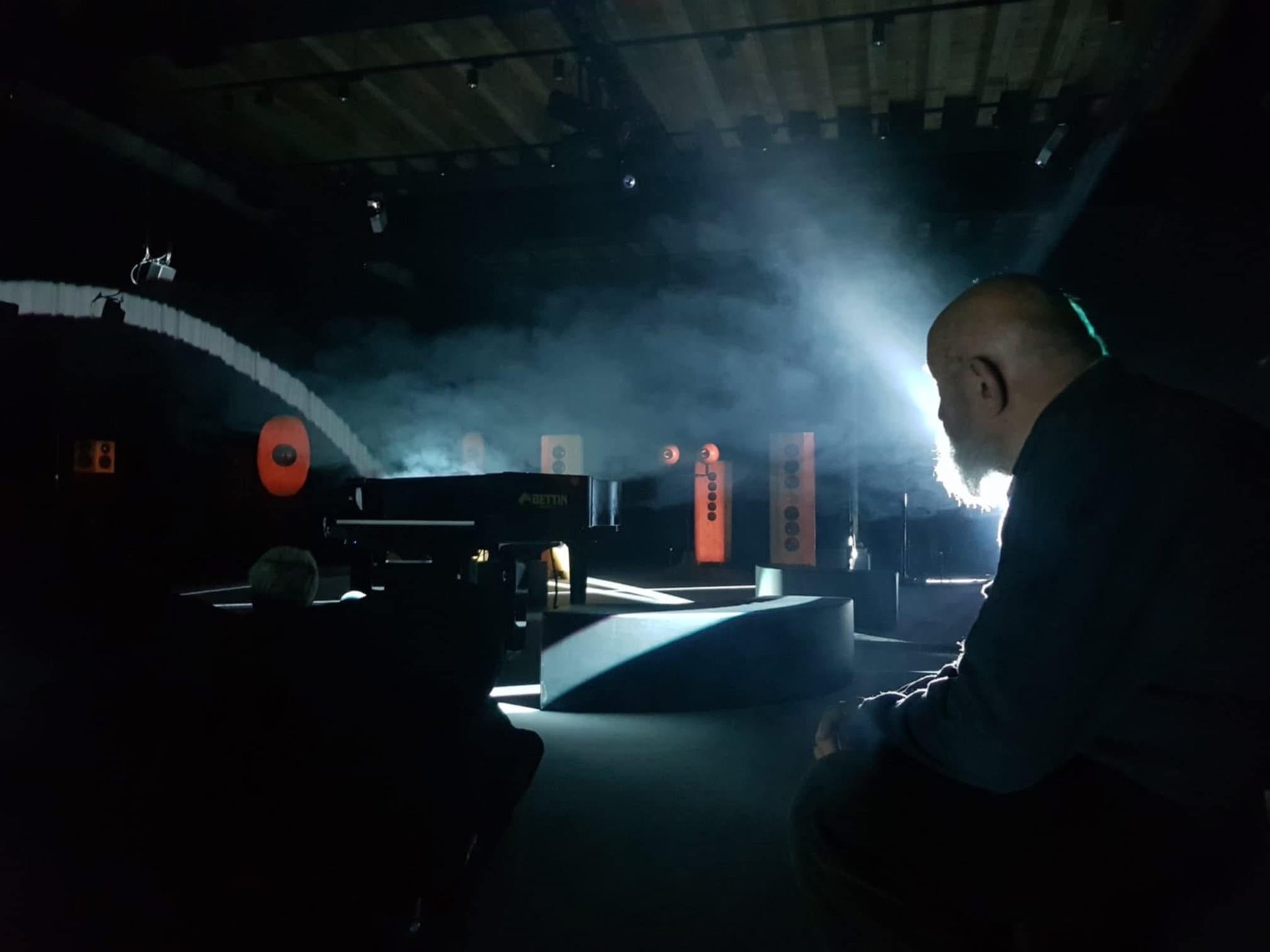
Fig. 1. Eraldo Bocca during the arrangement and monitoring of the acoustic field at the Biennale Musica 2024. The scenic articulation highlights the interaction between the traditional acoustic source (the grand piano) and the complex of elliptical and vertical transducers of the AUDIOR spatial lutherie, configuring the space as an integrated phenomenological apparatus (dispositivo). Photo: Venice Biennale Historical Archives.
Part I – The Phenomenology of the «Déjà-là» in Eraldo Bocca
«Sound does not merely occupy space; it enunciates it, reveals its fractures, and redefines its physical memory.»
The passing of Eraldo Bocca marks a point of no return and an immeasurable loss for the international electroacoustic and acousmatic community. With his departure, we lose not only an extraordinary builder, but a true 'luthier of three-dimensional space.' His work represented the most radical, inflexible, and concrete response to the «electroacoustic imperative»: it allowed sound to emancipate itself not only from the two-dimensionality of the support but also from the conceptual limitations in which acousmatic and electroacoustic music itself too often still persists. He enabled sound to become living architecture, body, and pure phenomenology, restoring to it its terrestrial share, its specific weight, and its inevitable phenomenological gravity.
Geographies of a Common Resonance: From Sator to Audior
The theoretical and practical relationship between the research of the writer and the technological mastery of Eraldo Bocca is rooted in a fifteen-year period of fruitful sonic militancy. It was 2012 when the inauguration of the historic SATOR Acousmonium at the San Fedele Auditorium in Milan was documented—a pioneering infrastructure conceived by Bocca and directed by Dante Tanzi and Giovanni Cospito, which radically redefined the projection of sound understood as a plastic substance of physical space [1]. Upon that very loudspeaker orchestra, the absolute premiere of La Natura Assente came to life, finding in that system not a neutral vehicle, but a dialectical partner of friction and phenomenological unveiling.
The trajectory of this inquiry consolidated in the subsequent years through a constant dialogue between the performer-composer and the builder-philosopher of the instrument. We think of the absolute premiere of La Natura Assente (II) in June 2013, diffused over the 54 loudspeakers of the AUDIOR Acousmonium—rigorously driven by 44 high-profile amplifiers and interconnected via passive connections to minimize electrical distribution points—as part of the festival Chitarre ed altre corde (Guitars and Other Strings) [2], and its subsequent discographic historicization in the 2014 collective release published by Ops/Akusma/AUDIOR.
Entirely designed and built by Eraldo Bocca in 2012, the AUDIOR acousmonium inherits and reworks the double-ring architecture of the celebrated French acousmonium «MOTUS», originally conceived by Jonathan Prager. The expansion of AUDIOR's performance practice over the last decade [3]—through systematic interventions in contexts such as the Prix Russolo in Milan and the 2024 Biennale Musica in Venice—offers the experimental testing ground for the categories investigated here. This continuous evolution has led the AUDIOR acousmonium to constantly expand its roster of 'voices,' now counting an impressive orchestra of 80 loudspeakers, configuring itself as one of the largest and most complex mobile sound projection systems in Europe. In these settings, the persistence of Bocca's projection method emancipates itself from the contingency of the individual performance to become a permanent research protocol, legitimizing the extension of the theoretical analysis—and its corresponding iconographic apparatus—to its most recent structural configurations.
The Resistance of Matter on This Side of Digital Evaporations
While the contemporary industry tends to 'vacuum up the air' in order to remove any material obstacle, Bocca’s 'acoustic sculptures' exalt the very resistance of materials.
Analyzing the frictions of matter and the «place of enunciation» [4], it is impossible not to recognize how the physical work of Eraldo Bocca represents the perfect counterpoint to this theoretical tension. Bocca does not merely assemble transducers; he creates devices of phenomenological unveiling. Monumental instruments such as SATOR, AUDIOR, and ADAM are not simple diffusion systems, but acoustic prostheses designed to govern the dialectic between the objectivity of the physical wave and the construction of those enunciational geometries that constitute the core of the most originary listening.
The lesson of rigor, humility, and extraordinary vision of Eraldo Bocca remains engraved upon the cornerstone of electroacoustic research. His physical absence leaves a profound void, yet his 'technological creatures' will continue to resonate, projecting into time the memory of a man who taught silence how to become space.
To Eraldo, with immense gratitude and infinite esteem.
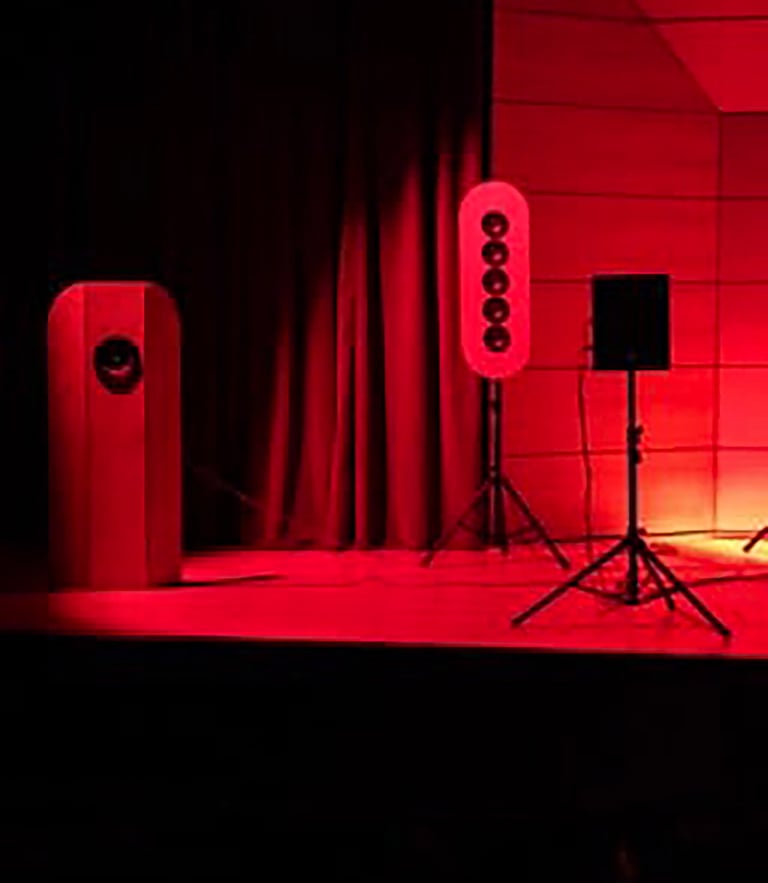
Fig. 2 – The inauguration of the SATOR Acousmonium (Auditorium San Fedele, Milan, 2012). The space manifests itself as a «déjà-là» (already-present): a three-dimensional acoustic architecture conceived by Eraldo Bocca that redefines ontological coordinates and deep listening even before the propagation of sound. Official documentation of the inaugural concert of the SATOR Acousmonium, Auditorium San Fedele, Milan, January/February 2012.
Notes to Part I
[1] Daniele, R. (2012). Acousmonium Sator Opening. ElectroAcoustics Magazine / Arts & Technologies Archive. Available at: https://rdmrecords.com/acousmonium-sator-opening
[2] Daniele, R. (2013), La Natura Assente (II) – World Premiere for 54 Loudspeakers, performance on the AUDIOR Acousmonium at the Chitarre ed altre corde Festival (promoted by the Lodi Civic School of Music "A. Pozzi"), Lodi, June 2013. Official historical documentation available at: https://rominadaniele.com/audior-chitarra-ed-altre-corde-festival
[3] See Bocca, E,, & Tanzi, D. (2018). «Showing the Acousmatic Sounds through the Mobile Acousmonium AUDIOR». Proceedings of the Electroacoustic Music Studies Network Conference (EMS18), Firenze, 20–23 giugno 2018. URL: http://www.ems-network.org/IMG/pdf_BOCCA_TANZI_EMS18.pdf; Bruce-Jones, H. (2020), «Acousmonium AUDIOR is a bespoke spatial sound projection system», FACT Magazine.
[4] See Daniele, R. (2026). The Resonance of the «Déjà-Là»: Correspondences, Inversions, and Material Frictions Between Chion’s Impossible History and the «Electroacoustic Imperative». ElectroAcoustics Magazine, 2026 Series, Art. 2026.05.en. (Selected for Arts & Technologies Print Edition). DOI: Pre-assigned (eam.2026.05.en). Available at: https://rdmrecords.com/the-resonance-of-the-deja-electroacoustic. The conceptual vocabulary extensively employed herein—including notions such as «déjà-là», «lissage», «apport de réel», and «sentiment du concret»—borrows its terminological matrix from M. Chion, as reinterpreted and theoretical translated by the author in the aforementioned essay. See Chion, M. (2026), Pour une histoire impossible du cinéma [online essays available at michelchion.com].
Part II - Ontology of the Support: Friction, Already-Present Space, and «Retained Time»
Physical Friction on This Side of «Lissage» (The Resistance of Materials)
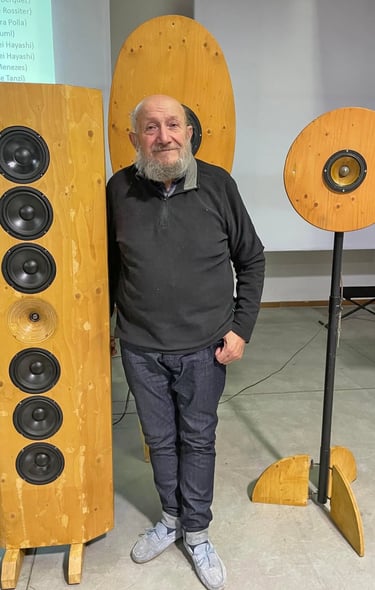
As amply demonstrated in prior investigations, both modern cinema and electroacoustic music—even though the latter suffers from the lack of a solid musicological reference infrastructure—preserve physical disturbance, the 'raw,' and noise as an irreducible contribution of the real (apport de réel). Positioning themselves this side of the «lissage» of the contemporary digital realm, they remain untouched by that clinical smoothing which anesthetizes frequencies and flattens the thickness of experience. Eraldo Bocca's acousmoniums (SATOR, AUDIOR, ADAM) constitute the technological and physical alternative to «lissage», situating themselves in a dimension radically other than it. Building an orchestra of loudspeakers with wooden transducers, custom cones, and physical positioning in real space means safeguarding and asserting friction, gravity, and acoustic thickness this side of the digitized flow. Bocca's instrument does not passively 'reproduce'; it physically impacts the air of the hall, without theorizing or abstracting, but acting, scientifically, on the very resistance of the material. Bocca overcomes the logic of standardized diffusion by employing custom-built dipole loudspeakers for mid-range frequencies, designed to emit sound both frontally and posteriorly [5], thereby exploiting the reflections of the hall's walls as integral elements of the composition. These are complemented by D'Appolito and Bessel array configurations; the latter, in particular, generate cylindrical waves that minimize parasitic reflections from the ceiling and floor, sculpting the acoustic space and heightening the tridimensionality of the sonic scene even before any interpretive action takes place.
The «Déjà-là» as Architecture: SATOR and the Pre-existence of Space
In light of the principle of the «déjà-là» (the already-present) through which one analyzes the structural priority of objects and spaces with respect to action, the acousmonium is par excellence the electroacoustic «déjà-là». In the theoretical and analytical framework proposed here, it constitutes the «ad-venient» technical-linguistic and aesthetic condition of the audiovisual support [6]: an architecture of loudspeakers that pre-exists the interpretive and compositional act, in the sense that it determines its presence. Even before the sound is projected, Bocca's apparatus is already there, with its assigned parameters and its physical presence, determining from the outset the substance that the phenomenon will assume within the physical space of the hall—while respecting the initial acoustic characteristics of any music ready to be transmitted—and thereby redefining the ontological coordinates of the event and of listening in its primary sense, before the acoustic wave propagates. Through the strategic positioning of diffusers characterized by deliberately diversified and asymmetrical spectral responses, Bocca has operated this side of the flatness of standardized reproduction. The sound projected onto his machines is never 'smooth' (that is, subject to «lissage»): it bumps and rubs against the physical space, generating an authentic «feeling of the concrete» analogous to the anti-narrative force of the harsh industrial noise textures that preserve the gravity of the real. This conception does not emerge in isolation, but connects back to a precise historical genealogy of apparatuses that sought to rescue sound from the flatness of the stereophonic plane or neutral reproduction. Space as a dramaturgical and acoustic pre-existence has its historical roots in pioneering apparatuses [7], moving from Pierre Schaeffer and Jacques Poullin (1952) through the Philips Pavilion (1958) and Stockhausen's Sphere (1970).
Through the subsequent stage of Christian Clozier's Gmebaphone (1973), up to the definitive formulation of the GRM Acousmonium in Paris in 1974 by François Bayle, sound projection has positioned itself as a physical and epistemological alternative to sheer domestic listening or dull diffusion. Eraldo Bocca's systems inherit and actualize this tradition, not as a mere 'amplification installation,' but as monumental luthiery that interrogates the intrinsic resonances of each individual architecture.
«Pan-Significancy» and «Retained Time» (Temps Retenu)
Within the framework of the Chionian concept of cinema as a «concrete art» governed by «pan-significancy» [8], every micro-event recorded on the support (a tressaillement [shudder], a micrometric edit) is charged with absolute meaning, perceptible only through «retained time» (temps retenu). As we have seen, the ideological drift of the contemporary industry, which generates artificial, flat sonic spaces afflicted by a radical lack of place. Even at the heights of certain avant-gardes, one senses a subjugation to the digital. This very homogenization, however, acts as a tracer, revealing where the original act of matter continues to resist. Acousmatic performance on Bocca's machines is a practice of pure, micro-phonic «pan-significancy».
The millimetric modulation of the potentiometers across the different registers of the acousmonium allows the performer to govern the micro-fluctuations of spectral densities, dilating time and unveiling the most intimate grain of acoustic matter. Bocca's work of acoustic luthiery is an act of resistance and of geographical and acoustic relocation, at the most concrete and originary levels. Through the physicality of his instruments, synthesized or recorded sound re-establishes a specific localization, an apprehension, and a spatial gravity that shatter any flatness. Since the audio bands (low, low-mid, mid, mid-high, high, and very high) are physically separated across distinct loudspeakers, the fader ceases to be a mere volume control, becoming a real-time timbral modulator. Operating the console requires, as Bocca and Tanzi point out, an authentic performance 'virtuosity': the simultaneous control of these variables transforms spatialization into a live rewriting—a «second-order writing»—in which the fixed support is constantly re-sculpted by the responsiveness of the human gesture.
If cinema and electroacoustic music are concrete arts governed by «pan-significancy»—where every microscopic shudder of the signal or micrometric edit becomes an absolute bearer of meaning—the acousmonium configures itself as the most compelling instrument for interacting with this micro-flow. Sound projection, as understood in the vision of Bocca and his closest interpreters, demands a temporal dilation: a «retained time» in which silence, subtraction, and the manual modulation of spectral densities rescue listening from distraction, steering human consciousness back to its originary source of knowledge.
The loss of Eraldo Bocca leaves an unfillable void, yet his legacy does not belong to museum preservation. Within the horizon of the «electroacoustic imperative», the digital itself remains an apparatus of friction to be sculpted. The speaker orchestras he created—SATOR, AUDIOR, ADAM—will continue to resonate as apparatuses of phenomenological disclosure, exhibiting the flagrancy of matter and reminding us that spatialization, before being a technique, is an ontological act.
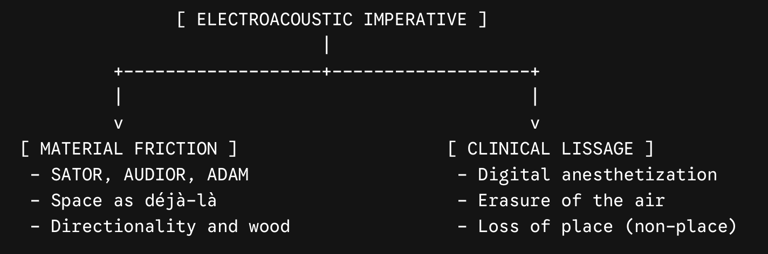
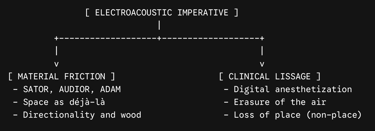
Fig. 3 – Taxonomic Scheme of the «Electroacoustic Imperative»
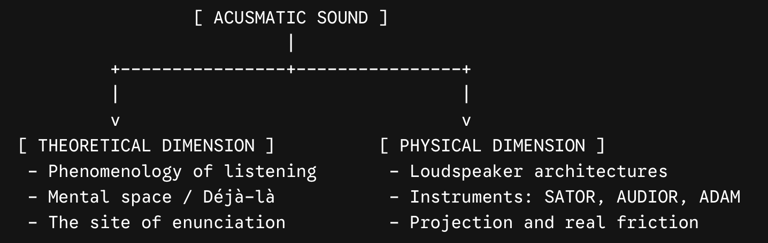
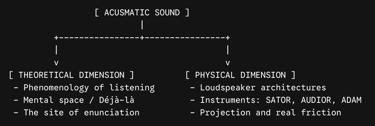
Fig. 4 – Polarity of Acousmatic Sound: Theoretical Dimension vs. Physical Substance
Notes to Part II
[5] See Brümmer, L. (2012), «The ZKM Sound Dome: Spatialization in Electroacoustic Music», ICMC Proceedings, pp. 182–189; Smalley, D. (1995), «La spectromorphologie: une explication des formes du son». In Louise Poissant (Ed.), Esthétique des arts médiatiques, Tome 2, pp. 77–98. Sainte-Foy: Presses de l'Université du Québec [Eng. tr. «Spectromorphology: Explaining Sound Shapes», Organised Sound, 2(2), 1997, pp. 107–126. Cambridge: Cambridge University Press]
[6] The concept of «déjà-là» (already-present) employed herein finds its ontological-temporal foundation in Heidegger, M.(1927), Sein und Zeit, Tübingen: Max Niemeyer Verlag (ref. ed. 2006) [Eng. tr. Being and Time, trans. J. Macquarrie and E. Robinson, London: SCM Press, 1962], particularly in § 41 (p. 192) regarding the structure of «ahead-of-itself-already-in» (Sich-vorweg-schon-sein) as an articulation of Care (Sorge), and in § 65 (pp. 325–328) for the «ad-venient» character of the future (Zukunft) understood as Auf-sich-zukommen (coming-towards-itself), wherein the priority of structure predetermines the horizon of possibility of the event. The reinterpretation and mediation of this temporal horizon within the electroacoustic and audiovisual context is elaborated by the author through the convergence between her own theoretical-performative research and the recent theorization of Michel Chion: the analysis on the place of technologies in music and the pre-existence of acoustic space in Daniele, R. (forthcoming), Voce Sola. Essay around the Vocal Discourse, Milan-Miami: RDM Records, Cap. II: «Il luogo delle tecnologie nella musica»; the conceptual formalization contained within the performative-discographic framework of Daniele, R. (2015), Spannung, Triple CD and accompanying essay booklet, Milan: RDM Records; the analytical extension of the category of «déjà-là» formulated by Chion, M. (2026), Pour une histoire impossible du cinéma [For an Impossible History of Cinema], cit., esp. Cap. 3: The Silence of the Lambs, regarding the invisible breach of the acoustic barrier, formalised by the author in Daniele, R. (2026), The Resonance of the «Déjà-Là»: Correspondences, Inversions, and Material Frictions Between Chion’s Impossible History and the «Elettroacoustic Imperative», cit.
[7] For the primary sources on this historical genealogy, see: 1952 (Schaeffer & Poullin): Poullin, J. (1957), L'apport des techniques d'enregistrement dans la musique contemporaine, Paris: GRMC/RTF. 1958 (Philips Pavilion): Xenakis, I. (1958), «Le Pavillon Philips à l'Exposition Universelle de Bruxelles 1958», Revue Technique Philips, 20(1), pp. 1–11.. 1970 (Stockhausen's Sphere): Stockhausen, K. (1971), «Spatialisierung», in Texte zur Musik 3 (1963–1970), Cologne: DuMont Schauberg. 1973 (Clozier's Gmebaphone): Clozier, C. (1998), «The Gmebaphone (1973–1998): A System for Sound Spatialization and Performance», Computer Music Journal, 22(2), pp. 18–25. 1974 (Bayle's GRM Acousmonium): Bayle, F. (1993), Musique acousmatique, propositions... positions, Paris: Buchet/Chastel, pp. 75–88.
[8] See Chion, M. (1990), L'audio-vision. Son et image au cinéma, Paris: Éditions Nathan [Eng. tr. Audio-Vision: Sound on Screen, trans. C. Gorbman, New York: Columbia University Press, 1994]; Chion, M. (2003), Un art sonore, le cinéma, Paris: Cahiers du Cinéma, p. 45 [Eng. tr. Film, a Sound Art, trans. C. Gorbman, New York: Columbia University Press, 2009}. On the formulation of cinema as a «concrete art» governed by «pan-significancy» and the category of admirably «retained time» («tempo retenu»), see Chapter 4 (June 2026) of Chion, M. (2026), Pour une histoire impossible du cinéma, cit.. For the theoretical translation and application of these categories within the phenomenological friction of electroacoustic space, see Daniele, R. (2026), The Resonance of the «Déjà-Là»: Correspondences, Inversions, and Material Frictions Between Chion’s Impossible History and the «Elettroacoustic Imperative», cit.
Part III – The «Electroacoustic Imperative» and the Status of the «Para-Acousmatic»
The Epistemological Threshold of Post-Digitalism
Within the perspective of contemporary research, the electroacoustic imperative is not merely a category of musicological analysis applied to cinema, nor is it just a formula of technological resistance; it configures itself as a true epistemological and phenomenological threshold.
The general loss of friction lamented here is not to be attributed to a chronological-technological transition from analog to digital. Contemporary smoothing is a linguistic choice, not a limitation of the medium: the digital itself, within the horizon of the «electroacoustic imperative», is an apparatus and a material of friction to be sculpted, an elevated and open medium of creation, rather than an instrument of perceptual anesthetization. The assumption that the latter operation seems to prevail does not concern the feasibility of the work of art, but once again the conventions of the industry, which we like to call by its true name: a mere ideological drift.
While the Deleuzian «time-image» historicizes the suspension of action [9], and Chion theorizes the «pan-significancy» of the recorded micro-sign and of «admirably retained time» [10], we reclaim a necessity for the «electroacoustic imperative» to take a further step: to subordinate and redeem the chaos of the acoustic signal through the rigorous and conscious awareness of the text.
Within the post-digital horizon, the «electroacoustic imperative» redefines the boundaries of listening and viewing through a dialectical tension situated this side of any form of anesthetization or commercial compromise. This imperative imposes itself through a dynamic polarity, configuring a genuine resistance of the sonic material [11].
The Double Tension of the «Electroacoustic Imperative»
Contemporary listening is positioned prior to the hypnotic passivity of standardized digital streams through a dual, rigorous formal strategy:
Melodic reduction and timbral stripping. The removal or suspension of traditional melody and the drastic stripping of instrumental textures eliminate any escape route or distraction for the listener. Deprived of the comfort of a reassuring melodic line, the ear is forced to remain confined within the perimeter of pure sound.
The interlocking of noise into voids and the transdiegetic sonic body. Where the melody withdraws, the textual voids are occupied by concrete and industrial noises, equally structural. These insertions do not act as mere background sound effects, but elevate material friction («frottement») and the physical density of the medium to a true transdiegetic and «para-acousmatic» sonic body [12].
The «Para-Acousmatic» and the Overcoming of Visual Subordination
The concept of the «para-acousmatic» [13] is introduced to define an essential condition of filmic or multimedia listening. It describes a situation in which the sound source is diegetically identified and confined within the visible space (such as the elevator cage in Louis Malle), but the status of the acoustic material—due to its density, violence, and syntactic dislocation—deviates toward the morphological properties of reduced listening typical of the Schaefferian acousmatic phenomenon. The sound thus emancipates itself from its referential pact and enters into a purely compositional dialogue with the soundtrack.
In light of these considerations, the physical presence of the acousmonium speakers becomes pure theatrical matter on the stage from the perspective of the «para-acousmatic».
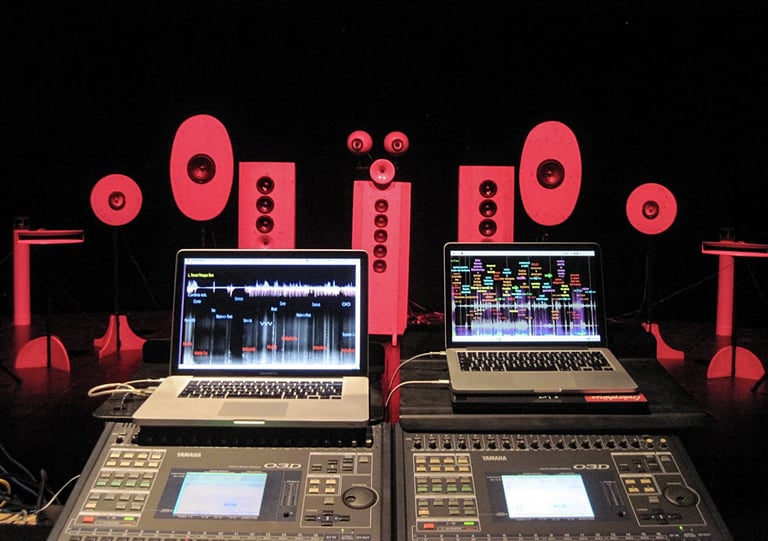
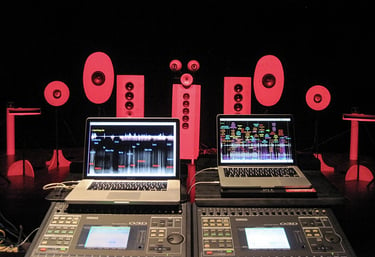
Fig. 5 – Projection and control device of the AUDIOR Acousmonium. The transition from the digital and analytical flow of the screen (the waveform) to the concrete enunciative act of the console. Sound projection (regia del suono) configures itself as a second-order writing: a manual and millimetric modulation of the potentiometers that transforms space into a transdiegetic and «para-acousmatic» body. Archive of the AUDIOR Association. This transition from the analytical flow of the screen to the physicality of control materializes in a precise evolution of the performance interface. The AUDIOR setup reflects the historical trajectory of its creators: an initial five-year phase grounded in the exclusive use of analog consoles was followed by a systematic adoption of the digital environment. This transition does not represent a rupture, but rather a structural coupling: the tactile experience and articulative sensitivity forged in the analog era are transferred to and bent under the requirements of digital control, ensuring an immediate timbral and dynamic response in the management of space.
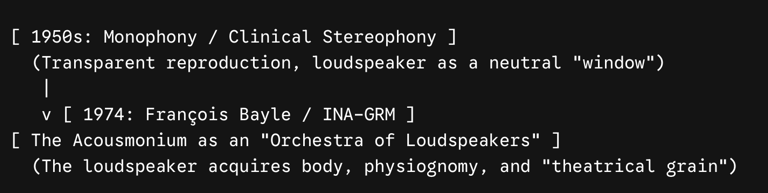
Fig. 6 – Genealogy of Sound Projection: From Clinical Transparency to «Theatrical Grain».
From Clinical Objectification to the «Theatrical Grain» of the Loudspeaker
To From Clinical Objectification to the «Theatrical Grain» of the Loudspeaker
To understand the significance of this transition, it is necessary to trace a historical genealogy of the support and its diffusion, reconstructing the evolutionary links of sound projection in space:
The archaeological phase and the origins of spatialization (1950s–1960s): At the origins of musique concrète and Elektronische Musik, tape reproduction was conceived through rudimentary systems. In 1952, with Pierre Schaeffer and Jacques Poullin's Pupitre de relief, the first true manual spatial projection apparatus (dispositif) made its appearance via magnetic coupling, followed by the multi-track experiments at the Philips Pavilion in Brussels (1958). The loudspeaker, however, was often understood as a neutral terminal—a clinical reproduction tool that was ideally meant to 'disappear' to allow the phono-fixed sound to emerge.
The dramaturgical transition and the formalization of performance practice (1970s–1990s): In 1970, Stockhausen's Spherical Concert Hall in Osaka distributed 50 sound sources over a three-dimensional spherical structure, enveloping the listener. In 1973, Christian Clozier's Gmebaphone introduced real-time corrective equalization to characterize diffusion bands, laying the foundation for a timbral direction (regia timbrica) of the diffused sound. Building on this nexus, Annette Vande Gorne would codified the subsequent methodological formalizations of performance practice and spatial interpretation within the Belgian acousmatic school.
The 1974 breakthrough (François Bayle's Acousmonium): With the birth of the Acousmonium at INA-GRM, a Copernican revolution took place. Loudspeakers ceased to be simple diffusers and were arranged in space like actual characters on a stage. Each possessed its own acoustic physiognomy (tweeters, woofers, horns, reflection speakers), its own directionality, and a specific dynamic response. The loudspeaker thus acquired a «theatrical grain»: we no longer merely witness sound dislocated in space, but rather the physical action of «electroacoustic actors» performing the score within concrete space.
The Contemporary International Constellation and the Network of Loudspeaker Orchestras (1990s to Present) [14]: The lesson of the acousmonium branches out into a complex global network of research and performance practice. Alongside historical institutions—such as Musiques & Recherches in Brussels (Vande Gorne), BEAST at the University of Birmingham (Jonty Harrison), the Klangdom at ZKM in Karlsruhe, and the Klangtheater at MDW in Vienna—spatial luthiery develops through mobile systems and avant-garde research centers: from the MOTUS Acousmonium in France (Denis Dufour, Jonathan Prager) to the Alcôme collective in Paris, from the San Francisco Tape Music Festival in the USA to Tempo Reale in Florence (Luciano Berio) and the acousmoniums of Italian Conservatories. Within this international geography, sound projection definitively frees itself from mere technical reproduction to become a living, shared interpretative practice.
Audior, Sator, and Spatialization as «Concrete Enunciation»
The theoretical and practical contribution of entities like Audior and Sator fits directly into this historical groove, having successfully evolved the historical lesson of the acousmonium:
The Concrete Enunciational Space: Audior and Sator rescue the acousmonium from the risk of mere technological idolatry or pure engineering display. They elevate the diffusion system into a true enunciative apparatus (dispositif d'enonciation). Space is no longer a geometric container in which channels are ‘distributed’, but becomes the text itself: a field of dramaturgical forces where the act of sound projection (projection du son) is equivalent to a directorial and interpretative gesture.
The Cognitive Anchoring of the Ear: This theatricalization of space never slips into accidental contingency, formal whim, or special effects for their own sake. On the contrary, the work of Audior and Sator keeps pure sound rigorously anchored to the cognitive functions of the ear. By exploiting the timbral variety and physical dislocation of the loudspeakers, they stimulate the listener's spatial perception (localization, near/far effects, material density), transforming reduced listening into an immediate somatic and intellectual experience.
Synthesis: The «Para-Acousmatic» Paradox
It is precisely along this crucial axis that the nature of the «para-acousmatic» resides:
Just as in cinematic space we see the elevator shaft but hear its creaking estranged from its utilitarian meaning, so in the contemporary acousmatic concert we see the loudspeaker-actor on stage, yet we are sucked into a reduced listening that denies its pure function as an 'acoustic box.' The apparatus shows itself in order to be transcended: the physical presence of the source (visible and theatrical) becomes the springboard for the cognitive emancipation of pure sound.
The sound directionperformed by systems like Audior is thus, programmatically, configured as a true second-order writing. Far from being a mere reproduction or a passive spatial mapping of the file, acousmatic projection acts as a live rewriting that rescues the score fixed on the support from the risk of a cold, museum-like hibernation. In this concrete enunciative act, we do not face an immutable archive but rather a plastic medium: the loudspeakers, in their role as theatrical actors, stage a direct physical confrontation between the structural rigidity of the sound object and the acoustic unpredictability of space. It is in this extemporaneous rewriting that the «para-acousmatic» finds its most radical fulfillment: the visual display of the apparatus (the loudspeaker-character) does not serve to reassure the gaze, but to dismantle the clinical reproduction of the digital, restoring to listening the vertigo of a unique, carnal, and unrepeatable event.
Notes to Part III
[9] See Deleuze, G. (1985), Cinéma 2. L'image-temps, Paris: Éditions de Minuit, pp. 11–34 [Eng. tr. Cinema 2: The Time-Image, trans. by H. Tomlinson and R. Galeta, Minneapolis: University of Minnesota Press, 1989]. Gilles Deleuze formalizes here the passage from the «movement-image» (typical of classical cinema, structured upon the subordination of time to action and the efficacy of the «sensory-motor schema») to the «time-image» (emblematic of post-war modern cinema). In the latter, as the sensory-motor concatenation and dramaturgical causality break down, time liberates itself from movement and becomes perceptible in its purity. It is within this horizon that «opsigns» («opsignes», pure visual situations) and «sonisigns» («sonsignes», pure acoustic situations) emerge: sound signs entirely freed from the function of mere commentary or dramaturgical concatenation. In the present work, this philosophical intuition is extended and radicalized this side of the screen, applying it directly to the sifting and discomposition of acoustic material on magnetic tape (see infra, Part IV).
[10]. See Chion, M. (2026), Pour une histoire impossible du cinéma, Chapter 4 (June 2026), cit..
[11] See Daniele, R. (2026). The Resonance of the «Déjà-Là»: Correspondences, Inversions, and Material Frictions Between Chion’s Impossible History and the «Elettroacoustic Imperative», cit.; RDM Records Editorial Team & ElectroAcoustics Board (2012-2026). Research Around Sound and Technologies. Arts & Technologies Manifesto. ElectroAcoustics Magazine, 2026 Series, Art. 2026.01.en. (Selected for Arts & Technologies Print Edition). DOI: Pre-assigned (eam.2026.01.en), available at: https://rdmrecords.com/arts-and-technologies; Daniele, R. (2010). Ascenseur pour l'échafaud: il luogo della musica nell'audiovisione [Ascenseur pour l'échafaud: The Place of Music in Audio-Vision]. Milan: RDM Records: Daniele, R. (2010). «Il dialogo con la materia disintegrata e ricomposta». Un'analisi di Thema (Omaggio a Joyce) di Luciano Berio [Dialogue with Disintegrated and Recomposed Matter: An Analysis of Luciano Berio's Thema (Homage to Joyce)]. Milan: RDM Records.
[12] Daniele, R. (2026). The Resonance of the «Déjà-Là»: Correspondences, Inversions, and Material Frictions Between Chion’s Impossible History and the «Elettroacoustic Imperative», cit. (in which the first definition of the neologism «para-acousmatic» is formalized in relation to audible editing and detachment from mimesis. See in particular Part III: Clarification Note on the Departure from Modern Cinema and the Overdetermination of the «Para-acousmatic»).
[13] Ibid.
[14] See Vande Gorne, A. (ed.) (1991), Vous avez dit acousmatique?, Ohain: Musiques & Recherches; Harrison, J. (1998), «BEAST: Sound in Space», Organised Sound, 3(1), pp. 19–27; Dufour, D., & Prager, J. (2008), L'art de la projection acousmatique, Paris: Motus.
Part IV – The Status of the Support: From Film Theories to the «Electroacousmatic ense»
The «Electroacousmatic Sense»: Music Does Not Need Images
The mediation of film theories within electroacoustic research does not at all imply that electroacoustic music needs images to legitimize itself or to function autonomously. On the contrary, the theoretical project consists in translating and shifting cinematic language toward pure sound for a very precise epistemological reason:
1a. What Musicology lacks: Film theories possess an analytical maturity and an exceptional 'toolbox' to deconstruct virtual space, the enunciative instance (who organizes the discourse, from where, and with what power), and the dialectic of presence/absence (the off-screen). Classical musicology, historically entrenched in formal or notational abstractions, often lacks these critical tools to analyze the fixed-sound support; indeed, electroacoustic analysis in recent decades has made minimal progress, pale in comparison to the advancements in film theories.
1b. What cinema lacks (The Pure Acousmatic Sense): While film studies offer the analytical rigor of the text, sound on its own intrinsically possesses a textual power that cinema constantly borrows—even down to its terminology: the capacity of sound to travel swiftly across cognitive and spatial planes, moving before and beyond visual representation and the retinal constraint, and thus determining, through its internal architecture, the deep meaning of entire films throughout history. By elevating the discourse from cinema to pure sound, the concept of the «para-acousmatic» unites filmic textual awareness with the sovereign autonomy of electroacoustic material.
It is precisely within this gap that the acousmatic paradigm expands into what we may define as the «electroacoustic sense», or more accurately: the «electroacousmatic sense»—that is, the condition in which the dramatugy of the support and spatial direction no longer serve an absent representation, but instead sanction the definitive sovereignty of sound matter, now regardless of seeing or not seeing the source.
The moment cinema short-circuits the dualism between diegesis and extradiegesis (the inside and outside of the frame) through sound, and the moment an orchestra of loudspeakers—with its heterogeneous forms, lights, colors, and architectures—presides over the hall as an assembly of sacred powers, we find ourselves this side of any debate of genre: what remains and dominates is solely sound.
The Deleuze-Berio Translation: The Material Status of the Tape
To rescue electroacoustics from the risk of becoming a mere engineering exercise or an archival catalog, its analysis must be reformulated starting from the formal and enunciative status of film analysis [15] The dismantling and reassembling of magnetic tape (as in Berio’s Thema - Omaggio a Joyce) share the exact same material status as the cinematic apparatus: the manipulation of time and the exhibition of the support's friction.


Fig. 7 – Ontological Correspondences between Electroacoustic Tape and the Filmic Apparatus.
Table 1 – Comparative Analysis of Ontological and Aesthetic Correspondences Between Tape and Film.


The Acoustic «Time-Image» and the Disintegration of Flow
In Thema (Omaggio a Joyce), Luciano Berio takes the recording of Cathy Berberian’s voice and subjects it to physical decomposition on magnetic tape [16], segmenting it into micro-phonemes and reorganizing them into new structural constellations.
The manipulation of time: Exactly as the film editor operates through cuts, physical splices, and transitions on the film stock, the electroacoustic composer objectifies time on tape, transforming a linear and ephemeral flow into a solid, spatialized matter.
Deleuzian suspension applied to sound: This operation on the support radicalizes Gilles Deleuze’s «time-image» (immagine-tempo). By breaking the logical-causal and narrative bond of language (the literal meaning of the text), Berio coaxes forth authentic «sonisigns» (pure acoustic signs). The listener is directed to experience pure time and the visceral grain of the voice through the exhibition of the very friction of the support.
Map of Aesthetic Oppositions: Contemporary «Lissage» vs. Electroacoustic Friction
Today, media historiography and contemporary analytical practice clash over two opposing visions of the support and space:
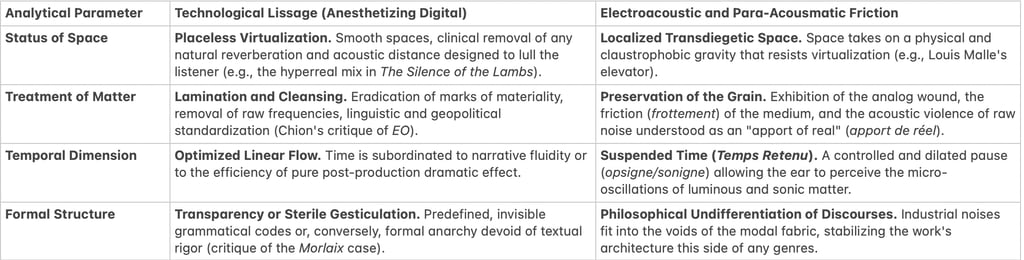
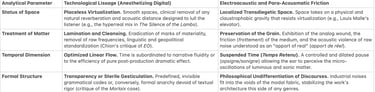
Table 2. Map of aesthetic oppositions between technological «lissage» and electroacoustic friction.
Epistemological Conclusions
The post-digital horizon must not be understood as a technological limitation, but rather as an apparatus and a material of friction to be sculpted. If contemporary digital technology is too often exploited by the industry to execute an anesthetizing smoothing («lissage»), the «electroacoustic imperative» asserts the necessity of a permanent inquiry into the very matter of sound.
By borrowing the textual awareness and millimetric precision of film analysis (frame by frame, fraction of tape by fraction of tape), electroacoustics emancipates itself from a mere technical exercise and establishes itself as a rigorous system of thought—one capable of shaking perception and restoring to the work of art its original, incisive truth of knowledge.
If the philosophical indifferentiation between diegetic noise and the jazz section in Ascenseur pour l'échafaud historically constitutes a «para-acousmatic» sonic body that resists classical transparency, post-digital multichannel spatialization responds today to the threat of technological standardization through a radical theatrical translation. To preserve the authentic «friction of the support» and evade the sterile formal gesticulation of loops denounced by Chion, electroacoustics elects space as the site of concrete enunciation. Through sound staging (regia del suono) understood as a second-order writing, the loudspeaker orchestra—transfigured into a chorus of actors endowed with physiognomy and «theatrical grain»—reenacts the wound of the support and the physicality of sound within the living flesh of performance. The event is thus fulfilled not as technical reproduction, but as a dramaturgy of space, where the «para-acousmatic» paradox finds its definitive sanction: exposing the visible presence of the apparatus in order to dismantle its utility function, unleashing reduced listening into the unpredictability of an embodied and unrepeatable present.
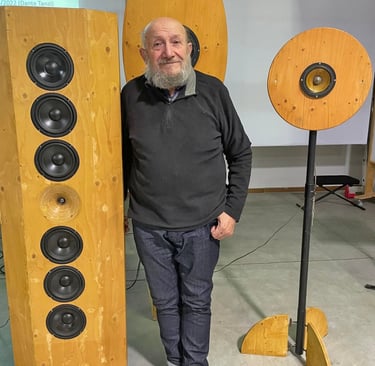
Fig. 8 – Eraldo Bocca alongside his 'acoustic sculptures.' The primacy of matter: the use of wood and customized transducers as a physical bulwark against the «lissage» of contemporary digital technology. The loudspeaker is no longer a neutral reproduction terminal; instead, it acquires its own «theatrical grain» and dynamic physiognomy, becoming a physical actor on stage. Archive of the AUDIOR Association.
Notes to Part IV
[15] The formalization and theoretical development of this epistemological transmutation from the filmic apparatus to the «electroacoustic sense» are extensively articulated in R. Daniele, The Resonance of the «Déjà-Là»: Correspondences, Inversions, and Material Frictions Between Chion’s Impossible History and the «Elettroacoustic Imperative», cit. To delineate this theoretical transition, and by implementing an original theoretical axis between Berio and Deleuze, we take as an emblematic example Thema (Omaggio a Joyce) by Luciano Berio—a work we previously analyzed in our 2010 monograph («Il dialogo con la materia disintegrata e ricomposta». Un'analisi di Thema (Omaggio a Joyce) di Luciano Berio)—which rests on the demonstration that electroacoustics and cinema share the exact same genetic code: the objectification of time onto a support and its manipulation through montage. This conceptual axis is structured around four fundamental nodes: 1. The Support as a «Virtual Screen» and the Response to Eisenstein: If in cinema the director and the sound engineer isolate a micro-sign (a breath, a rustle) to tear it from the chaos of the real and confer structural value upon it, L. Berio executes the exact same action on the magnetic tape of Thema (Omaggio a Joyce): he cuts through the linearity of Cathy Berberian’s recorded voice to reassemble it into new spectral constellations. Sergei Eisenstein's historical query regarding whether sound could ever achieve a technical reproduction capable of mimicking the active behavior of the eye finds its answer precisely in the gesture of the electroacoustic composer, whose physical "disassembly and reassembly" shares with the film editor the exact same material status (the friction of the support). 2. Acoustic «time-image» (Deleuze-Berio): The Deleuzian «time-image» transcends the visual track to realize itself through the emergence of pure signs (sonignes) liberated from movement and action. By shattering the linear flow of language and decomposing it into phonemes, Berio halts the logical-causal chain and forces the listener to experience pure time and the material grain of the voice, applying the logic of the «time-image» on this side of the screen. 3. From Counterpoint to Continuum (The «Para-Acousmatic»): Unlike the counterpoint of modern cinema (based on semantic rift or asynchronism between distinct images and sounds), the «Para-Acousmatic» operates an ontological transmutation of the acoustic material itself. As demonstrated in our analysis of Louis Malle's Ascenseur pour l'échafaud, the industrial noise of the elevator cab and the low-frequency pulse of the double bass and drums lose their anecdotal contingency to fuse into an indivisible material continuum. The noise is the composition, and the composition is the noise. 4. In Situ Reduced Listening and Post-Digital «Pan-Significancy»: The "para-acousmatic" filter applies the essentiality of Schaefferian reduced listening without resorting to visual blinding or acousmatic darkness: the mechanical source remains displayed on screen, yet it is perceived in its pure, dense spectral morphology. This close-up, frame-by-frame gaze—extended from film analysis to concrete music—demonstrates that «pan-significancy» (the absolute value of the micro-sign and material friction) governs Berio's score just as rigorously as it governs the direction of Ridley Scott or David Lynch, erecting an analytical bulwark against the clinical smoothing and lamination («lissage») of contemporary digital media. See R. Daniele, The Resonance of the «Déjà-Là»: Correspondences, Inversions, and Material Frictions Between Chion’s Impossible History and the «Elettroacoustic Imperative», cit. ; RDM Records Editorial Team, & ElectroAcoustics Board (2026), Research Around Sound and Technologies. Arts & Technologies Manifesto, cit.; Daniele, R. (2010), «Il dialogo con la materia disintegrata e ricomposta». Un'analisi di Thema (Omaggio a Joyce) di Luciano Berio, cit.; Chion, M. (2026), Pour une histoire impossible du cinéma, cit.; Deleuze, G. (1985), Cinema 2: The Time-Image,, cit.; Ejzenštejn, S. M. (1938–1940), Montaž [Montage]. Moskva: VGIK [Eng. tr. Towards a Theory of Montage, ed. M. Glenny & R. Taylor, trans. M. Glenny, London: British Film Institute, 1991, specifically the essays on the «Filmic Fourth Dimension» and «Vertical Montage»]; Daniele, R. (2011), Theoretical Analysis: Ejzenštejn’s Montage and Electroacoustic Reality, ElectroAcoustics Magazine / Arts & Technologies Archive, available at: https://rdmrecords.com/il-montaggio-di-sergej-ejzenstejn (for an initial formulation of the «electroacoustic sense» applied to filmic editing); Daniele, R. (2010), Ascenseur pour l'échafaud: Il luogo della musica nell'audiovisione, cit.; Metz, C. (1991), L'énonciation impersonnelle, ou le site du film, Paris: Méridiens Klincksieck [Eng. tr. Impersonal Enunciation, or the Place of Film, Columbia University Press, 2016]; Chion, M. (1981); Berio, L. (1958), Thema (Omaggio a Joyce), for magnetic tape, voice by Cathy Berberian, Milan: Studio di Fonologia RAI; Malle, L. (dir.) (1958), Ascenseur pour l'échafaud (Elevator to the Gallows), feature film with original soundtrack by Miles Davis, Paris: Nouvelles Éditions de Films (NEF).
[16 ]See Daniele, R. (2010), «Il dialogo con la materia disintegrata e ricomposta». Un'analisi di Thema (Omaggio a Joyce) di Luciano Berio, cit.; Berio, L. (1976), "Poesia e musica - un'esperienza", in H. Pousseur (ed.), La musica elettronica, Milan: Feltrinelli; Daniele, R. (2026), The Resonance of the «Déjà-Là»: Correspondences, Inversions, and Material Frictions Between Chion’s Impossible History and the «Elettroacoustic Imperative», cit.
Index of Figures, Analytical Diagrams, and Tables Photographs and Archival Documentation
Fig. 1. Eraldo Bocca at the Venice Music Biennale 2024. Setup of the acoustic field between grand piano and AUDIOR transducers.
Fig. 2. Inauguration of the SATOR Acousmonium (San Fedele Auditorium, Milan, 2012). Three-dimensional acoustic architecture.
Fig. 5. AUDIOR Acousmonium projection and control apparatus (dispositif). Sound diffusion console and manual modulation of potentiometers.
Fig. 8. Eraldo Bocca and his 'acoustic sculptures'. Custom-built wooden transducers and theatrical grain of the loudspeaker.
Conceptual Diagrams and Comparative Tables
Fig. 3. Taxonomic diagram of the «electroacoustic imperative» (Material friction vs. clinical «lissage»).
Fig. 4. Polarities of acousmatic sound: Theoretical dimension & physical substance.
Fig. 6. Genealogy of sound diffusion: From clinical transparency to theatrical grain.
Fig. 7. Ontological correspondences between magnetic tape and the filmic apparatus (dispositif).
Table 1. Comparative analysis of ontological and aesthetic correspondences between magnetic tape and the cinematographic apparatus (dispositif).
Table 2. Comparative overview between the support as a writing space and material friction.
Iconographic Credits and Notes on Sources
Fig. 1: Historical Archive of the Venice Music Biennale.
Figs. 2, 5, and 8: Official documentation of the inaugural concert of the SATOR Acousmonium (2012) and Historical Archive of the AUDIOR Association / Eraldo Bocca.
Figs. 3, 4, 6, 7, and Tables 1, 2: Original analytical diagrams, conceptual charts, and comparative matrices by Romina Daniele.
All archival documents, tables, and photographs are reproduced under a scientific license and pursuant to Fair Use / right of reporting and critique for musicological research.
Bibliography
Primary Literature and Manifestos
Daniele, Romina (2010), «Il dialogo con la materia disintegrata e ricomposta». Un'analisi di Thema (Omaggio a Joyce) di Luciano Berio, Milan: RDM Records, Edizioni Letterarie.
Daniele, Romina (2010), Ascenseur pour l'échafaud: Il luogo della musica nell'audiovisione, Milan: RDM Records, Edizioni Letterarie.
Daniele, Romina (2011), Theoretical Analysis: Ejzenštejn's Montage and Electroacoustic Reality. ElectroAcoustics Magazine / Arts & Technologies Archive. Available at: https://rdmrecords.com/il-montaggio-di-sergej-ejzenstejn
RDM Records Editorial Team & ElectroAcoustics Board. (2012-2026). Research around Sound and Technologies. Arts & Technologies Manifesto. ElectroAcoustics Magazine, 2026 Series, Art. 2026.03.en. (Selected for Arts & Technologies Print Edition). DOI: Pre-assigned (eam.2026.03.en). Available at: https://rdmrecords.com/arts-and-technologies
Daniele, Romina (2015), Spannung, Triple CD and essay booklet, Milan: RDM Records.
Daniele, Romina (forthcoming), Voce Sola. Essay Around the Vocal Discourse, Milan-Miami: RDM Records (sp. Chapter II: «Il luogo delle tecnologie nella musica»).
Daniele, Romina (2026), The Resonance of the «Déjà-Là»: Correspondences, Inversions, and Material Frictions Between Chion’s Impossible History and the «Electroacoustic Imperative». ElectroAcoustics Magazine, 2026 Series, Art. 2026.05.en. (Selected for Arts & Technologies Print Edition). DOI: Pre-assigned (eam.2026.05.en). Available at: https://rdmrecords.com/the-resonance-of-the-deja-electroacoustic
Theoretical Sources, Cinema, and Philosophy
Berio, Luciano (1976), «Poesia e musica - un'esperienza (1959)» in H. Pousseur (Ed.), La musica elettronica, Milan: Feltrinelli. pp. 131–148.
Chion, Michel (1981). La voix au cinéma. Paris: Éditions de l'Étoile / Cahiers du cinéma [Eng. tr. The Voice in Cinema, trans. C. Gorbman, New York: Columbia University Press, 1999].
Chion, Michel (1990). L'audio-vision. Son et image au cinéma. Paris: Éditions Nathan [Eng. tr. Audio-Vision: Sound on Screen, trans. C. Gorbman, New York: Columbia University Press, 1994].
Chion, Michel (1991). L'Art des sons fixes ou La Musique Concrètement. Fontaine: Éditions Métamkine / Nota-Bene / Sono-Concept [Eng. tr. The Art of Fixed Sounds, trans. O. Cullen, London: Metamkine, 2009].
Chion, Michel (2003). Un art sonore, le cinéma. Paris: Cahiers du Cinéma [Eng. tr. Film, a Sound Art, trans. C. Gorbman, New York: Columbia University Press, 2009].
Chion, Michel (2026), Pour une histoire impossible du cinéma, at michelchion.com (Essays and critical interventions section): Chapter I: The Valley of Gwangi (Jim O'Connolly, 1969); Chapter II: EO (Jerzy Skolimowski, 2022); Chapter III: The Silence of the Lambs (Jonathan Demme, 1991); Chapter IV : Blade Runeer (Ridley Scott, 1982).
Deleuze, Gilles (1985). Cinéma 2. L'image-temps. Paris: Éditions de Minuit [Eng. tr. Cinema 2: The Time-Image, trans. H. Tomlinson & R. Galeta, Minneapolis: University of Minnesota Press, 1989].
Derrida, Jacques (1967). L'écriture et la différence (contains the essay «Force et signification», 1963). Paris: Éditions du Seuil [Eng. tr. Writing and Difference (contains the essay «Force and Signification»), trans. A. Bass, Chicago: University of Chicago Press, 1978].
Ejzenštejn, Sergej M. (1985). Izbrannye proizvedenija v šesti tomach (Vol. II). Moscow: Iskusstvo [Eng. tr. Towards a Theory of Montage, trans. M. Glenny, London: British Film Institute, 1991; official English quotations adapted from Nonindifferent Nature, trans. H. Marshall, Cambridge: Cambridge University Press, 1987, specifically regarding the «generalized integral representation of the process» and «arising through the alternation of contradictory moments internal to its unity»].Heidegger, Martin (1927). Sein und Zeit. Tübingen: Max Niemeyer Verlag (ref. ed. 2006) [Eng. tr. Being and Time, trans. J. Macquarrie & E. Robinson, London: SCM Press / New York: Harper & Row, 1962].
Metz, Christian (1968). Essais sur la signification au cinéma. Paris: Éditions Klincksieck [Eng. tr. Film Language: A Semiotics of the Cinema, trans. M. Taylor, Oxford: Oxford University Press, 1974].
Metz, Christian (1991). L'énonciation impersonnelle, ou le site du film. Paris: Méridiens Klincksieck [Eng. tr. Impersonal Enunciation, or the Place of Film, trans. E. A. Kelly, New York: Columbia University Press, 2016].
Historical and Artistic Documentation of Works by Romina Daniele with Eraldo Bocca
Daniele, Romina (2012), La Natura Assente, World premiere for the inauguration of the Acousmonium SATOR, Milan, San Fedele Auditorium, January–February 2012.
Daniele, Romina (2013), La Natura Assente (II), World premiere for 54 loudspeakers on the AUDIOR Acousmonium, Festival Chitarre ed altre corde, June 2013.
Various Authors (2015), Ops/Akusma/AUDIOR, Collective album release, Milan/Lodi: AUDIOR Association, 2014.
Studies, Documents, and Design on SATOR, AUDIOR, and Spatial Craftsmanship
AUDIOR Association, Official Chronology of Concert Seasons and Acousmatic Projections, accessible at audior.eu/concerti.
Bocca, Eraldo, & Tanzi, Dante (2018). «Showing the Acousmatic Sounds through the Mobile Acousmonium AUDIOR». Proceedings of the Electroacoustic Music Studies Network Conference (EMS18), Firenze, 20–23 giugno 2018. URL: http://www.ems-network.org/IMG/pdf_BOCCA_TANZI_EMS18.pdf
Bruce-Jones, Henry (2020). «Acousmonium AUDIOR is a bespoke spatial sound projection system». FACT Magazine, April 3, 2020.
Daniele, Romina (2012). Acousmonium Sator Opening. ElectroAcoustics Magazine / Arts & Technologies Archive. Available at: https://rdmrecords.com/acousmonium-sator-openingTanzi, Dante (2004). «Information Technology and Communication of Musical Experience: Categories, Conflicts and Intersections». Organised Sound, 9(1), pp. 27–34. Cambridge: Cambridge University Press.
History and Technology of the Acousmonium and Spatialization
Bayle, François (1993). Musique acousmatique, propositions... positions. Paris: INA-GRM / Buchet/Chastel.
Brümmer, Ludger (2012). «The ZKM Sound Dome: Spatialization in Electroacoustic Music». In Proceedings of the International Computer Music Conference (ICMC 2012), pp. 182–189. Paris: IRcam / Michigan Publishing.
Dufour, Denis, & Prager, Jonathan (2008). L'art de la projection acousmatique: le système Motus. Paris: Éditions Motus.
Gayou, Évelyne (2007). Le GRM (Groupe de Recherches Musicales): Cinquante ans d'histoire. Paris: Fayard.
Giomi, Francesco, & Ligabue, Marco (1998). «Tempo Reale: Research and Production in Florence». Journal of New Music Research, 27(4), pp. 392–403.
Harrison, Jonty (1998). «BEAST: Sound in Space». Organised Sound, 3(1), pp. 19–27. Cambridge: Cambridge University Press.
Poullin, Jacques (1957). L'apport des techniques d'enregistrement dans la musique contemporaine: le pupitre de projection sonore. Paris: Groupe de Recherches de Musique Concrète (GRMC) / RTF.
Smalley, Denis (1997). «La spectromorphologie: une explication des formes du son». In L. Poissant (Ed.), Esthétique des arts médiatiques, Tome 2, pp. 77–98, Sainte-Foy: Presses de l'Université du Québec, 1995 [Eng. tr. «Spectromorphology: Explaining Sound-Shapes». Organised Sound, 2(2), pp. 107–126. Cambridge: Cambridge University Press].
Vande Gorne, Annette (Ed.) (1991). Vous avez dit acousmatique?, Special Issue of LIEN. Ohain: Musiques & Recherches.
Vande Gorne, Annette (2002). «L'interprétation spatiale: Essai de formalisation méthodologique». LIEN. Ohain: Musiques & Recherches.
Vande Gorne, Annette (2017/2021). Traité d'écriture sur support. Online digital publication by INA-GRM. Available at: https://sites.inagrm.com/avdg/index.xhtml#AjMYpEBeBqiMNNekH1GbNe
Discography and Filmography
Berio, Luciano (1958), Thema (Omaggio a Joyce), for magnetic tape, voice by Cathy Berberian, Milano: Studio di Fonologia RAI.
Malle, Louis (dir.) (1958), Ascenseur pour l'échafaud (Elevator to the Gallows), Feature film with original soundtrack by Miles Davis, Paris: Nouvelles Éditions de Films (NEF).
How to Cite this Essay
APA 7th Edition: Daniele, Romina (2026). Spatialization as an Ontological Act: The Spatial Lutherie of Eraldo Bocca and the Resistance of Matter. ElectroAcoustics Magazine (Continuous Digital Publication) / Arts & Technologies, Issue #01 «The Electroacoustic Imperative», Vol. 1 (Selected for Print Edition), RDM Records, 2026 Series, Art. 2026.06.en.DOI: Pre-assigned (eam.2026.06.en). Available at: https://rdmrecords.com/spatialization-as-an-ontological-act
RDM RECORDS IS A FLORIDA-REGISTERED DBA OF ROMINA DANIELE, OPERATING AS A RECORD LABEL AND BOOK PUBLISHER FOR RDM ROMINA DANIELE MUSIC, A BMI-AFFILIATED MUSIC PUBLISHER.
[CATALOG] — [ABOUT] — [PRESS] — [MAGAZINE] - [CONTACT]
TERMS & POLICIES: © 2010–2026 RDM RECORDS. ALL RIGHTS RESERVED.
ALL TEXTUAL, MUSICOLOGICAL, AND AUDIO CONTENT IS PROTECTED UNDER INTERNATIONAL INTELLECTUAL PROPERTY LAWS. DATA SUBMITTED VIA OUR PORTALS IS PROCESSED STRICTLY FOR INTERNAL INSTITUTIONAL COMMUNICATION.THIS INDEPENDENT INSTITUTIONAL LABEL IS DEDICATED TO PURE PHENOMENOLOGICAL, VOCAL, AND SONIC RESEARCH, AND MAINTAINS A STRICT POLICY OF COMPLETE DETACHMENT FROM ALL FORMS OF BLASPHEMY, EXPLICIT THEMES, OR PROFANE PERFORMANCES, SYSTEMATICALLY EXCLUDING THEM FROM ITS CATALOG AND SCOPE.


Get in touch