

The Resonance of the «Déjà-Là»: Correspondences, Inversions, and Material Frictions Between Chion’s Impossible History and the «Elettroacoustic Imperative»
On the theoretical correspondences in reverse between Michel Chion’s recent writings and the place of music within audiovision, from the «audible montage» of Ascenseur pour l'échafaud to Chionian «pan-significance», passing through the Deleuzian «time-image» to discover «para-acousmatic» horizons, this side of the erasure, lamination, and hyperreal clarity of digital flows.
ELECTROACOUSTICS MAGAZINE ARTICLES2026 SERIESFILM THEORY & AUDIO-VISUAL MEDIASOUND RESEARCH
Romina Daniele
6/8/202697 min read
Online Journal Title: ElectroAcoustics Magazine
Print Series Destination: Arts & Technologies (Annual Print Selection)
Classification / Category: 2026 Official Series · Film Theories & Sound Research / Theoretical Essay
Article Identifier: Art. 2026.05.en
Publishing Model: Continuous Digital Publication · Peer-Review Selected for Print
Contribution & Peer Review Status: Keynote Paper / Scientific Directorate Essay.
Subjected to methodological rigor verification and archive peer review.
Issue #01 «Electroacustic Imperative»
Indexing & Registrations
ISSN (Online): Application in Progress
ISBN (Print): Reserved for Arts & Technologies 2027
DOI: Pre-assigned (eam.2026.05.en)
Publication Date: June 8, 2026
📥 PDF (ITA) | PDF (ENG)
Editorial and Typographical Note: To bridge European philosophical traditions with international indexing standards in bilingual contexts, Arts & Technologies / ElectroAcoustics Magazine utilizes a hybrid APA 7/Chicago Notes citation framework embedded seamlessly within footnotes. Rather than using parenthetical in-text citations, each footnote pairs the original work's chronological origin with complete translation and pagination metadata [e.g., Metz, C. (1991), ... [Eng. tr. ..., p. XX]]. Readers will also note our signature European typographic hierarchy: guillemets («...») designate core theoretical concepts and primary quotes, double quotation marks ("...") mark nested citations, and single quotes ('...') frame metaphors or scare quotes, with foreign terms uniformly italicized.
Traditional media historiography often treats the evolution of cinematic sound as a linear teleological march toward technological optimization. Yet, Michel Chion’s interrupted and contemporary interrogation, unfolding along the opening of an impossible history and unrealized paths («possibles non réalisés»), reopens an originary wound: the fracture between material resistance—understood as fixation on the support and localization within the audiovisual fabric—and synthetic erasure, or the neutralization of the indices of materiality.
This study returns to the foundations of audiovisual theory, placing Chion’s recent critical essays in dialogue with the concrete topography of Louis Malle’s cherished 1957 film. What emerges is not a claim of historical, logical, or syntactical priority, but rather a constellation of correspondences wherein analytical models, themselves «advenient», illuminate our compressed and optimized digital everydayness. This contemporary landscape too often drives toward a linguistic and formal leveling ascrivable to the concept of technological «lissage»; such a dynamic ultimately extends as a methodological imperative aimed at refounding the analysis of the electroacoustic support.
Annotated Index & Reading Guide
I. Critical Nuances and Correspondences from Pour une histoire impossible du cinéma: The archaeology of the support through The Valley of Gwangi and the accidental cluster as «apport de réel». The transdiegetic formal analogy with Malle’s elevator, the counterpoint with Michelot and Clarke, and the rigorous critique of Eo and Anatomie d'une chute. The dialectic of the «déjà-là» in The Silence of the Lambs and the specular contrast between hyperreal 1991 manipulation and Malle’s technical-aesthetic strategy of 1957.
II. The Manifesto of ElectroAcoustics Magazine: Focus on the concept of «electroacoustic sense», emancipation from traditional analytical categories, the technological logic of recording in 1957, and the audiovisual medium understood as a place of convergence and ferment.
Part I: The Trajectory of Recent Chionian Chapters and the Articulation of Acoustic Matter
I.I Between the «Impossible», «Lissage», the «Déjà-Là», and «Pan-Significance»: The impossible and the destructuring of the origin (Chapter 1 - Morlaix). Digital standardization and «lissage» (Chapter 2 - Eo). Structural anteriority and material accident (Chapter 3 - The Valley of Gwangi | The Silence of the Lambs). Cinema as a «Concrete Art» Regulated by the Principle of «Pan-Significancy» (Chapter 4 – Blade Runner).
I.II The Musicological Counterpoint: Correspondences in Reverse and Material Resistance: The parallel with the 2010 study: the interaction between Michelot's pizzicato and mechanical noise, the critique of Chionian idealization of the 'disorder' of Morlaix, and the theoretical risk of a sterile gesticulation.
I.III The Morlaix Case and the «Impossible Anacousmetre»: The paradox of enunciation and being-having-been as origin. The Lacanian «impossible anacousmêtre» (1981) and the inventory of radical precedents of musical subtraction: from Wiseman's Direct Cinema to Dogme 95, passing through the Czechoslovakian Nová Vlna and Jean-Luc Godard.
Part II: The Transdiegetic Sound Body and the Inversion of the Mute Opening
II.I The Claustrophobic Closure and Electroacoustic Friction: Textual estrangement re-read through Metz, para-acousmatic hybridization, the timbral stripping of the Michelot/Clarke duo, and the black box of the elevator.
II.II Acousmatic Filters and Spatial Thresholds: Micro-textual study across three phenomenological levels: 1. Preserved friction and textual estrangement; 2. Low-frequency impulse and biological extension; 3. Minimalist reduction and structural confinement.
II.III The «Electroacoustic Sense» as a Threshold of Knowledge: Malle's horizon and the redefinition of filmic space as a material continuum, toward the textual inversion of Florence's walk analyzed in Appendix A. The contrast between digital dematerialization and Mallesian reduction: the aesthetics of subtraction and the ontological tearing of the act of closing.
Part III: Historiographical Synthesis and Openings of Audiovision
III.I The «Electroacoustic Imperative»: Between Scientific Research and Musique Concrète: 'Retained time' and «pan-significance» of the late Chionian arrival in dialogue with the suspension and signal-matter of Deleuze's «time-image». The Berio-Deleuze axis applied to magnetic tape and the phonetic disintegration of Thema (Omaggio a Joyce) as a 'virtual screen'. The theoretical-methodological legitimization of the concept of «para-acousmatic» against the clinical anesthesia of the digital realm.
III.II Impossible Conclusions: The Derridean quotation from Force and Signification, the track Necessity (Part II), the path of Voce Sola, and the already-having-been-state structure.
Critical Apparatus, Appendices, and Bibliography
List of Figures and Visual Credits: Chronological and analytical prospectus of the visual corpus (Figs. 1–10), conceptual diagrams, and notes on Fair Use / copyright attribution.
Appendix A: Inventory of stylistic markers and phenomenological levels in Nuit sur les Champs-Élysées (Daniele, 2010), including the analysis of the mute urban opening, the three phenomenological levels, stylistic markers, and the author's analytical note on Still 727.
Bibliography and Online References: Structured into four sections (I. Monographs and author's manifesto; II. Contemporary historiographical and theoretical sources; III. Philosophical horizons, textual frameworks, and film theory; IV. Examined filmography and textual coordinates).
The Resonance of the «Déjà-Là»: Correspondences, Inversions, and Material Frictions Between Chion’s Impossible History and the «Electroacoustic Imperative»*
Includes an Integrative Note by the Author (August 19, 2026)


Figure 1: The place of enunciation and the dissimulated author. Still 727 from shot 121 of Ascenseur pour l'échafaud (1957), depicting Florence (Jeanne Moreau) in a lateral tracking shot. The shop window reveals a hidden, Hitchcockian-style silhouette corresponding to Malle’s profile—hypothesized by the undersigned as a deliberate and otherwise unrecorded cameo. In: Daniele, R. (2010) Ascenseur pour l'échafaud: il luogo della musica nell'audiovisione, [Elevator to the Gallows: The Place of Music in Audio-Vision], Milano: RDM Records Edizioni Letterarie, p. 211.
Epistemological Premise
I. Critical Nuances and Correspondences from Pour une histoire impossible du cinéma
In the recent writings of Michel Chion, particularly in the third chapter of Pour une histoire impossible du cinéma and starting from the analysis of The Valley of Gwangi (1969) by Jim O'Connolly, the French theorist highlights the concept of the non-intentional event as an element that brings a contribution of reality («apport de réel») [1]. This phenomenon is activated when an actor, backing away terrified inside a church, inadvertently falls onto the keyboard of an organ, provoking an anarchic and involuntary «cluster». This accidental sonic collision acts upon the perception of the audio-viewer as the unplanned physical result and byproduct of a body impacting against an apparatus, generating a genuine feeling of the concrete rather than configuring itself as a calculated musical insert. Chion’s explicit use of the term «cluster» claims a precise musical categorization of the accident, elevating the simultaneous agglomeration of notes to a pure apport de réel.
When we return to our 2010 study, Ascenseur pour l'échafaud: il luogo della musica nell'audiovisione [Elevator to the Gallows: The Place of Music in Audio-Vision] [2], and cross-examine this datum with the sound design of Ascenseur pour l'échafaud (by Louis Malle, 1957), we observe a brilliant formal analogy: the harsh industrial noise textures, the metallic clattering of the grate, and the heavy structural thuds of the stuck and falling elevator cabin behave exactly like non-intentional «apports de réel», sharing the same material density as the organ «cluster» in Gwangi, but with a transdiegetic value. Louis Malle does not treat these mechanical noises as clean post-production environmental effects, and their insinuation between the filmic and the profilmic is less accidental but equally surprising, as we shall see; yet, they are preserved in their raw and resistant state. These emissions rub directly against the minimalist instrumentation, anchoring the scene to a secure yet textually defamiliarizing spatial gravity that lays bare the physical entrapment of the subject, and reveals the techno-linguistic apprehension of the author working on the filmic text during the montage phase.
Critical inquiry has widely demonstrated how these sounds dialogue in counterpoint with Pierre Michelot’s double bass and Kenny Clarke’s drums—the only two instruments present in the tracks dedicated to the elevator sequence—operating a textual friction within the soundtrack for the described scene [3]. In the tracks specifically recorded for the elevator cage (Julien dans l'ascenseur and Évasion de Julien), Miles Davis, Barney Wilen, and René Urtreger do not play at all. The music is reduced to the bone, to the absolute structural essence: a duo composed exclusively of Pierre Michelot’s double bass and Kenny Clarke’s drums. The «non-intention» attributed to those sounds does not reside, therefore, in the unpredictability of the event, but rather in the material and anti-narrative status of the sound itself. It is not a clean, ‘catalog’ sound effect crafted to blend invisibly into the cinematic illusion. It is «non-intentional» precisely because its acoustic violence, its analog grain, and the manner in which it unexpectedly fuses with Michelot and Clarke’s jazz strip it of any mere function as commentary or environmental effect. It becomes autonomous matter. This instrumental rarefaction causes the industrial, metallic, and mechanical noises of the elevator not to overlap with a melodic line, but rather to occupy the textual space left vacant by the trumpet and the piano, merging with the rhythm section into a single, dense, avant-garde transdiegetic sonic body. Although Chion’s structural example refers to a pure absence of intention on the level of the diegesis (resolved in the accidental cluster-event), the critical perception of the creaks and industrial cuts of that elevator—which exhibits the material flagrancy of the analog cinema of the late 1950s—makes the syntactic foreignness defined by the French theorist as «non-intentional» resonate.
Non-intention, here, reveals itself as nobly material and analog: the contemporary listener and viewer does not securely associate those noises with the mechanical origin of the elevator destined to collide, nor do they passively assimilate them into the filmed object. These extremely real and concrete sounds activate an imperative dialogue with every other filmic element, to the point of being understood as an integral part of the jazz fabric, constituting to all intents and purposes an avant-garde micro-musical texture.
This resistance to artificial smoothing becomes even more symptomatic when placed in comparison with the criticism leveled by Chion in the second chapter of Pour une histoire impossible du cinémaagainst Eo (2022) by Jerzy Skolimowski [4]. Here emerge the nodes of a denunciation of the dual contemporary crisis linked to the virtualization of geographical and linguistic space through modern digital optimization.
On one hand, on the visual level, he criticizes the omniscient and detached flight of drone cameras, which performs a geometric leveling, causing the loss of the visual altitude and the terrestrial anchoring of the donkey’s point of view, elevating itself artificially to the sky. Chion writes: «It seems to me that Skolimowski could have stayed at the level of the donkey, at human/animal eye level. Filmed from the sky on several occasions, his donkey seemed to me to ‘step out of character’ and become an extra» [5].
On the other hand, on the sonic and cultural level, Chion identifies a true linguistic and geopolitical lissage, attributed to the practice of universal subtitles and to the choice of making characters speak in a standardized English (as in Anatomie d'une chute, by Justine Triet, 2023). This process strips the media of their material friction, erasing regional speech and physical distances: «The point is that there is always a spot where languages clash against each other, and avoiding this clash in a multilingual film, relying solely on subtitles, means transmitting a reality devoid of thickness» [6].
All too often, this macro-narrative leveling of the idiom corresponds to the contemporary micro-phonic level, where a similar process of technological smoothing («lissage») erases the thickness of frequencies. This digital lamination brings us back to Florence in Ascenseur pour l'échafaud, within the visual framework of Paris, when the space literally strips itself of all its sonic connotations [7]. Yet, the total silencing of the urban landscape and the suppression of the very words spoken by the protagonist create a deeply localized and syntactically strategic void, within the scope of the false subjective shot upon which the entire sequence is based. The surrounding metropolis does not go missing in the silence that envelops it; on the contrary, even on the ideological level, it takes upon itself an immense and crushing weight, actively resisting the placeless virtualization that defines modern digital soundscapes.
This dialectic connects, in fact, to the principle of the «déjà-là» (the already-present) that Chion evokes in the third chapter regarding The Silence of the Lambs(1991) [8]. In truth, Jonathan Demme’s film has inhabited Chion’s analytical registers since the 1990s. Already in La Musique au cinéma(1995), Chion highlighted how the mixing performed an almost ‘obscene’ operation: «the glass is there, but the sound behaves as if the air between the characters had been sucked away», eliminating every environmental reverberation of the cell [9]. Through the miniaturization of detail (sighs, tongue clicks), cinema no longer uses sound to describe space, but to annul physical distance, depositing the sonic block directly into the spectator's ear.
Today, with the third chapter of the impossible history, the French theorist tightens the mesh of this analysis and registers the configuration of the separation glass and the positioning of Hannibal as a simple ‘cinema effect’ internal to the dynamics of the screenplay, elevating the barrier itself to an expression of the «déjà-là». We are tempted to join Chion in the unanimous consensus paid to this sequence, without forgetting that we have always opposed radical theoretical reservations to it: by raising questions concerning the manner—«Has he been standing for only five seconds, or has he remained in that position for an hour? And does this idea come from the director or, as far as I know, from the performer Anthony Hopkins?» [10] —the French theorist today finally recognizes the configuration of the separation glass and the positioning of Hannibal as a ‘cinema effect’ in keeping with the dynamics of the screenplay. The glass as «déjà-là» is an inflexible and already present visual datum; however, the erasure of air and acoustic distance transforms the entire sonic block into a conspicuous and manipulative ‘cinema effect’. An artifice useful for channeling the emotional reaction of the spectator rather than preserving the flagrancy of matter.
Classical historiography of the support postulates a linear march toward absolute transparency and the total isolation of frequency bands; for this reason, the general public was able to welcome this entirely post-production and non-realistic sound manipulation with enthusiasm and astonishment. On the other hand, however, what we define here as contemporary technological-sonic «lissage», by tending to eliminate all friction, generates artificial spaces afflicted by a radical lack of place and apprehension. The Silence of the Lambs contains everything and nothing: the persistence of an originary wound of the medium that resides as much in the ideology of the modes of production of meaning as in the resistance of materials subjugated or loaded with effect. A specular correspondence and contrast is thus established with a practice of a different ideological weight, such as that of Louis Malle, an operation that allows us to reactivate the analytical cores of our 2010 study [11].
In 1957, the French director valued the mechanical noises of the cage—and the studied acoustic subtraction of the metropolis—conferring upon the sonic materials such a concrete value as to act this side of a neutralization of the medium, which at the time was already deeply rooted in the formal fabrics of classical transparency, well before the analog became post-modern or the digital was coded. While the structural friction in the 1991 film seems almost contingent, and is partially absorbed by the hyper-presence of the voice, Malle’s 1957 choice configures itself as a true techno-aesthetic strategy that restores to audio-vision the material density of an authentic ‘place of the text’.
II. The Manifesto of ElectroAcoustics Magazine
This analytical bridge finds its proper manifestation in relation to the Manifesto of Electroacoustics Magazine: an editorial project — in which extreme importance is given to the so-defined «electroacoustic sense» — founded on the epistemological concept of the work of art, viewed as such in consideration of historical-artistic, cultural, and aesthetic values, and of reflections on the conditions of knowledge, on the means of production, on the modes of production meaning [12]. This project is therefore emancipated from traditional categories and genre definitions of artistic practice, as it is inherent to formal and compositional processes which, from the perspective of technical and expressive research, primarily imply an analysis of systems of thought and of the structuring of the same for creative purposes.
This logic sees contemporary creators at work within a technological framework, even when they do not explicitly employ digital or electronic tools. Therefore, when we analyze the audiovisual syntax of 1957, we do not find ourselves before a ‘primitive’ and pre-electronic relic. Although Malle and Miles Davis worked with acoustic instruments and physical film, they were already operating within a radical ‘technological logic’ of recording, microphone placement, and tape manipulation that directly aided the syntactic processes of thought concerning the real that becomes filmic [13].
The manifesto asserts that the contemporary landscape must be understood through the terrain of the audiovisual, as a place of convergence and ferment; and that the histories of modern technological arts, such as photography and electronic music, are internally defined by the profound passage from analog friction to digital imaginaries. Today, the audiovisual apparatus represents the definitive place where these digital, musical, and visual imaginaries confront each other to trace human consciousness back to its own cognitive origin [14].
*Methodological Note on the Serial Nature of Michel Chion's Writings (Summer 2026) and the Perspective of the Present Monograph (Author's Integrative Note — August 19, 2026).
This critical study stems from the analysis of the first four chapters of the series Pour une histoire impossible du cinéma, published by Michel Chion on his blog between May and June 7, 2026. From its inception, the analytical framework of this survey accounts for the open, serial, and in fieri character of Chion's work, conceived as a digital logbook aimed at a subsequent systemic reorganization. Restricting the primary inquiry to Chapters 1–4 made it possible to isolate the theoretical core that sparked the summer debate (sealed on June 7, 2026, coinciding with the publication of Chapter 4 dedicated to Blade Runner, which formally marked the completion of the drafting of this monograph). However, the subsequent publication of Chapters 5, 6, 7, and 8 (appearing between June 14 and July 12, 2026) — together with the re-emergence of key archival writings such as post no. 54 (Schaeffer et moi) — confirms the diagnostic accuracy and urgency of the approach proposed here along three foundational axes:
The Unlimited Extension of the «Cinema Field» (Chapters 5 and 6): By incorporating music videos (Manchild) and television seriality (Fanny and Alexander, The Best of Youth), Chion confirms the «pan-significancy» and the impossibility of historically circumscribing the audiovisual domain. The analysis of bord-cadre, inlaying/incrustation, and lissage extends cinematic grammaticality to any screen flow — key concepts that are introduced and examined throughout this study.
The Diagnosis of Stagnation: «Numérisme» and «Néoténie» (Chapters 7 and 8): In his critique of «numérisme» (the idolatry of real-time digital technology) and his introduction of «néoténie» (the neotenic, permanent larval state of the axolotl), Chion identifies the causes of the academic stagnation in musique concrète/electroacoustic music. His reaffirmation of écoute réduite and the dialectic of montage audible (from the Symphonie pour un homme seul to Pierre Henry) calls for a return to the physical resistance of sound objects and their fixation onto the support. For rigorous philological accuracy, this stance should be framed within the three pivotal moments of Chion's critical trajectory:
1991 (L'Art des sons fixés): The critique targets composers and institutions (IRCAM) chasing the rituals of live concerts and live electronics out of institutional inferiority complexes;
1990s–2010s (Le Son, Guide des objets sonores): The critique shifts toward the epigones of acousmatic purism, accused of turning écoute réduite into a closed, dogmatic scholasticism;
Summer 2026 (Chapter 8 and post Schaeffer et moi): Chion denounces the «academicism-stagnation» (académisme-stagnation) and the didactic-historiographical drift of the field, condemning the attitude that reduced fixed-media works to 'museum pieces that it was useless to study' and freezing research in a state of «néoténie» (arrested development) due to the superstition of «numérisme». Thus, while Chion historically diagnoses the academic stagnation and the block in the study of works fixed onto the support (July 2026), the present monograph (June 7, 2026) — drawing heavily upon Chion's prior theoretical output — identifies the root of this impasse within the structural limitations of traditional musicology, devoting extensive analysis to these constraints and proposing a cross-pollination with film theory as a necessary path toward emancipation, in full continuity with the manifesto of this journal (See RDM Records Editorial Team & ElectroAcoustics Board, 2012-2026) and with the theoretical framework introduced in 2011 regarding Ejzenštejn, which linked «cinematic montage with electroacoustic reality» (See Daniele, R., 2011, Theoretical Analysis: Sergei Ejzenštejn's Montage and Electroacoustic Reality).
Conceptual Autonomy and Hermeneutic Convergence: The publication of Chion’s July texts — revisiting theoretical nexuses such as montage audible and the diagnosis of electroacoustic music's stagnation (Chapter 8) — provides significant validation for the questions outlined in the original drafting of this study (June 7, 2026). This convergence does not weaken or diminish the undisputed, pioneering theoretical primogeniture of the French author, to whom we have paid tribute throughout our entire research career. This side of any exegetical dependency, however, the original categories introduced here — particularly the «para-acousmatic», the «electroacoustic imperative», and the «electroacoustic sense» — maintain their distinct epistemic identity. They align with the principles of this journal's manifesto (See RDM Records Editorial Team & ElectroAcoustics Board, 2012-2026) in an ongoing investigation into sound and technology, striving for a trans-analytical clarity free from traditional categories and disciplinary divisions, restoring to electroacoustic and audiovisual media their complex, reticular nature in the historical transition from analog to digital within the opening of a «thought yet to be thought» (See Daniele, R., 2011, Theoretical Analysis: Sergei Ejzenštejn's Montage and Electroacoustic Reality). Such an opening toward a «thought yet to be thought» — a central theoretical category that receives its systematic treatment and foundation in our monograph Voce Sola. Essay around the Vocal Discourse (in final drafting) — is not to be understood as a mere methodological instance, but as the ontological root of the inquiry into humanity and sound. While Heidegger states: «Most thought-provoking in our thought-provoking time is that we are not yet thinking... that which is to be thought turns away from us» (Das Bedenklichste ist, dass wir noch nicht denken), the question of the margin, the trace, and the incompleteness of meaning leads directly to deferral (différance): the «thought yet to be thought» in Derrida defines that which exceeds the closure of the metaphysics of presence. In the author's thought, the «thought yet to be thought» defines the inexhaustible reserve of meaning in vocal and electroacoustic matter: a horizon in which the support and the voice are not configured as historically finished or frozen objects, but as dynamic matrices generated by humanity's incessant ex-position to the world: authentic electroacoustic technology is the apparatus that emancipates research, transforming it into an «advenient thought».
Theoretical Synthesis and Comparative Bibliographical Outlook: While Chion mapped out a preliminary historical parallel in 1972 (at a time when musique concrète had not yet slipped into academic routine), this study and the Manifesto of this journal formulate the «electroacoustic imperative» and the integration with film theories not merely as an analogical comparison, but as an urgent and continuous epistemological necessity: not only to move this side of the stagnation of traditional musicology, but above all to move this side of the stagnation of human conditions of knowledge, establishing the technological apparatus as an emblem for reflecting upon and understanding the means and modes of meaning production. «Research of knowledge is firmly intertwined with technology when the latter is employed functionally within creative processes», and «the most originative and authentic technical-scientific approach lies in opening up a “thought yet to be thought,” yet “advenient” within the totality of means and levels that we ourselves are». Pursuing an «authentic research embedded and understood within our existences» constitutes an «urgent and immediate primordial responsibility, as vital as breathing, and “already ahead of itself in the world” where we are born and thrown». Music and research are «essential acts regarding human apprehensive concern and its production».
It should be specified that within the horizon of our decade-long theoretical and compositional research, the concepts of «advenient» (coming-toward), «yet to be thought», and «already ahead of itself» find their ontological-temporal roots in our translation of the structure of «Being-in-the-world» from Sein und Zeit (specifically in the articulation of Care as Sich-vorweg-schon-sein and the «advenient» character of the temporal horizon as Auf-sich-zukommen), as well as in the Heideggerian formulation of «noch zu Denkendes» (What Is Called Thinking?), reworked within the circuit of Derridean deconstruction (Speech and Phenomena) and phonation as ontological ex-position (Jean-Luc Nancy).
— See See Heidegger, M. (1927), Sein und Zeit, Tübingen: Max Niemeyer Verlag [Eng. tr. Being and Time, trans. by J. Macquarrie & E. Robinson, New York: Harper & Row, 1962, § 41, p. 192 & § 65, pp. 325–328]; Heidegger, M. (1954), Was heißt Denken?, Tübingen: Max Niemeyer Verlag [Eng. tr. What Is Called Thinking?, trans. by F. D. Wieck & J. G. Gray, New York: Harper & Row, 1968]; Derrida, J. (1967), La voix et le phénomène, Paris: PUF [Eng. tr. Speech and Phenomena, trans. by D. B. Allison, Evanston: Northwestern University Press, 1973]; Nancy, J.-L. (2002), À l'écoute, Paris: Éditions Galilée [Eng. tr. Listening, trans. by C. Mandell, New York: Fordham University Press, 2007]; Daniele, R. (2011), Theoretical Analysis: Sergei Ejzenštejn's Montage and Electroacoustic Reality, ElectroAcoustics Magazine / Arts & Technologies Archive, available at: https://rdmrecords.com/il-montaggio-di-sergej-ejzenstejn; Daniele, R. (2015), Spannung, Triple CD and Monograph, Milan: RDM Records; Daniele, R. (in final draft), Voce Sola. Essay Around the Vocal Discourse, Milan: RDM Records [specifically the chapters dedicated to the structure of the «thought yet to be thought», advenient temporality, and phonation as ontological inscription]; RDM Records Editorial Team & ElectroAcoustics Board (2012–2026), Research Around Sound and Technologies. Arts & Technologies Manifesto, ElectroAcoustics Magazine, available at: https://rdmrecords.com/arts-and-technologies; Chion, M. (1972), Musique électroacoustique et cinéma: trois stades d'évolution, Musique en jeu, no. 9 [early critical study published at age 25 in which Chion proposed an initial parallel between the evolutionary stages of cinema and recorded music onto the support between 1948 and 1972, before musique concrète fell into academic routine; passage recalled by Chion himself in Ch. 8 in 2026]; Chion, M. (1991), L'Art des sons fixés ou La Musique concrètement, Paris: Metamkine / INA-GRM [Eng. tr. The Art of Soundportraits / Fixed Sounds, 2009]; Chion, M. (1998), Le Son: Traité d'acoulogie, Paris: Nathan; Chion, M. (2010), Guide des objets sonores: Pierre Schaeffer et la recherche musicale, Paris: Buchet/Chastel; Chion, M. (2026), Pour une histoire impossible du cinéma, blog essay series, michelchion.com, specifically: Ch. 1 (May 2026), The Valley of Gwangi (J. O'Connolly, 1969), Ch. 2 (May 24, 2026), EO (J. Skolimowski, 2022), Ch. 3 (Late May 2026), The Silence of the Lambs (J. Demme, 1991), Ch. 4 (June 7, 2026), Blade Runner (R. Scott, 1982), Ch. 5 (June 14, 2026), Manchild (N. Cherry, dir. J.-B. Mondino, 1989), Ch. 6 (June 21, 2026), Fanny and Alexander (Fanny och Alexander, I. Bergman, 1982–1983) and The Best of Youth (La meglio gioventù, M. T. Giordana, 2003), Ch. 7 (July 5, 2026), Pour une histoire possible du cinéma, et incertaine de la musique concrète (on The Crowd, K. Vidor, 1928), Ch. 8 (July 12, 2026), Pour une histoire débloquée (si possible) de la musique concrète; Post no. 54, Schaeffer et moi; Cortázar, J. (1956), Axolotl, in Final del juego, México: Los Presentes (literary source for the axolotl metaphor and the permanent larval state adopted by Chion in Ch. 8); Dolto, F. (1984), L'Image inconsciente du corps, Paris: Éditions du Seuil (psychoanalytic reference cited by Chion to theorize the blockage of neoteny in the development of listening).
Notes to the Premise
[1] See Chion, M. (2026), Pour une histoire impossible du cinéma, Ch. 1: The Valley of Gwangi (Jim O'Connolly, 1969), michelchion.com. For the theorization of the «apport de réel» and of the acoustic accident as a collision between body and profilmic element, see also Chion, M. (1990), L'Audio-vision. Son et image au cinéma, Paris: ÉditionsNathan [Eng. tr. Audio-Vision: Sound on Screen, trans. by C. Gorbman, New York: Columbia University Press, 1994, Ch. 1].
[2] Daniele, R. (2010), Ascenseur pour l'échafaud: il luogo della musica nell'audiovisione, Milan, RDM Records, Edizioni Letterarie.
[3] Ibid., pp. 155–159. For the breakdown of Miles Davis's soundtrack and the erasure of the melodic section (trumpet and piano) in the sequences Julien dans l'ascenseur and Évasion de Julien in favor of the double bass-drums duo alone (Pierre Michelot and Kenny Clarke) intertwined with the metallic noises of the elevator.
[4] See Chion, M. (2026), Pour une histoire impossible du cinéma, Ch. 2: EO (Jerzy Skolimowski, 2022), michelchion.com. The citations from Chion's text concerning the loss of the visual quota and linguistic «lissage» in contemporary films (including J. Triet's Anatomie d'une chute, 2023) are drawn from the same chapter.
[5] Ibid. The reported quotation is a faithful translation from Chion's original French text regarding the aerial drone shots of the donkey.
[6] Ibid. The phrase constitutes the translation from French of the passage in which Chion examines the erasure of linguistic and geopolitical nuance through the standardized use of English and subtitles (extended in the text to Justine Triet's Anatomie d'une chute, 2023).
[7] See Daniele, R. (2010), Ascenseur pour l'échafaud: il luogo della musica nell'audiovisione, cit., Ch. III, for the deconstruction of Florence's 'Nocturnal Odyssey' sequence (shots 119–124 with the track Nuit sur les Champs-Élysées). For the theoretical framework on the treatment of silenced urban space, see also Metz, C. (1977), Le signifiant imaginaire, Paris: Union Générale d'Éditions [Eng. tr. The Imaginary Signifier: Psychoanalysis and the Cinema, trans. by C. Britton et al., Bloomington: Indiana University Press, 1982].
[8] See Chion, M. (2026), Pour une histoire impossible du cinéma, Ch. 3: The Silence of the Lambs (Jonathan Demme, 1991), michelchion.com.
[9] Chion, M. (1995), La Musique au cinéma, Paris: Fayard [Eng. tr. Film Music, trans. by C. Gorbman, New York: Columbia University Press, 2003]. For further insights on the 'centralisation of sound' and the recording in 'absolute presence' of Lecter's voice, see also Chion, M. (2003), Un art sonore, le cinéma: histoire, critique, esthétique, Paris: Cahiers du Cinéma [Eng. tr. Film, a Sound Art, trans. by C. Gorbman, New York: Columbia University Press, 2009].
[10] Chion, M. (2026), Pour une histoire impossible du cinéma *, Ch. 3, cit. Direct translation from the French text in which Chion discusses the manipulative and spectacular nature of Anthony Hopkins's static posture behind the transparent glass.
[11] Daniele, R. (2010), Ascenseur pour l'échafaud: il luogo della musica nell'audiovisione, cit.
[12] See RDM Records Editorial Team & ElectroAcoustics Board (2012–2026), Research Around Sound and Technologies. Arts & Technologies Manifesto, ElectroAcoustics Magazine, 2026 Series, Art. 2026.01.en, DOI: eam.2026.01.en, available at: https://rdmrecords.com/arts-and-technologies.
[13] See Daniele, R. (2010), Ascenseur pour l'échafaud: il luogo della musica nell'audiovisione, cit., pp. 112–118.
[14] See RDM Records Editorial Team & ElectroAcoustics Board (2012–2026), Research Around Sound and Technologies. Arts & Technologies Manifesto, cit.


Figure 2: The shattering of Morlaix (The crisis of the post-digital code).
The polyphonic fragmentation and formal anarchy in Morlaix (Jaime Rosales, 2024). The film adopts continuous and seemingly chaotic variations of ratio, fast-motion (accelerati), and passages between black-and-white and color which, as highlighted by Michel Chion, act «in disarray», refusing to become a grammatical code or a reassuring temporal delimitation (past/present). This decomposition of cinematic form is indissociable from the story itself: a structure of loops and embeddings («enchâssement») which, as Chion emphasizes, is not sterile mannerism, but a specific means of cinema explainable only through cinema itself.
Part I – The Trajectory of the Recent Chionians Chapters and the Articulation of Acoustic Matter
I.I. Between the «Impossible», «Lissage», «Déjà-Là», and «Pan-Significancy»
The progression of Chion’s online chapters enables an interrogation articulated across distinct moments regarding acoustic matter, examining the way in which structure, body, and signal interact in the history of cinema.
The Impossible and the Destructuring of the Origin (Chapter 1 – Morlaix)
Key Concept: Interlocking/embedding («enchâssement») as a geometric structure of the impossible [15].
Analytical Focus: In Morlaix (Jaime Rosales, 2024), the wild and codeless use of cinematic parameters (arbitrary variations of ratio, still frames, narrative loops) renders the film impossible to recount in words. Nesting (the ‘film within the film’) is not a form of virtuosity, but the illustration of Lacan’s maxim that «the impasse secretes the fictions that rationalize the impossible from which it originates» [16].
Sonic Connection: This formal dead end is welded to the «impossible anacousmetre» (theorized since 1981): if the acousmetre is the omnipresence of the «déjà-là», the «anacousmetre» represents the traumatic, abrasive, and corporeal fall of the voice that scratches the margins of the visible, exhibiting its constitutive lack [17].
The Structural Counterpart of Rohmer: To understand the real scope of the Chionian rejection of the 'Rohmerian' cliché applied to Morlaix, it is necessary to trace back to the direct use that the theorist makes of the cinema of Éric Rohmer. In Écrire un scénario (1985), Chion indeed takes Pauline at the Beach (Pauline à la plage, 1983) as a masterful model of comédie de moeurs capable of dismantling the monopoly of the classical Hollywood screenplay [18]. In that essay, Rohmer is praised for a virtuous and elegant construction that distributes the action within the rigid boundary of a single week, rejecting visual gags to confer a 'voluntaristic' weight upon the word. The Rohmerian word is therefore not the 'chaotic flow' or the direct sound recording (presa diretta) of Rosales, but a logical architecture that culminates formally in the pronounced sentence.
Digital Standardization and «Lissage» (Chapter 2 – EO)
Key Concept: The «lissage» (smoothing/polishing) of contemporary media [19].
Analytical Focus: Looking at EO by Jerzy Skolimowski, Chion diagnoses the erosion of concrete matter on two distinct fronts. He criticizes the visual choice of the omniscient flight of drones, which abandons the terrestrial perspective of the animal for a virtual verticality. In parallel, he identifies in linguistic «lissage» the result of universal subtitling and the globalization of English in dialogues; practices that act like a clinical patina, removing the acoustic friction and the specific thickness of mother tongues [20]. This geopolitical leveling can accommodate, by extension, a critique of the «lissage» of the acoustic signal.
Structural Anteriority and Material Accident (Chapter 3 – The Valley of Gwangi / The Silence of the Lambs)
Key Concept: The «déjà-là» (the already-present) and the encounter with the «apport de réel» [21].
Analytical Focus: Chion unites in this chapter the physical accident of The Valley of Gwangi (the cowboy who accidentally falls onto the organ, provoking an unforeseen sonic «cluster», pure contribution of reality) [22] and the famous sequence of the encounter between Clarice and Hannibal Lecter in The Silence of the Lambs (1991). The pivotal principle is that the spatial and objectual configuration preexists the entry of the characters: the organ (which was already there in the desert) or the cell preexist the subjects. Lecter is already there, immobile and frontal, before the framing and the subject converge upon him. On the audiovisual plane, textual analysis reveals a paradox: while the découpage visually erases the presence of the dividing glass, making it almost invisible and leaving Clarice ideally exposed, the sound mixing cancels the environmental acoustic absorption on Lecter’s voice, restoring it in an unnaturally close close-up devoid of reverberations, which sharply contrasts with the oppressive heaviness of the micro-noises of the cell-cage [23].
Cinema as a «Concrete Art» Regulated by the Principle of «Pan-Significancy» (Chapter 4 – Blade Runner)
Key Concept: «Pan-significancy» (pan-signifiance) and «retained time» [24].
Analytical Focus: This progressive reconfiguration of acoustic matter finds its historiographical fulfillment in the recent fourth chapter of Chionian reflection (June 2026), wherein cinema is defined as a «concrete art» regulated by the principle of «pan-significancy» [25]. In this theoretical horizon, the articulation of the text is no longer parcelable into abstract macro-categories: every minimal element recorded and fixed onto the support— from the microscopic tressaillement (shudder) of an actor, to a millimeter-precise montage match, down to the morphological fusion of sound waves and lights (think of the test sequence in Blade Runner) — becomes an absolute carrier of meaning. Within this phenomenological grid, the backbone of direction and perception is no longer the visual order, but rather time admirably retained, whose controlled suspension configures itself as the sole condition capable of allowing the spectator's eye and ear to perceive and see the micro-fluctuations of luminous and sonic matter in motion. The consequence is a radical historicization of underground currents — such as the transnational trajectory of the 'laconic film' between the late Sixties and the early Seventies (from Stanley Kubrick to Sergio Leone and Pier Paolo Pasolini), characterized by ample laconic extensions, deliberately stripped of music or dialogue — which Chion mobilizes in opposition to the rigid categorical compartmentalization of traditional criticism [26].


Figure 3: The spatial typologies of confinement.
(Above) Structural anteriority and the transparent enclosure («déjà-là» as a 'cinema effect') in The Silence of the Lambs (1991): A case operating on a double track; the unbreakable glass barrier is almost concealed by the montage, while the sound direction exacerbates the confinement through a hyper-realistic and close-up treatment of the voice.
(Below) Visceral material friction («frottement») in Ascenseur pour l'échafaud (1957): The physical entrapment of Julien Tavernier within the heavy mechanical structure of the elevator cabin. The structural convergence between the industrial noises of the cage and the jazz rhythm section (double bass and drums) generates that «sentiment du concret» and that resistance of materials that shatters the flatness of the filmic space.
The choices made at the mixing desk are never mere technical options; they are profound ideological and formal actions that sometimes flatten the material world into a frictionless or placeless commodity, and at other times preserve its raw and inflexible bones to lay bare the work on the conditions of knowledge, on the means of production, on the modes of producing of meaning.
On the one hand, we have the clinical aesthetic lamination of contemporary «lissage» strategies — of which EO is the emblem and which the manipulative use of the voice in The Silence of the Lambs had already foreshadowed — where every physical barrier is smoothed and places are neutralized to cradle the listener even within the most terrifying story. On the other hand, a dialectical relationship is established in favor of a complex electroacoustic friction — Ascenseur pour l'échafaud —, in which the raw physical properties of sound generate meaning independently of classical definitions of musical or cinematic genre.
It is necessary to clarify that the loss of friction we lament here is not to be attributed to a chronological-technological transition from analog to digital. Contemporary smoothing is a linguistic choice, not a limitation of the medium: the digital itself, within the horizon of the «electroacoustic imperative», is an apparatus and a material of friction to be sculpted, an elevated and open medium of creation, and not an instrument of perceptual anesthetization. The assumption under which this latter operation would seem to prevail does not concern the feasibility of the work of art, but once again the conventions of the industry, which we like to call by its true name: a mere ideological drift.
I.II. The Musicological Counterpoint: Inverse Correspondences and Resistances of Matter
Rather than considering these three contemporary perspectives as isolated phenomena, our 2010 research offers a precise musicological parallel to Chion’s current formulations [27]. Rooted in Chion’s fundamental principle according to which film music intervenes directly on the meaning of filmic reality through its formal (technical-aesthetic and linguistic) qualities and its modes of production, the study investigated the visual framework and the specific structural positionings of the soundtrack within film language.
Let us return to the claustrophobic core of Malle’s elevator. The interaction between the naked, isolated pizzicato of Pierre Michelot’s double bass and the inflexible mechanical noise of the machine creates a transdiegetic space. The soundtrack systematically denies the reassuring and traditional structures of an orchestral or instrumental score, while the noise of the diegetic apparatus and the sound-musical signal act in a dialectic relationship that coincides with the «electroacoustic sense». When we juxtapose our 2010 models with Chion’s recently published definitions of the «déjà-là» and the «sentiment du concret», we observe a mirrored and inverse analysis that shows the living resistance of matter prior to its technological capitulation.
The loss of matter, the erasure, and the clinical «lissage» of which Chion writes today allow us to see by contrast how, in a work such as Ascenseur pour l'échafaud, matter is alive, pulsating, resistant, and present: both in the rendering of the sonic lack within the diegesis, where the music on the soundtrack dialogues with the structure of the montage in the pivotal scene with Florence; and in the dialectical opposition between the sounds of the elevator and the avant-garde soundtrack, in the sequence with Julien. In the Florence sequence, the false subjective shot or the «real objectivity of the silent place» implies the studied subtraction of the city’s environmental noises to exhibit the impersonal enunciation of the text, transforming the urban space into a rigid and silent geometric-linguistic container that isolates the character’s body and makes her vulnerability resonate [28].
If Michel Chion, in the first chapter of his essay, goes so far as to define Morlaix a 'beloved film' [29] precisely by virtue of that expressive disarray and that acoustic-visual variation devoid of legible codes, our bibliographical analysis imposes a necessary reversal of course. Certainly, a film configured exclusively on direct sound recording (presa diretta), anchored to the environmental noises of the small Breton town and to the naked musicality of the spoken word, is destined to enthuse the cultists of a certain 'Nouvelle Vague sentiment' — or those critics inclined to superficially dismiss the work under the lazy label of a 'Rohmerian' preciousness, justified only by the dense presence of sentimental and youthful digressions. This is a juxtaposition that tightly constrains Chion: «Rien à voir, à mon avis» («Nothing to do with it, in my opinion») [30], he cuts short, denying any direct kinship with the Nouvelle Vague or with the cinema of Jean Eustache. Where criticism discerns French dialogic naturalism, Chion traces an opposite structural mechanism based on nesting («enchâssement»); a formal choice that shifts Rosales’s genealogy outside transalpine borders to anchor it to a deep Hispanic matrix (from Cervantes to Raúl Ruiz). Yet, according to the French theorist: «the means, the changes of ratio or coloration seem unleashed and vary in disarray, without referring to a legible code. What is more, the end is not an end, it seems as though one is caught in a loop. All this contributes to making this film impossible to recount except by evoking its cinematic form, and this literally, as it proceeds. It comes at the perfect time, since in my view it is about the impossible» [31]. This Chionian idealization forces us to look severely at the relationships between materials and processes of meaning. It is not enough to accumulate chaotic materials (be they fragments of direct sound recording or continuous changes of visual format) to automatically generate meaning. The risk — to cite an expression that Chion himself uses in the third chapter as a warning — is that the film slides into a sterile «gesticulation» or into a «formalisme» as an end in itself [32], incapable of becoming an authentic narrative. Where Chion sees an impossible story linked to the specificity of the medium, we trace an impossibility of wanting to continue, an ostentation in the lack of meaning rather than in openness, a voluptuousness toward remission.
I.III. The Morlaix Case and «The Impossible Anacousmetre»
Reading and interpreting Michel Chion directly in the language of origin, we clash precisely with the most intimate paradox of audiovisual enunciation: «At the dawn of cinema, the "already-there"... was not yet there. A certain number of films were necessary to confer existence and meaning upon it» [33].
This means that cinema and the recorded track have invented a specific way of making one experience the being-as-origin: in the montage and the découpage, the apparatus isolates the objectivity of the world (the profilmic) and transforms it into a destiny. Apparently neutral elements are fragments of the world that man did not create expressly for that specific action, but which welcome the action itself, found it, and make it «concrete» in time. Thus is configured the opening in which three parallel dimensions coexist: the impossible of an origin that gives itself only when it is «déjà-là», the impossible of a film that cannot be translated into linguistic codes (Morlaix), and the impossible of a pure voice that resists the prison of the flesh (the «anacousmetre»).
If cinema is the place where the origin manifests through the trauma of recording, contemporary criticism struggles to understand texts that exhibit this wound in a radical way. It is thus that we can attempt an understanding of the intrinsic reasons for which Chion expresses an unconditional feeling of affection for the case of Morlaix by Jaime Rosales, an exhibition of the 'impossible' which, according to a precise historiographical line, unites the formal anarchy of Rosales to the monumental and primigenial attempt of D.W. Griffith in Intolerance (1916) [34].
The word 'impossible' reveals itself as the secret center — recognized retrospectively by Chion himself — of all his theoretical reflection. It binds itself double-threaded to his own biography: divided between the institutional, paternal validation of Pierre Schaeffer and the psychoanalytic horizon of Jacques Lacan. It is no coincidence that the pivotal section of his first essay, La Voix au cinéma (1981) — a deeply Lacanian text —, was programmatically titled «the impossible anacousmetre» («impossible anacousmêtre») [35]. If the acousmetre is, par excellence, the entity of the «déjà-là» — a u-topic voice (devoid of place) that preexists the framing and enjoys omniscience and omnipotence precisely because it is not yet bound to the prison of visibility and the flesh (the voice before the mirror stage) —, the «anacousmetre» (that is, the non-acousmetre) represents the mirrored drama of presence. It stages the inconceivable and violent union of the body with the voice: the traumatic impact between the purity of the origin (the voice alone, the silent call) and its fall into corporeal and visual determination.
As much in the visual and structural chaos of Morlaix as in the radical desynchronization of the acousmetre, the filmic text ceases to be a code to be decoded and offers itself as pure material resistance. Cinema discovers itself then as the art of the Impossible: an apparatus which, in the desperate attempt to capture itself while it gives itself, can retain the origin only by exhibiting its very own, ungraspable lack (a structural impossibility that anticipates here our subsequent Derridean curvature of the text).
On the other hand, the historiography of the media reminds us that we have plenty of radical precedents founded on the total abjuration of extradiegetic music, and with a far greater theoretical thickness:
The American Direct Cinema (1960s): The aesthetic of Leacock and the Maysles brothers elects synchronous direct sound recording (presa diretta) devoid of musical commentary as an ethical bulwark against the manipulation of the spectator.
The observational documentary of Frederick Wiseman: In masterpieces such as Titicut Follies (1967), institutional hum and the naked word alone structure the rhythm of the montage, without any orchestral crutch.
The fictional radicalism of Dogme 95: Lars von Trier’s «vow of chastity» definitively historicizes the prohibition of using music not present on the set as a marker of authenticity.
The chromatic guerrilla warfare of the Czechoslovak Nová Vlna (e.g., Sedmikrásky / Daisies by Věra Chytilová, 1966): A monumental model of formal decomposition that demolishes the classical visual code by alternating arbitrarily and in full disarray sequences in black-and-white, saturated monochromatic tinting, and color, attacking the stability of bodies and space through a montage that brutally dissects the details of faces.
The multi-format collage and the destructuring of the portrait in the Jean-Luc Godard of the 1960s (from Vivre sa vie to La chinoise): Where the use of traumatic jump-cuts that shatter the anatomical continuity of the framed face, combined with the frontal clash between films of differing grain, mattes, and unstable visual formats, acted as an apparatus of political estrangement, demonstrating that formal rupture acquires meaning only if it becomes an explicit critique of the ideology of the medium.
For all these monumental precedents, we could debate whether the breaking of the code — be it the harshness of direct recording or the chromatic-structural decomposition of the frame — corresponds to a retreat into arbitrariness, or to an act of formal resistance that refounds a precise regime. On the other side, Chion seems to elect Morlaix as his 'beloved film' (film chéri) precisely by virtue of that disarray in which the changes of ratio and coloration seem «déchaînés» («unleashed») and devoid of a describable dialectical tension, that is to say, one corresponding to an apprehension toward the processes of writing [36]. In doing so, the French theorist performs a fascinating operation of philosophical anchoring: he enlists Lacan’s famous maxim according to which «l'impasse sexuelle sécrète les fictions qui rationalisent l'impossible», to elevate the film to a poetic demonstration of the cinematic «impossible» and of the irreconcilable body-voice fracture (his «impossible anacousmêtre») [37]. However, the risk — «one must dare» («il faut oser»), Chion says [38] —, is that the post-digital anarchy of Morlaix ends up consuming the void without critical redemption. It is precisely this radical gap between the illegible contemporary and the endurance of cinematic modernity that illuminates, by contrast, the underground and far more rigorous operation performed in 1957 by Malle.
In Ascenseur pour l'échafaud, nesting («enchâssement») does not occur through the fragmentation of visual formats on a documentary basis, but through a stylistic indifferentiation of grammars: he interlocks the noises of the machine into the structural voids of the electroacoustic modal fabric [39].
Both models, however, reject commercial «lissage» (smoothing): if Morlaix exhibits the wound of enunciation through the impossibility of critical reading, Ascenseur pour l'échafaud exhibits it through material flagrancy, a decomposition of traditional codes that interrogates reality on the plane of its very own linguistic mechanisms.
Notes to Part I
[15] See Chion, M. (2026), Pour une histoire impossible du cinéma, Ch. 1: Morlaix (Jaime Rosales, 2024), cit.
[16] Ibid. Jacques Lacan’s famous maxim («l'impasse sexuelle sécrète les fictions...») is cited by Chion in the first chapter to theorize the narrative-structural nesting («enchâssement») of Morlaix.
[17] For the concept of «anacousmetre» and the loss of acoustic omnipresence, see Chion, M. (1981), La voix au cinéma, Paris: Cahiers du Cinéma / Éditions de l'Étoile [Eng. tr. The Voice in Cinema, trans. by C. Gorbman, New York: Columbia University Press, 1999].
[18] See Chion, M. (1985), Écrire un scénario, Paris: Cahiers du Cinéma / INA, pp. 45–52.
[19] See Chion, M. (2026), Pour une histoire impossible du cinéma, Ch. 2: EO (Jerzy Skolimowski, 2022), cit.
[20] Ibid. The examination of the loss of acoustic and linguistic friction refers to Chionian treatment of leveled multilingualism and the use of global English (extended in the chapter to Anatomy of a Fall / Anatomie d'une chute by J. Triet, 2023).
[21] See Chion, M. (2026), Pour une histoire impossible du cinéma, Ch. 3: The Silence of the Lambs (Jonathan Demme, 1991) and The Valley of Gwangi (Jim O'Connolly, 1969), cit.
[22] Ibid. For the analysis of the accidental event of the organ in The Valley of Gwangi as an unintentional «apport de réel».
[23] Ibid. For the decomposition of the sound direction in Hannibal Lecter’s cell and the cancellation of environmental reverberation on Anthony Hopkins’s voice.
[24] See Chion, M. (2026), Pour une histoire impossible du cinéma, Ch. 4: Blade Runner (Ridley Scott, 1982), michelchion.com. See also Chion, M. (2015), Seventies en folie, in Entre deux images, no. 21, June 28, 2015, Blog de Michel Chion (michelchion.com), where the scholar initiates his historiographical survey of forms of dramatic suspension in 1970s cinema. On a theoretical level, it should be noted that in the original French Chion uses the Italian musical term «tempo» (rather than the generic chronological temps), pairing it with the participle retenu (an «admirably retained tempo») to designate the specific suspension of expressive rhythm produced by direction. This intuition—which draws upon classical musical notation already employed by Chion in his earlier analyses of filmic temporality (see Chion, M., 1995, Film Music, cit.) — is here formalized as an expressive category of the filmic text in Ch. 4 of the 2026 essay.
[25] See Chion, M. (2026), Pour une histoire impossible du cinéma, Ch. 4: Blade Runner (Ridley Scott, 1982). The essay defines «pan-significancy» (pan-signifiance) as a condition in which every visual and acoustic detail fixed upon the physical support becomes a bearer of meaning within an admirably retained «tempo». In his theoretical maturity—specifically in Pour une histoire impossible du cinéma (2026, Ch. 3 and Ch. 4, cit.) — Chion describes cinema as a «concrete art» («art concret») and redefines «pan-significancy» to explain how, the moment direction suspends dramatic time, every acoustic or visual micro-detail on the support (breath, grain, film rustle, material accident) ceases to act as mere accidental 'background noise' and acquires primary textual dignity and absolute autonomy of meaning, endowed with the same structural value as dialogue or score. This marks an evolution beyond his classic text L'Audio-vision (Paris: Éditions Nathan, 1990 [Eng. tr. Audio-Vision: Sound on Screen, trans. by C. Gorbman, New York: Columbia University Press, 1994, Ch. 1]), where Chion defined the audiovisual contract primarily through «added value» («valeur ajoutée») and «synchresis» («synchrèse») as the weld between frame and soundtrack. The concept of «pan-significancy» (pan-signifiance) is traditionally linked to general semiotics and film theory to designate the condition of the visual or profilmic text in which 'everything signifies' and every element assumes expressive value. See in this regard the formulations on semiosis and sign-vehicles in Morris, C. W. (1938), Foundations of the Theory of Signs, Chicago: University of Chicago Press; the deconstruction of the iconic code and the dynamics of ostension in Eco, U. (1968), La struttura assente, Milan: Bompiani and in Id. (1976), A Theory of Semiotics, Bloomington: Indiana University Press / London: Macmillan; as well as the theorization of meaning saturation and polycodicity in the filmic text in Metz, C. (1968), Essais sur la signification au cinéma, Tome I, Paris: Klincksieck [Eng. tr. Film Language: A Semiotics of the Cinema, trans. by M. Taylor, New York: Oxford University Press, 1974] and Id. (1971), Langage et cinéma, Paris: Larousse [Eng. tr. Language and Cinema, trans. by D. Umphrey, The Hague: Mouton, 1974].
[26] See Chion, M. (2026), Pour une histoire impossible du cinéma , Ch. 4: Blade Runner (Ridley Scott, 1982), cit. Chion places Blade Runner and his own theorization of concrete art within the historiographical trajectory of the 'laconic film' of the 1968–1973 period.
[27] See Daniele, R. (2010), Ascenseur pour l'échafaud: il luogo della musica nell'audiovisione, cit., Chs. II–III, for the analysis of the aesthetic-linguistic value of sound materials and the modes of producing meaning within the diegesis.
[28] Ibid., pp. 155–159.
[29] See Chion, M. (2026), Pour une histoire impossible du cinéma, Ch. 1: Morlaix, cit. The expression («mon film chéri») is used directly by Chion in the essay to declare his predilection for Rosales’s work.
[30] Ibid. Direct translation of the sharp phrase («Rien à voir, à mon avis») with which Chion rejects critical interpretations that compare Morlaix to the Nouvelle Vague or Jean Eustache.
[31] Ibid. Faithful translation of the passage in which Chion describes the disarray of ratio changes and the absence of a legible code in Rosales’s film.
[32] See Chion, M. (2026), Pour une histoire impossible du cinéma, Ch. 3, cit. The author theorizes the specificity of 'cinema effects', highlighting the risk of formalism: «In any case, there is a history proper to "cinema effects," not to be confused with special effects [...]. Simply put, if they are not articulated to a narrative, they have no weight; they are nothing but gesticulation, formalism. In many books, the film screenplay is often [...] considered as a "theme" upon which to embroider [...]. In my books [...] my constant has been [...] to take films as far as possible at the letter of the story they told [...]. It always seems abusive to me to jump immediately to the level of an interpretation, of a meta-discourse that neglects as secondary the story told.»
[33] See Chion, M. (2026), Pour une histoire impossible du cinéma, Ch. 1, cit. Translation of the open quotation on the «déjà-là» at the dawn of film history.
[34] Ibid. Chion traces a deep analogy between the operation of Morlaix and the original ambition of D. W. Griffith in Intolerance (1916). The author traces the structure of the film back to a spontaneous nesting («enchâssement») in the Hispanic tradition (from Cervantes to Raúl Ruiz and García Márquez, but also present in Corneille’s L'illusion comique). In Morlaix, formal variations do not function as a code transposable into grammar or typography (as normally occurs with B/W-color alternation or ratio changes to divide past and present), but vary in an «unleashed» («déchaînés») and chaotic manner. This disarray, combined with the loop structure, makes the film impossible to recount except by evoking its form: a staging of the «impossible» that Chion compares to D. W. Griffith’s original experiment in Intolerance (1916). In Griffith’s project, born from the segment The Mother and the Law, the conjunction «and» of the title acts as a «fig leaf» intended to conceal pure parataxis and juxtaposition, deceiving as to the impossibility of a real conjunction. This structural impossibility is ultimately welded to Jacques Lacan’s famous maxim («The sexual impasse secretes the fictions that rationalize the impossible from which it originates»), delivered in Benoît Jacquot’s television program Télévision (1973), produced for Pierre Schaeffer’s Service de la Recherche.
[35] See Chion, M. (1981), La voix au cinéma, Paris: Cahiers du Cinéma / Éditions de l'Étoile [Eng. tr. The Voice in Cinema, trans. by C. Gorbman, New York: Columbia University Press, 1999], Ch. 3 («The impossible anacousmetre» / «L'impossible anacousmêtre»). The theoretical weight of this chapter is re-examined and claimed by Chion himself in Pour une histoire impossible du cinéma (Ch. 1: Morlaix, 2026, cit.) as the secret and unacknowledged center of his entire theoretical trajectory, situated under the dual influence of Pierre Schaeffer (who early on encouraged his vocation as a writer) and Jacques Lacan. Chion reiterates the precise definition of his neologisms: if the «acousmetre» («acousmêtre») identifies the invisible character installed in off-screen space who enjoys hearing without sight, the «anacousmetre» («anacousmêtre», that is, the non-acousmetre) stages the «inconceivable body-voice reunion», namely the loss of acousmatic omnipresence through the traumatic anchoring of the voice within the visible boundaries of the flesh.
[36] See Chion, M. (2026), Pour une histoire impossible du cinéma, Ch. 1, cit. For further insight into the contrast between grammatical code and «unleashed disarray»: Chion observes how format changes, chromatic variations, or slow-motion usually represent in cinema the equivalent of verb tenses or typography (italics/roman). In Morlaix, the rejection of this reassuring code and the presence of the 'film within the film' force the spectator to adhere solely to cinematic form in its making, founding the experience of the film on the very impossibility of verbal translation.
[37] See Lacan, J. (1975), Le Séminaire, Livre XX: Encore, Paris: Éditions du Seuil; cited in Chion, M. (2026), Ch. 1, cit. [38] See Chion, M. (2026), Pour une histoire impossible du cinéma *, Ch. 1, cit. («Il faut oser...» / «One must dare...»).
[39] See Daniele, R. (2010), Ascenseur pour l'échafaud: il luogo della musica nell'audiovisione, cit., pp. 162–168.
Part II – The Transdiegetic Sonic Body and the Reversal of the Silent Opening
As previously anticipated, within this complex texture two distinct modalities immediately emerge to constitute the status of matter: on one hand, the mechanical friction of the claustrophobic closure through the transdiegetic soundtrack — that is, structured according to a dense counterpuntal-dialectical relationship between the diegetic level of noises and the non-diegetic level of the score during Julien’s entrapment —; on the other hand, the complete erasure of urban sound within the false subjective upon which is founded what we define as the silent urban opening, embodied in the pivotal scene of Florence’s walk, which we have already analyzed under the microscope in the 2010 book and whose summary can be found in Appendix A.
In Ascenseur pour l'échafaud, Malle utilizes radical acoustic omissions and presences to exhibit the friction of materials [40]. The French director thus creates linguistic relations and counterpoints that lay bare the «fractures mondaines» and psychological fractures of his environments, anchoring them to the physical and claustrophobic density of analog cinema from the late 1950s. The framework is not chronological but linguistic.
II.I. The Claustrophobic Closure and the Electroacoustic Friction
In the claustrophobic core of the elevator, matter is neither erased nor smoothed away; on the contrary, it resists and demands to be listened to in its rawest form. The linguistic estrangement — which in Christian Metz’s theories (1968) is fulfilled at the moment a filmic element is subtracted from its immediate referentiality to assume an autonomous textual function [41] — does not occur here by means of an artificial alteration, but rather through the exasperation of the very natural and concrete elements of the diegetic sound itself. The noises of the plunging elevator are not merely deafening, but are technically dislocated at the exact moment they interact with the meshes of the soundtrack, generating a single electroacoustic sonic fabric.
In this specific node, the hybridization is not limited to a textual cohabitation, but becomes «para-acusmatic» — occupying a threshold of adjacency and deviation with respect to the pure acousmatic —: the mechanical noise strips itself of its narrative and anecdotal contingency to become pure sonic morphology, integrating itself vertically into the spectrum of musical frequencies. Far from resolving into that «lissage» (smoothing) devoid of apprehension that is unfortunately typical of contemporary production — or into the plague of that unleashed and disorderly embedding in which people mistakenly discern a certain linguistic development — this process reclaims the material density of the analog wound. The hybrid does not erase the friction; on the contrary, it exasperates the physical presence of the cinematic apparatus through an unpacified coexistence between the frequency bands. — By the term «para-acusmatic» we intend to define here a liminal condition of filmic listening: a situation in which the source of the sound is diegetically identified and confined within the visual space (the elevator cage), but the status of the acoustic material, by virtue of density and syntactical dislocation, deviates toward the morphological properties of the reduced listening typical of the Schaefferian acousmatic phenomenon [42]. The Greek prefix para- (indicating proximity, alteration, or the overcoming of a limit) is engrafted onto the Chionian concept of the «acousmatic» to define a situation in which the visual source is theoretically known and confined (the noises in the falling elevator), but the sound behaves in a partially autonomous way, altering the standard diegetic pact and emancipating itself toward electroacoustic composition, until it intersects with the soundtrack and assumes the status of pure concrete morphology [43]. The «para-acusmatic» is the cinematic enunciation that flirts with acousmatic blindness while remaining inside the cage of the visible.
The instrumental rarefaction and timbral stripping in Julien dans l'ascenseur — due to the duo composed exclusively of the naked pizzicato of Pierre Michelot’s double bass and the neurotic hammering of Kenny Clarke’s drums — transmutes the rhythm section into a cell generating concrete resonances, where the grave strings of the double bass seem to evoke the tense elasticity and the friction of the steel cables, while the cymbals and brushes of the drums reflect, through acoustic sympathy, the high metallic frequencies of the cage. Let it be well understood: even though we are describing a cinematic event, this does not imply that this description is to be considered conclusive: far from it! No other way remains to experience this event than to make a return to Malle’s 1957 film. Neither the CD of the soundtrack nor this description in periphrasis can substitute for the cinematic event in itself. — It follows that wherever a filmic object programmatically eludes critical articulation (such as the formal chaos of Morlaix), it redefines the very limits of theoretical investment, shifting the axis from textual analysis to the pure statement of its material resistance.—
The musical subtraction in terms of melody produces a radical reconfiguration of the enunciation space. The industrial, metallic, and mechanical noises of the cabin — the creaks, the electrical shut-offs of the stopping cage — do not superimpose themselves onto a preexisting musical theme, but rather interlock into the structural voids of a modal fabric «already-ahead-of-itself», in line with a status of a «déjà-là» of the most authentic kind: a Heideggerian «adveniant» [44]. The noise of the diegetic apparatus and the signal of the rhythm section do not fuse to smooth the space, but collide within the same textual enclosure, exalting the acoustic, even unpleasant grain of confinement, and elevating the analog friction to a transdiegetic avant-garde sonic body. The indefinite pitch of the creak and the percussive attack of the jazz note weld into an indivisible material continuum. The bass does not accompany the noise of the machine, nor does the noise disturb the weave of the bass; both cohabit in a phono-fixed groove that anticipates the intuitions of spectral music and industrial sound design, extending the horizon of cinematic sonorization toward the territories of avant-garde acousmatic research (typical of contemporary phonology laboratories) [45]. The elevator cabin ceases to be a mere scenographic element to transform into a true autonomous electroacoustic resonator: a black box in which the analog glue between noise and instrument unveils the most visceral and least virtualized core of modern cinematic sound.


Figure 4: Confinement in Ascenseur pour l'échafaud (1957). The vertiginous low-angle frame crushes Julien’s body (Maurice Ronet), suspended along the elevator shaft outside the cab, inside geometric, inflexible perspective lines. Visually, this claustrophobic rigor corresponds to the drastic timbral stripping of the soundtrack: the silence of Davis’s trumpet leaves space solely for the material friction (frottement) of the drum brushes and the pizzicato of the double bass, which resonate in the vacuum as mechanical and biological extensions of the elevator architecture.
II.II. Acousmatic Filters and Spatial Thresholds
To fully validate how these strategies of linguistic and historical resistance operate at a micro-textual level, it is necessary to reexamine more closely the precise audiovisual mechanisms at play.
In the claustrophobic core of the elevator in Ascenseur pour l'échafaud, the severe minimalist reduction forces the spectator into an oscillation toward a state of «reduced listening» («l'écoute réduite») [46]. This structural confinement operates through three distinct phenomenological levels:
The Preserved Friction and Textual Estrangement: The industrial and harsh noises of the elevator mechanism — the clattering of the metal, the dull hum of the electrical grid, the heavy structural thuds — are intentionally preserved, demanding to be listened to in their rawest form. They represent what Chion defines as the «sentiment du concret» (the feeling of the concrete), forcing the spectator’s ear to oscillate between causal listening (the origin of the cage) and a genuine «reduced listening» [47]. By excluding the distraction of the main melodic line of trumpet and sax, attention is channeled entirely toward the purity and morphological violence of the remaining sonic materials (the creaks, the thuds), independently of their cause or their narrative meaning. It is here that the linguistic estrangement theorized by Metz (1968) is fulfilled [48]: by subtracting the melodic section (trumpet, sax, piano), the text forces the perception of the «raw acoustic matter». The diegetic noise is technically dislocated, subtracted from its mere indexical function and transformed into an autonomous textual unit that interacts with the meshes of the soundtrack to generate an unprecedented electroacoustic sonic body.
The Low-Frequency Impulse and Biological Extension: Melodic safety is completely denied; Miles Davis’s soaring trumpet remains entirely silent, depriving the spectator of any traditional cinematic comfort. The vertical void is occupied exclusively by the naked and isolated pizzicato of Pierre Michelot’s double bass, echoing inside the dark shaft [49]. This low-frequency pulse does not function as accompanying music, but interlocks millimetrically with the cuts of montage and with the slow pacing of the camera. This beat ceases to act as external music and substitutes itself for the character’s biological pulse and the mechanical movement of the elevator, configuring itself as an ‘inner clock’ and as a rhythmic extension of the metallic cage.
The Minimalist Reduction and Structural Confinement: The beat of the rhythm section introduces a concrete, modal, and irremovable weight that occupies a large part of the space, refusing to let the ear escape through any concept of virtualization or lamination. The walls of the elevator function as a «para-acusmatic» confinement apparatus which, while anchored to the brutality of the falling elevator, works as an electroacoustic element of the music that in turn fuses with the flesh of the profilmic.
II.III. The «Electroacoustic Sense» as an Epistemological Threshold
The elevator is a space of temporal suspension and decomposition of classical narrative logic, and it is a laboratory of applied concrete music.


Figure 5. Diagram of the perspective evolution from the 2010 structural analytical model to the «electroacoustic sense».
The screeching cables, the metallic click of the switch, and the pneumatic silence of the cabin no longer function as elements of suspense. Through the emphasis placed on the electroacoustic sense, we are forced to hear the sequence as if the elevator itself were a tape recorder, a support-fixing apparatus that manipulates phonic matter. The mechanical noises interlock with the silences of Davis’s trumpet not out of emotional counterpoint, but out of morphological affinity: they are both sonic bodies isolated from their original context and hurled at the spectator with a friction («frottement») which contemporary digital cinema («lissage») has no concern for. In this way, the enunciative horizon is historicized: the impersonal enunciation becomes incarnate in the very matter of concrete sound [50].
The phenomenological investigation into the materiality indices and spatial thresholds of Ascenseur pour l'échafaud cannot be exhausted by the simple cataloging of a textual hybridization. The radicality of Louis Malle’s operation demands a critical paradigm shift, capable of emancipating itself from traditional categories and definitions of genre in artistic practice to position itself within the horizon of an authentic «electroacoustic sense», as theorized in the Manifesto of Electroacoustics Magazine (Arts and Technologies) [51].
The moment the «para-acusmatic» nature of the cabin transforms mechanical creaking and the vibration of the double bass into a single material continuum, the work acts directly upon its own formal and compositional processes, structuring the modes of systems of thought. If, when faced with the radical formal ruptures of the coeval cinematic avant-garde — as in the extreme case of Morlaix — Chion rejects traditional critical labels to highlight an apparatus in which expressive parameters «seem unleashed and vary in disorder, without referring to a legible code» («semblent déchaînés et varier en désordre, sans renvoyer à un code lisible») [52], Malle’s horizon outlines a radically different epistemological posture: a philosophical undifferentiation of discourses and grammars in which the collapse of linguistic hierarchies between music, noise, and ambience ceases to be a deconstructive gesture for its own sake or a fragmentary anarchy. Instead, this clearing away of classical codes becomes the main axis of a new, rigorous textual stability, capable of governing the very architecture of the work [53].
From this perspective, the formal autonomy of cinematic sound is no longer measured by its fidelity to the visual, but by its capacity to become a permanent inquiry into its own conditions of knowledge, its own processes, and its modes of production of meaning. This complex audiovisual textuality anticipates the insights of successive electronic avant-gardes: Malle’s work does not wait for historiographical codification to legitimize itself; nor does it need the most advanced analog or digital systems of the High-Tech corporate industry. It inhabits, from its very inception, the originary anticipation of its own linguistic becoming, demonstrating that the ‘black box’ of the elevator is not a mere diegetic expedient — and that the filmic text is not an exercise in style—, but a technical-linguistic and aesthetic resonator in which composition discovers its deepest, most visceral, and radically integrated nature. Furthermore, let us not forget that if Julien’s cabin saturates space through a transdiegetic sonic body, Florence's famous night walk (Nuit sur les Champs-Élysées) represents its exact structural reversal: a spatial opening defined by a diegetic sonic void [54].


Figure 6. Diagram of the transition from the profilmic space to the «electroacoustic sense» through the threshold of the «para-acusmatic» filter.
Malle operates here a total suspension of the urban landscape and of the protagonist's very words, configuring a mute urban opening that actively resists the virtualization of modern digital landscapes which do not care for technical-aesthetic localizations. In this topophonic void, Miles Davis's trumpet intervenes as the authentic transdiegetic surrogate of the unspoken word, interlocuting with the visual montage to isolate the character's body and make her existential vulnerability resonate (Appendix A).
Finally, this dialectic of absence and subtraction, which shifts the axis of meaning onto the pure sonic trace, reveals its own theoretical and formal archetype by tracing back to the very origin of cinematic writing. This enunciative logic, capable of redefining audiovisual power relations, finds an extraordinary historical anticipation in the plastic textures of the first French avant-garde, particularly in the theorizations on photogénie by Jean Epstein and on temporal density in La Chute de la maison Usher (1928) [55]. This is an elected formal territory that our research has investigated on a theoretical level and which finds a concrete interpretative translation in the radical «sound-thought» («suono-pensiero») reinterpretation of Epstein’s work [56].
Ultimately, we are faced with a collision — more accurately defined as a difference — between contemporary dematerialization and the work of Louis Malle. If the current digital transition operates by means of a lamination that erases the physical resistances of supports and the specificity of diegetic chronotopes, resulting at best in a stylistic and grammatical authorial anarchy, Malle’s work acts according to the originary principle of difference, of reduction and resistance.
Audiovisual power does not achieve emancipation through the technological optimization or normalization of spaces, nor does it disperse into the arbitrariness of a groundless anarchy; rather, it asserts itself by reducing the profilmic world to its linguistic structures. It is an aesthetics of subtraction that, by suspending significant excess, opens the text to the origin, ensuring that the filmic apparatus exhibits the investigative posture of the gaze and the phenomenological status of knowledge — the modes of meaning production remain distinct, different, and always open.
The formal drama of closure: the physical act of sealing the structure — of arresting the syntactic and grammatical curvature of a film and a text — configures the ontological laceration of closure, understood as a retaining, rather than a sacrifice, of meaning’s expansive force. Yet, whereas Jaime Rosales’s The Morlaix Case responds to the trauma of textual farewell through a centrifugal loop, the indifferentiation of discourses in Malle is philosophical as well as stylistic: it becomes a resonator of a retained origin, opening the field to the paradox of the concluding threshold.
Notes to Part II
[40] See Daniele, R. (2010), Ascenseur pour l'échafaud: il luogo della musica nell'audiovisione, cit., Ch. II, pp. 89–102.
[41] See Metz, C. (1968), Film Language: A Semiotics of the Cinema, cit., pp. 115–124.
[42] See Schaeffer, P. (1966), Traité des objets musicaux, Paris: Éditions du Seuil, pp. 91–98 [Eng. tr. Treatise on Musical Objects, trans. by C. North and J. Dack, Berkeley: University of California Press, 2017, pp. 75–81].
[43] On the historiographical status of the term: the variant «para-acousmatique» (or «para-acousmatic») appears rarely in international avant-garde literature, employed mostly within boundary spaces of French Lettrist and Situationist performance to indicate a position of laterality with respect to pure acousmatic listening. Cf. Wolman, G. J. (1952), L'Anticoncept, Paris: Allia, 1994 [orig. ed. in Ur: Cahiers pour un nouvel art, no. 1, 1952]; Isou, I. (1947), Introduction à une nouvelle poésie et à une nouvelle musique, Paris: Gallimard [Eng. tr. Introduction to a New Poetry and a New Music, New York: Rizzoli, 1990]; Debord, G. (1958), Thèses sur la révolution culturelle, in Internationale Situationniste, no. 1, pp. 20–21 [Eng. tr. «Theses on Cultural Revolution», in Situationist International Anthology, ed. by K. Knabb, Berkeley: Bureau of Public Secrets, 2006, pp. 45–47]. In the present study, the term is re-adopted in Italian («para-acusmatico») as a conceptual neologism for the analysis of the filmic text.
[44] Regarding the concepts of Anwesenheit and «advenient» (coming-toward), we specify the ontological-temporal grounding of our translation of the concept of «déjà-là», as distinguished from what is theorized by Michel Chion [cf. Chion, M. (2026), For an Impossible History of Cinema, Ch. 1, cit.]. Our primary reference stems from the analysis conducted in Heidegger, M. (1927), Sein und Zeit, Tübingen: Max Niemeyer Verlag [Eng. tr. Being and Time, trans. by J. Stambaugh, Albany, NY: State University of New York Press, 1996], with particular regard to the structure of «ahead-of-itself-already-in» (Sich-vorweg-schon-sein) as the articulation of Care (Sorge, § 41, p. 192) and to the «coming-toward» character of temporality (Zukunftunderstood as Auf-sich-zukommen, § 65, pp. 325–328). In the present work, Heideggerian exegesis is brought into convergence with Chion's notion of «déjà-là» [cf. Chion, M. (2026), For an Impossible History of Cinema, cit., Ch. 3] and with our previous research on the Heidegger-Berio-Deleuze axis as well as performative-theoretical practice [cf. Daniele, R. (2015), Spannung, Triple CD and essay, Milan: RDM Records; Daniele, R. (forthcoming final draft), Voce Sola. Essay Around The Vocal Discourse, Milan: RDM Records; Daniele, R. (2010), «Il dialogo con la materia disintegrata e ricomposta», un'analisi di Thema (Omaggio a Joyce) di Luciano Berio, cit.]. See also the theorization of the time-image in Deleuze, G. (1985), Cinéma 2. L'image-temps, Paris: Éditions de Minuit [Eng. tr. Cinema 2: The Time-Image, trans. by H. Tomlinson and R. Galeta, Minneapolis: University of Minnesota Press, 1989].
[45] See Daniele, R. (2010), Ascenseur pour l'échafaud: il luogo della musica nell'audiovisione, cit., pp. 165–172.
[46] On the theoretical concept of «écoute réduite» (reduced listening) and its declinations within the audiovisual text, see Schaeffer, P. (1966), Traité des objets musicaux, cit., pp. 260–272 [Eng. tr. Treatise on Musical Objects, cit., pp. 209–218]; cf. also Chion, M. (1990), Audio-Vision: Sound on Screen, cit., pp. 29–31.
[47] See Chion, M. (1998), Le Son: Traité d'acoulogie, Paris: Armand Colin [Eng. tr. Sound: An Acoulogical Treatise, trans. by A. Steintrager, Durham: Duke University Press, 2016, Ch. 4: «The Three Listening Modes»].
[48] See Metz, C. (1968), Film Language: A Semiotics of the Cinema, cit., pp. 115–124; for the analytical application and the deconstruction of acoustic matter in Malle, cf. Daniele, R. (2010), Ascenseur pour l'échafaud: il luogo della musica nell'audiovisione, cit., pp. 155–159.
[49] See Daniele, R. (2010), Ascenseur pour l'échafaud: il luogo della musica nell'audiovisione, cit., p. 212.
[50] On the nature of the cinematic signifier grounded in the perception of absence and on the detachment of the sonic from naturalistic acoustic physicalism in favor of an effect of technological presence, see Metz, C. (1977), The Imaginary Signifier: Psychoanalysis and the Cinema, cit. For the articulation of «indices de matérialité» (indices of materiality) and the distinction between «Rendering» (rendu) and «Reproduction», cf. Chion, M. (1990), Audio-Vision: Sound on Screen, cit., Ch. 5: «Real and Rendered», pp. 95–108 [orig. Fr. ed. Ch. 5: «Le réel et le rendu»].
[51] For the formalization of the programmatic theoretical manifesto outlining the technological-cultural logic, interdisciplinarity, and theorization of the «electroacoustic sense» within the syntactic processes of contemporary art, see RDM Records Editorial Team & ElectroAcoustics Board (2026), Research around Sound and Technologies. Arts & Technologies Manifesto, cit. For the connection of the «electroacoustic imperative» to cinema theories and for the reference to the Ejzenštejnian question regarding the reproduction of the ear's conditions through the dismantling of the support, cf. Daniele, R. (2011), Theoretical Analysis: Ejzenštejn's Montage and Electroacoustic Reality, ElectroAcoustics Magazine / Arts & Technologies Archive, URL: https://rdmrecords.com/il-montaggio-di-sergej-ejzenstejn
[52] For the theoretical premises on acousmatic listening and sonic fixation, see Chion, M. (1991), L'Art des sons fixés ou La Musique concrètement, Paris: Metamkine/INA-GRM [Eng. tr. The Art of Fixed Sounds, trans. by O. Cullen, Paris: Metamkine, 2009]. Regarding the practices of dislocating and manipulating meaning through détournement, cf. Debord, G. & Wolman, G. J. (1956), «Mode d’emploi du détournement», in Les Lèvres Nues, no. 8 [Eng. tr. “Methods of Detournement”, in Situationist International Anthology, cit., pp. 14–21]. With respect to pure acousmatic listening (founded on the concealment of the visual source) and the semantic counterpoint of modern cinema, the notion of «para-acousmatic» formulated by the author defines a specific ontological and perceptual posture: a ‘reduced listening in situ’ where the profilmic source remains conspicuously displayed in frame, while the acoustic emission autonomizes itself into a material and electroacoustic continuum. For the examination of the theoretical gap separating the «para-acousmatic» from the counterpoint of modern cinema, see the Theoretical Clarification Note on the Gap from Modern Cinema and the Overdetermination of the «Para-acousmatic» in Part III of the present study.
[53] Chion, M. (2026), For an Impossible History of Cinema, Ch. 1, cit.
[54] See Pasolini, P. P. (1972), Empirismo eretico, Milan: Garzanti, pp. 9–28 [Eng. tr. Heretical Empiricism, trans. by L. K. Barnett and B. Lawton, Bloomington: Indiana University Press, 1988]. The essay constitutes the key philosophical and semiotic text from which the author borrows the notion of the «philosophical indifferentiation of grammars», assumed as the cornerstone for the zeroing of classical codes and the redefinition of syntactic structures both in the electroacoustic work and in Louis Malle's audiovisual horizon. On the application of this matrix of indifferentiation to sonic and vocal structures (underpinning the author's entire analytical-musical production), cf. the theoretical line in Daniele, R. (2008), Aisthànomai, il Dramma della Coscienza, Milan: RDM Records (available at: https://rominadaniele.com/aisthanomai-theoretical-line). For the historicization and application of the concept to the gestation phase of the Spannung project, see also Daniele, R. (2011), At the beginning of Spannung, Milan: RDM Records (available at: https://rominadaniele.com/at-the-beginning-of-spannung).
[55] See Epstein, J. (1921), Bonjour cinéma, Paris: Éditions de la Sirène [Eng. tr. in Jean Epstein: Critical Essays and New Translations, ed. by S. Liebman, Amsterdam: Amsterdam University Press, 2012]; Id. (1946), L'Intelligence d'une machine, Paris: Jacques Melot [Eng. tr. The Intelligence of a Machine, trans. by C. Wall-Romana, Minneapolis: Univocal Publishing, 2014]; Id. (1955), Esprit de cinéma, Paris: Jeheber. On the theoretical implications of Epsteinian photogénie as the disarticulation of the sensory-motor schema and the revelation of the 'optical unconscious' (Benjamin), cf. Benjamin, W. (1936), Das Kunstwerk im Zeitalter seiner technischen Reproduzierbarkeit [Eng. tr. «The Work of Art in the Age of Its Technological Reproducibility», in Selected Writings, Vol. 3, Cambridge, MA: Harvard University Press, 2002]. The theoretical line connecting Epstein's slow motion to the extraction of 'pure matter' and Deleuzian temporal suspension is formalized in Deleuze, G. (1983), Cinéma 1. L'image-mouvement, Paris: Éditions de Minuit [Eng. tr. Cinema 1: The Movement-Image, trans. by H. Tomlinson and B. Habberjam, Minneapolis: University of Minnesota Press, 1986, Ch. 8: «The Impulse-Image», in part. p. 156, pp. 162–163 for Epstein, and pp. 172–174 for bodily sacredness in Pasolini]; and Id. (1985), Cinéma 2. L'image-temps, cit. [Eng. tr. Cinema 2: The Time-Image, cit., Ch. 1 and Ch. 8, pp. 68–71, pp. 190–192] for the theorization of «purely optical and sound situations» (OPS) and time-crystals. For an in-depth analysis of the short-circuit between Epsteinian manipulation, Deleuzian suspension, and contemporary electroacoustic composition, see Daniele, R. (2026), Audiovisual Short-Circuit: Sound, Image, and Time from Epstein to the Digital Era, ElectroAcoustics Magazine, 2026 Series, Art. 2026.07.en (Selected for Arts & Technologies Print Edition), DOI: Pre-assigned (eam.2026.07.en), available at: https://rdmrecords.com/audiovisual-short-circuit-epstein.
[56] Cf. Riccardo Sinigaglia Ensemble with Romina Daniele (2010/2026), The Echoes of Usher (official announcement), RDM Records, Audio CD / Digital Edition [Official Label Edition 2026], URL: https://rdmrecords.com/new-release-the-echoes-of-usher. Drawn from the historic performance on July 17, 2010 at the Conservatory of Milan (dedicated to the memory of Francesco Bossi and his foundational contribution to the Arp Odyssey as 'pure sound'), the discographic work constitutes the practical-compositive translation and electroacoustic fixation in which the ensemble (Riccardo Sinigaglia, Romina Daniele, Francesco Bossi, Danilo Zaffaroni, Omar Dodaro, Danio Catanuto) interacts in real time with Jean Epstein's cinematic masterpiece (La Chute de la Maison Usher, 1928). This side of a logic of mere didactic commentary or illustrative redundancy, the operation establishes a direct dialectic between filmic matter and sonic matter: the cinematic image and the electroacoustic apparatus confront each other as autonomous and equiestensive material entities. The performative dimension is thus structured as a 'shared composition' in which the voice is not a lyrical retreat but a scientific inquiry and collective resonance embodying «sound-thought» (suono-pensiero), enacting the «electroacoustic imperative» and the temporal density of Epstein's film.
Part III – Historiographical Synthesis and Openings of Audio-Vision
The structural correspondences between Michel Chion’s latest critical essays and our 2010 analysis of Ascenseur pour l'échafaud reveal a number of crucial problems in audio-vision and electroacoustics [57], confronting the latter with an inescapable urgency: the necessity to critically investigate itself and its own material nature in order to avoid assimilation into today's aesthetic flattening. Precisely in reaction to this risk, one observes how the contemporary practice of «lissage» (smoothing) and digital lamination—traceable in contemporary sound design in ideal continuity with Chionian linguistic critiques [58]—constitutes the extremization of that horror vacui which classical Hollywood attempted to impose through fluid and transparent mixing. On the other hand, the historical avant-garde—from Sergej Ejzenštejn’s theories of counterpoint to the radical acoustic fractures of the Nouvelle Vague—has always sought to preserve the «apport de réel» (contribution of reality) through the resistance of materials and the marking of structural thresholds [59].
Historically opposed to this «lissage» is the underground and trans-epochal trajectory of what Chion dubs the 'laconic film': an aesthetic attitude traversing the decades—from the works of Kubrick, Jean-Pierre Melville, Leone, and Pasolini at the turn of the 1960s and 1970s, to the density of Ridley Scott’s Blade Runner (1982) [60]. However, the true knowledge challenge of the «electroacoustic sense» is not exhausted by an ascetic purification of the text from music, by the idolization of direct sound recording, or by the absolute primacy of silence—as these very filmmakers cited by Chion have amply demonstrated through their unquestionable attitude and apprehensive concern for the processes of meaning production and technical-aesthetic indifferentiation. The deepest theoretical wager consists in making music, the diegetic environment, and the «para-acousmatic» dimension coexist and interact within that very same «admirably retained time» [61]. When this occurs, the material and transdiegetic density of double bass and drums, for instance, becomes concrete and structural matter, capable of claiming the selfsame resistance of the apparatus that our analysis traces within the theories of audio-vision.
This meticulous negotiation between trace and resonance, inaugurated by a marked material sensibility, naturally finds a foothold and a historical radicalization within the heights of the modern fissure around 1968. One thinks of Stanley Kubrick’s 2001: A Space Odyssey, where the realistic silence of the cosmos is countered by an audiovisual score that fuses the biological and ultra-proximate noise of the spacesuit's respirator with the micropolyphonic textures of György Ligeti; here, the music loses any function of commentary to become a frequency mass, an electroacoustic territory endowed with a fertile material grain within an unsustainably retained time. Likewise, in Pasolini’s Teorema, the laconic emptiness of the volcanic ashes and the absence of dialogue are shattered by the textual blocks of Mozart’s music and Ted Curson’s free jazz; Pasolini operates through cuts and acoustic traumas, treating the score in the manner of a sonic detritus and an heterogeneous instance of the textual cage, imposing the friction of the support. Finally, in Sergio Leone's Once Upon a Time in the West [C'era una volta il West], the shrill and mechanical whistle of Charles Bronson’s harmonica—originating as an object internal to the diegesis—undergoes a saturation that transmutes it into an abstract, destabilizing, and extradiegetic motif, in cooperation with the micro-direct recording of the desert and with the grating orchestration of Ennio Morricone.
This trans-epochal constellation is imbued with «electroacoustic sense».
If film theory has extensively dissected and deconstructed its own technological apparatuses, tracing precise strategies of enunciation and material resistance within the analog and digital audiovisual setup (from the «apport de réel» of the accidental cluster to the «lissage» of contemporary lamination), musicological reflection often appears disciplinararily younger, less rich, and historically entrenched in formal abstractisms.
The most solid philological results are thus obtained by understanding that the toolbox for decoding the electroacoustic support originates precisely from this analytical maturity of film analysis, articulated along three indispensable axes:
The Status of 'Virtual Space' This Side of Acoustic Physicalism: Electroacoustic music thrives on spatialization (one need only think of the acousmonium), yet musicology tends to describe it in purely acoustic or physical terms [62]. Conversely, film theories (from Mitry to Metz, up to Sainati) have for a century studied how an imaginary and mental space is constructed through fragmentary cues. Cinema knows how the eye and the ear cooperate to negotiate presence and absence. As recently reiterated by Chion (2026), cinema configures itself as an 'concrete art' founded on «pan-significancy», wherein directorial wisdom hides precisely within a «time» admirably retained—the only one capable of allowing the listener to hear and perceive the profound movement of sound waves and lights upon the support. When musicology speaks of 'soundscape', it often produces naive sociology; film theory, on the other hand, possesses the tools to dismantle the structure of that landscape.
Overcoming the Illusion of Objectivity Through the Enunciative Instance: Much of electroacoustic musicology has remained anchored to a pure phenomenological approach (the Schaefferian sonorous object captured in reduced listening), as if sound floated in a vacuum. But the moment a sound is fixed onto a support and manipulated, an impersonal instance intervenes to organize that chaos [63]. Within the scope of film theories, the concept of enunciation has been absorbed and developed (who speaks? from where? how is the spectator's gaze/listening oriented?). Applying filmic enunciation to electroacoustics means shifting from asking «how is this sound made?» to asking «what is the discursive strategy behind this support?». These are questions in front of which, clearly, the analytical approach of classical musical notation has shown its structural and methodological limits for many decades.
The Dialectics of the Invisible (Off-Screen or Acousmatic): The theoretical fortune of Chion's proposal resides in having intuited how the acousmatic—a concept of concrete matrix—finds in cinema its own spectacularization and empirical verification through the play of the off-screen space [64]. Cinema thus recognizes in the invisibility of the source not a mere technical datum, but a dramaturgical tension, a vector of anxiety, or a dialectic of power internal to the enunciative instance. Electroacoustic musicology manages blindness as a starting point; cinema manages it as a structural force in the making.
In this light, the concept of the «para-acousmatic» introduced by us acts as an instance of epistemological disclosure aimed at creating a dialogue and integrating the assumptions of both sides. To film theorists, it serves as a reminder that enunciation does not stop at the visual logic of the off-screen space, but interrelates with the concrete frequencies and the grain of the support; to electroacoustic musicologists, it imposes the evidence that it is impossible to analyze the morphology of a mechanical noise without understanding the enunciative structure and the textual cage in which it is historically embedded. In short, electroacoustic musicology possesses the raw material, but film theories possess the awareness of the text. Electroacoustics, to save itself from becoming a mere technical-engineering exercise or an evanescent suggestion, must grant itself that structure which only the great school of film analysis can offer it.
«Il dialogo con la materia disintegrata e ricomposta», un'analisi di Thema (Omaggio a Joyce) di Luciano Berio — «The dialogue with the disintegrated and recomposed matter», an analysis of Luciano Berio’s Thema (Omaggio a Joyce) — in which we examine the electroacoustic composition that decomposes the originary textual and phonetic element to reorganize it into new structural constellations, represents our attempt so far to guide musicology toward an analytical rigor akin to that gaze upon the text proper to film criticism. This is done with the hope of tracing, even within the micro-texture of the electroacoustic support, that «transdiegetic material friction» capable of courageously dialoguing with the theories of the apparatus. By finding these intellectual parallelisms, the electroacoustic community acquires a vital analytical shield against the clinical patina of contemporary digital media. When one realizes that the architecture of the «déjà-là» (the already-there) is an «ad-venient» technical-linguistic and aesthetic condition of the audiovisual medium, it becomes possible to evaluate contemporary sound design not for its technological novelty, but for the relationship that the concrete world has always had with the originary investigation; in view of the shaking necessary to open a reclaimed perception and intellectual engagement, the tear from the hypnotic passivity of the worldly or commercial dimension is «already ahead of itself» in the originary opening of research [65].
Theoretical Clarification Note on the Departure from Modern Cinema and the Overdetermination of the «Para-Acousmatic» [66]
In modern cinema (Godard, Pasolini, Kubrick, Leone), the disruption of the classical audiovisual contract occurs primarily through semantic divergence, estrangement, or montage asynchronism. Consider the insertion of free jazz over the volcanic ashes in Pier Paolo Pasolini's Teorema, or the use of Ligeti's micropolyphonic masses detached from narrative time in Kubrick's 2001: A Space Odyssey: image and sound clash or diverge, forcing the viewer into an intellectual collision.
The «para-acousmatic», on the contrary, does not position itself as a further contrapuntal montage apparatus or an intertextual dialectic, but rather as an ontological and perceptual transmutation of the acoustic matter itself. This trajectory, which moves from the analog intuitions of Louis Malle (1957), traces fruitful linguistic ramifications and convergences in the cinema of Andrei Tarkovsky (where natural and mechanical noise transforms the profilmic material through Eduard Artemyev's electronic synthesis) and finds its fulfillment in David Lynch's industrial sound design—whose monographic examination conducted by Michel Chion highlights precisely the 'sculptural' nature and spectral density of industrial frequencies.
The theoretical shift separating the «para-acousmatic» from the counterpoint of modern cinema is articulated along three foundational axes:
The Hyper-presence of the Visual Source (Rooted Co-presence): In modern counterpoint, the sound source is often abstract, absent, or displaced. In the «para-acousmatic», the source is ostentatiously displayed in frame (the elevator cage, the mouth, the body), yet the acoustic emission no longer responds to the expected physical mimesis, constituting itself as an electroacoustic frequency block while remaining anchored to the profilmic.
Material Hybridization (Continuum): In modern counterpoint, diegetic noise and the musical score remain distinct colliding entities (consider the shrill whistle of the harmonica and Ennio Morricone's orchestration). In the «para-acousmatic», mechanical noise, low frequencies, and rhythmic sections fuse into an indivisible body (material continuum). Any line of demarcation between 'inside' and 'outside' the diegesis is thus erased: the noise is the composition, and the composition is the noise. Unlike the «quasi-diegetic» theorized by Christian Metz — which described a predominantly receptive and psychological effect whereby extradiegetic music mimics itself within the affective experience of the spectator —, «para-acousmatic» hybridization is not based on a perceptual assimilation or a mimetic illusion, but on a structural redefinition of the sound matter in situ. The erasure of the boundary between 'inside' and 'outside' the diegesis is not an auditory artifice, but the result of a real morphological and frequency fusion: the industrial noises of the visual profile (such as the plummeting elevator) and the estranging sounds of the soundtrack weld and interchange with one another, giving rise to a trans-diegetic and electroacoustic sound body [67].
In-Frame Reduced Listening (Écoute réduite in situ): While Pierre Schaeffer theorized reduced listeningthrough the blinding of sight (pure acousmatic listening), the «para-acousmatic» applies the phenomenological brutality of reduced listening without turning off the image. The viewer observes the machine in frame, but is forced to perceive it in its pure concrete and electroacoustic morphology.
In this process, the apparatus's diegetic sound ceases to act as a mere effect or ambient noise, transfiguring into a pure, autonomized electroacoustic presence. This is the very same operation conducted on magnetic tape by Luciano Berio in Thema (Omaggio a Joyce) — where Cathy Berberian's voice is disintegrated and recomposed as a frequency mass — or by Pierre Schaeffer with concrete sound objects. The radical difference lies in the fact that this concentration and reduction of sound occurs without resorting to acousmatic blindness and without resolving into an extradiegetic musical commentary: the physical profilmic matter itself becomes a concrete acoustic trace, an autonomous frequency block in which the presence of the apparatus remains ostentatiously displayed before the eyes, while its emission asserts itself as an electroacoustic work in situ.
III.I. The «electroacoustic imperative»: Between Scientific Research and Concrete Composition
Chion’s late thesis touches upon and converges with Gilles Deleuze’s philosophical framework on the «time-image»[68], but it does so through the concreteness of organizational practice and the philology of filmmaking crafts. It is a convergence that is rooted in the attention to the technical fragment and the accident fixed onto the support. And yet, what most interests our discourse in this context is the extension of such a posture to the living flesh of acoustic matter and to the methodological imperative of the electroacoustic support. While Deleuze defines the «time-image» in a philosophical key as the emergence of pure time, subtracted from the logical-causal chain of action (the transition from the sensory-motor schema to a purely optical and sound dimension) [69], Chion offers a reading of it that is exquisitely concrete and bound to the support. This convergence is articulated along three foundational axes:
The «Retained Time» as Deleuzian Suspension: When Chion writes that Ridley Scott’s great direction is founded upon a «time admirably retained», he is describing the physical condition of what Deleuze calls the suspension of action. In classical cinema («movement-image»), time is subordinated to action: we hear a noise because someone is shooting or fleeing. In Blade Runner, or among the directors of the «laconic film» cited by Chion (Kubrick, Leone, Pasolini), time stops, dilates, and is 'retained'. This halt — this «opsign» and «sonisign», to put it in Deleuzian terms — is the only phenomenological condition that allows the lights and sound waves to detach from the narration to make themselves felt as pure presence and material density [70].
The «Pan-significancy» and Cinema as Concrete Art: Deleuze argued that cinema was not a language, but a signaletic material laden with non-linguistic expressive features. Chion arrives precisely here with the concept of «pan-significancy»: the moment time is retained, the micro-sign (the flinch of an actor, the grain of the support, the background hiss) is no longer a «sideways noise» subordinated to dialogue, but becomes a pure sign, an autonomous constituent of the text carrying the same weight as the macro-verbal content [71].
The Capitalization of the Support and the Electroacoustic Shift: The crucial difference resides in the fact that Chion confines this intuition within the boundaries of the philology of filmmaking crafts (Hartstone’s miraculous mixing, the sounds of the Voight-Kampff test detector) [72]. The problematic and original core of our research is located precisely at this breaking point: when we weld the Chionian retained time to the phonetic disintegration of Berio’s Thema (Omaggio a Joyce), we accomplish another type of leap: subjecting word and sound to the physical decomposition of the tape, the electroacoustic operation upon the support radicalizes the Deleuzian «time-image»; because the composition compels the listener to experience pure time and the very friction of matter. The Chionian intuition, born on the set and at the mixing console, finds in musical matter its definitive epistemological and philosophical place.
To the skeptic of film or musicology—mindful of our aspiration for electroacoustics to inaugurate an analytical path that is more radically cinematic in looking at itself—it is necessary to recall that the heart of the discourse lies precisely in the status of the support (the magnetic tape / fixation). Before the advent of sound cinema and recorded music, music was configured as an art of linear and ephemeral temporal flow (live performance) [73]. With the birth of magnetic tape and the film soundtrack, the very same ontological revolution takes place: sound and time become a solid, segmentable, manipulable matter objectified upon a support. If in cinema (Chion/Scott) the director and the sound engineer isolate a micro-sign (a breath, a rustle) and fix it upon the support, tearing it from the chaos of reality to confer upon it a structural value independent of dialogue, in concrete and electroacoustic music (Berio) the composer intervenes directly upon the body of the magnetic tape: they operate through sections, caesuras, and physical cuts, severing the linearity of the recorded voice to recompose it into new constellations. This is the exact same operation carried out by the film editor. Film theories are the only aesthetic theories that for a century have interrogated the way in which isolated fragments bound to a support generate time and space; applying such a gaze to pure electroacoustics—Thema (Omaggio a Joyce)—therefore constitutes a rigorous philosophical connection and an intrinsic urgency of electroacoustics itself. Sergei Ejzenštejn’s inquiry from the late 1930s—whether sound could ever achieve a technical reproduction capable of mimicking the active behavior of the eye—finds here its corresponding place. By operating upon the support with the same constructive force as the filmmaker, the electroacoustic composer demonstrates that the ‘disassembly and reassembly’ (smontaggio e rimontaggio) of material constitutes their common, profound genetic code. It is not a matter, then, of ‘forcing’ cinema into music, but rather of demonstrating that electroacoustics shares with the filmic apparatus the exact same material status (the friction of the support) and the same, inescapable deep operation: the manipulation of time [74].
Table 1. Comparative overview of electroacoustic tape manipulation and the cinematic apparatus.


Figure 7.The spatialization of the track and the writing of the tape. Luciano Berio during the production of Thema (Omaggio a Joyce) (1958) and a detail of the composition's graphic-chronometric score. The decomposition of Cathy Berberian’s phonetic text on the magnetic support serves as a visual translation of the theoretical axis between acoustic "time-image" and the "para-acusmatic", wherein time becomes concrete, segmentable, and manipulable material. Luciano Berio and the transcription score of Thema (Omaggio a Joyce). Source: Shipwreck Library / Joyce Music - Berio: Thema (Omaggio a Joyce) – Shipwreck Library.
The Berio-Deleuze axis hooks us directly to the concept of the cinematic «para-acousmatic». Here is a direct outline ready for musicological reading:
The Support as a ‘Virtual Screen’: Even though the visual trace is absent in Berio, the fixation of the voice (the text by Joyce read by Cathy Berberian) upon the magnetic support and its subsequent electroacoustic disintegration create a temporal grid that functions exactly like filmic space. Time is no longer a fluid line (as in live instrumental performance), but becomes a concrete, manipulable, segmentable matter. Electroacoustics, precisely because it lacks visual images, requires film theories for its rigorous analysis—the only theories that for a century have studied how isolated fragments fixed upon a support generate meaning, time, and space within the mind of the recipient.
The Acoustic «Time-Image»: Deleuze himself specifies that the «time-image» does not necessarily require the visual in the traditional sense: it is defined by the emergence of «sonisigns» (pure sound-signs) and «opsignes» (pure visual-signs) that free themselves from movement and action. Through our analytical trajectory, we highlight how in Thema (Omaggio a Joyce), Berio takes the linear flow of language and breaks it, stops it, and decomposes it into phonemes, compelling the listener to experience pure time and the grain of the voice. This is, to all intents and purposes, the operation of a Deleuzian «time-image», applied to pure phonetic matter, this side of the screen [75].
The Placement of Our Concept of «Para-acousmatic»: If pure acousmatics (Schaeffer) claims that sound floats in a vacuum by ignoring the context, and film theory (Chion) binds the acousmatic to the interplay of the visual off-screen, our model envisages an essential convergence: the analytical, close-up gaze borrowed from cinema, when applied to a work of audio alone, demonstrates that «pan-significancy» (the absolute value of the micro-sign, of the fragment, of the friction of the tape) governs Berio’s composition just as much as Scott’s direction governs Blade Runner.
It is precisely within this theoretical posture that the «para-acousmatic» reveals its trans-epochal nature, expanding and bringing to completion the structural theses of our 2010 monograph on Ascenseur pour l'échafaud [76]. Within Julien’s claustrophobic cage, the «para-acousmatic» filter strips the industrial noises of their anecdotal contingency: the audio-viewer forgets their mechanical source as they occupy and redesign the pneumatic voids left by the silence of the trumpet. Here, a duo of double bass and drums pulses and vibrates rather than plays, transmuting into a low-frequency pulse that welds to the metallic squeaks. What is generated is the flagrancy of a single, indissoluble «electroacoustic sense» wherein music, the noise of the machine, and the entire apparatus fuse into an indivisible material continuum. In Berio just as in Malle, the friction of the support and the resistance of materials do nothing but confirm the same methodological imperative: the living flesh of sound which, emancipating itself from the «lissage» (smoothing) of the code, claims its own absolute structural autonomy and reveals itself as the text itself.
If film theory has widely deconstructed its apparatuses and linguistic structures, and if the historical avant-garde has radically shattered the linearity of classical notation, the contemporary challenge for musicological research does not reside in the algorithm, but rather in the exploration of the dialectic between scientific analysis and concrete composition, understood as an autonomous source of knowledge and as an act of investigative apprehension aimed at capturing the authenticity of existence.
The most robust philological results are obtained by analytically applying these categories of film language to electroacoustic matter: a tape, a support, a fixed sound are not exhausted within their musical encoding; their true life is activated within the transdiegetic material friction that interrogates the epistemological meaning of the being who investigates and composes. When acoustic material is analyzed as a concrete and spatialized entity that differentiates itself as much from the «lissage» (smoothing) of the contemporary digital as from the embedding (enchâssement) that refuses to be read, research operates within that territory wherein the raw element, the original index of materiality, is structured and preserved as an object of apprehension.
While Chion, in his recent theoretical developments of June 2026 [77], mobilizes the status of the digital to redefine the historical concepts of anacousmètre, noise, and void, and extends the scope of the medium through the formulation of «pan-significancy», it must be recognized that the digital has irreversibly altered our ear as twenty-first-century viewers. Consequently, when we listen today to Davis’s trumpet, the creaking of the 1957 elevator, Berio’s phonetic decomposition, or Kubrick’s laconic densities, ours is already a ‘post-digital’ listening. Recognizing this historiographical and textual shift is not a limitation, but an act of technical-linguistic autonomy.
Following up on our previous critique of a historiography entrenched in formal abstractions, we hope that electroacoustic musicology will likewise overcome passive archival cataloging and, borrowing the precision of the frame-by-frame gaze, become a permanent inquiry into the structural tension and the linguistic and aesthetic production that claims its place. And may there always be eyes to hear and ears to see beyond the clinical anesthesia of the medium, in favor of the original and unrealized possibilities («possibles non réalisés») of our very own knowledge.
Table 2. Comparative Overview Between the Support as a Space of Writing and Material Friction in the Cinematic Apparatus and Magnetic Tape.


III.II. Impossible Conclusions
For to speak is to know that thought must become foreign to itself in order to be pronounced and to manifest itself. That is, it wants to recover itself while giving itself away. This is why beneath the language of the authentic writer, of he who wants to keep himself as close as possible to the origin of his act, one hears the gesture of withdrawing, of holding back the exhaled word. — Jacques Derrida, Force and Signification [78]
Living permanently within the openness of research, wherein even closing an essay configures itself as a painful act, if we direct our thought toward the capillary Derridean trace that innervates both theoretical reflection and compositional praxis [79], the originary intuition continues to reveal itself in all its urgency. Hence, we perceive the necessity to fling open a parenthesis upon eternally connected topics, capable of recalibrating themselves and continuing within the horizon of a magnum opus [80] that challenges history, construct, and time according to a trajectory of profound resistance that evokes the Proustian temporal cathedral: we cannot avoid emphasizing how even this final reflection is, structurally, «déjà-là», «already-having-been»; originally «ahead of itself».
Notes to Part III
[57] See Daniele, R. (2010), Ascenseur pour l'échafaud: il luogo della musica nell'audiovisione, cit., Ch. III. It should be noted that while in the 2010 study the sequence of Florence's (Jeanne Moreau) «Nocturnal Odyssey» was considered the emblem and interpretative fulcrum of the entire research — the analytical summary of which is synthesized in Appendix A of this essay—, in the present work a decisive methodological shift takes place. Indeed, it is precisely in this contribution that primary and foundational value is attributed to the «electroacoustic sense» and to the regenerated status of the «para-acousmatic», whose phenomenological and linguistic scope is here revealed and examined starting from another fundamental sequence: Julien's entrapment inside the falling elevator.
[58] See Chion, M. (2026), Pour une histoire impossible du cinéma, Ch. 2: EO (Jerzy Skolimowski, 2022), cit., where the scholar theorizes the loss of the image and sound's 'grain' due to technological leveling. For an overview of digitization processes and the loss of the support's physical materiality, see also Manovich, L. (2001), The Language of New Media, Cambridge: MIT Press, pp. 135–142.
[59] See Ejzenštejn, S. M., Pudovkin, V. I., & Aleksandrov, G. V. (1928), Buduščee zvukovogo fil'ma. Zajavka [The Future of the Sound Film. Statement/Manifesto] [Eng. tr. A Statement on Sound, in S. M. Eisenstein (1949), Film Form: Essays in Film Theory, New York: Harcourt, Brace & World, 1957]. On the Chionian concept of «apport de réel » linked to the acoustic cluster, see also Chion, M. (2026), Pour une histoire impossible du cinéma, Ch. 1: The Valley of Gwangi (Jim O'Connolly, 1969), cit.
[60] On the concept of 'laconic film' and the rarefaction of the soundtrack in modern cinema, reference is made to Chion, M. (2026), Pour une histoire impossible du cinéma, cit., Ch. 4: Blade Runner (Ridley Scott, 1982), cit.
[61] While the category of «electroacoustic sense» finds its effective and complete analytical development within this very essay — positioned as the opening contribution of the current issue of ElectroAcoustics Magazine, titled The «Electroacoustic Imperative» —, for its origins and initial conceptual gestation reference is made to: RDM Records Editorial Team & ElectroAcoustics Board (2012-2026), Research Around Sound And Technologies. Arts & Technologies Manifesto, cit. This category is articulated here in close correlation with the status of the «para-acousmatic» (cf. supra, Note [43]) and borrows the Chionian notion of «retained time» («tempo retenu»)—for which reference is made to Chion, M. (2026), Pour une histoire impossible du cinéma, Ch. 4, cit.—, reworking it within an autonomous perspective that, throughout this Part III and towards the conclusions, moves at the crossroads between the thought of Deleuze, Heidegger, Berio, and Derrida.
[62] On virtual space versus acoustic physicalism: See Metz, C. (1977), Le signifiant imaginaire. Psychanalyse et cinéma, cit.[Eng. tr. The Imaginary Signifier: Psychoanalysis and the Cinema, Bloomington: Indiana University Press, 1982], in which the acoustic signifier is detached from mere physical mimesis and brought back to an imaginary and psychic construction. See also Sainati, A., & Gaudiosi, M. (2007), Analizzare il film [Analyzing Film], Rome: Carocci, pp. 45–78, for the decomposition of space as an effect of montage and dramaturgy.
[63] See Metz, C. (1991), L'énonciation impersonnelle, ou le site du film, Paris: Éditions Klincksieck [Eng. tr. Impersonal Enunciation, or the Place of Film, New York: Columbia University Press, 2016]. The application of the concept of impersonal enunciation to electroacoustic music — sustained in the present article — shifts the analytical axis from the pure formal analysis of the signal to the decoding of the apparatus of fixation, perspective, and manipulation that guides the listener's perception.
[64 ]See Chion, M. (1981), The Voice in Cinema, cit.; Chion, M. (1990), Audio-Vision: Sound on Screen, cit. The removal of the visual source acts as a dramaturgical engine of power and anxiety, finding its systematic realization in cinema through the dialectic between in-frame and off-screen (cf. Aumont, J., 1983, Le point de vue, in «Communications», n. 38, pp. 193–210).
[65] Here lies the ontological-temporal foundation of our translation of the concept of «déjà-là» with respect to Chion's theories. Cf. supra, Note [44]; Heidegger, M. (1927), Being and Time, cit.; Chion, M. (2026), Pour une histoire impossible du cinéma, cit. For the development of the Berio-Deleuze theoretical axis and the demonstration of the shared genetic code between the filmic apparatus and magnetic tape starting from Thema (Omaggio a Joyce), reference is made to Daniele, R. (2010), «Il dialogo con la materia disintegrata e ricomposta». Un'analisi di Thema (Omaggio a Joyce) di Luciano Berio, cit., and infra, Notes [72–74]. See also Deleuze, G. (1985), Cinema 2: The Time-Image, cit., and Daniele, R. (2015), Spannung, Triple CD and theoretical essay, cit.
[66] This explanatory note is a theoretical integration drafted on August 19, 2026, as an in-depth elaboration of this Part III, intended to circumscribe the ontological gap between the counterpoint of modern cinema and the continuum of the «para-acousmatic» within the general framework of the article Daniele, R. & ElectroAcoustics Editorial Board (2026). Audiovisual Short-Circuit: Sound, Image, and Time from Epstein to the Digital Era. ElectroAcoustics Magazine, Series 2026, Art. 2026.07.it. (Selected for the Print Edition of Arts & Technologies). DOI: eam.2026.07.it. Available at: https://rdmrecords.com/audiovisual-short-circuit-epstein.
[67] On the concept of the «quasi-diegetic»: this refers to the condition theorized by Christian Metz in the tenth chapter of The Impersonal Enunciation, or the Place of Film [Metz, C. (1991), cit.]. In the section titled Voice-Subject and Kindred Sounds, Metz adopts the notion of «voice-subject» (voix-sujet) coined by Michel Chion [Chion, M. (1990), Audio-Vision: Sound on Screen, cit.] to designate the off-screen voice of the character-narrator. Such a voice, despite being diegetic, due to its invisibility «tends endlessly to override the diegesis, to remain in part outside it» (Metz, C., 1991, cit., p. 162). Metz mirror-like extends this mechanism to extradiegetic background music: if the diegetic narrative voice 'slides' toward the outside, the underscore music undergoes the reverse process, ending up assimilated by the «affective and effective reality of reception and memory» and taking on a «something of the quasi-diegetic» (Ibid., p. 174).
[68] See Deleuze, G. (1985), Cinéma 2. L'image-temps, cit. (Eng. trans. Cinema 2: The Time-Image, cit.)
[69] See Deleuze, G. (1985), Cinéma 2. L'image-temps, cit. (Eng. trans. Cinema 2: The Time-Image, cit., Ch. IV: «The Crystals of Time», pp. 83–114). Deleuze formalizes here the rupture of the classical sensory-motor schema (the transition from the movement-image to the time-image), picking up and developing the intuitions of Walter Benjamin (see Benjamin, W., 1936, Das Kunstwerk im Zeitalter seiner technischen Reproduzierbarkeit [Eng. tr. The Work of Art in the Age of Mechanical Reproduction, in Illuminations, New York: Schocken Books, 1968]) regarding the capacity of the technical apparatus and montage to explode linear continuity, extracting visual and acoustic perceptions removed from dramaturgical causality.
[70] See Deleuze, G. (1985), Cinema 2: The Time-Image, cit., Ch. I: «Beyond the Movement-Image», pp. 1–24, for the notions of «opsign» («opsigne», pure visual sign) and «sonisign» («sonigne», pure sound sign). It should be specified that the theoretical merging of Deleuzian categories with Michel Chion's thought constitutes an original nexus of this essay. Chion, while not explicitly invoking Deleuze's philosophical framework in his writings, theorizes on the level of film practice the concept of «tempo retenu» («admirably retained time») — cf. Chion, M. (2026), Pour une histoire impossible du cinéma, cit., Ch. 4. It is within our analytical trajectory that this «retained time» is read as the indispensable phenomenological condition for the «sonisign» to emancipate itself from narration and manifest as pure presence and material density.
[71] At this point, the origins of semiotics (cf. supra, Note [25]), Deleuze's ontology, and Chion's theoretical maturity converge. If classical semiotics (Morris, Eco, Metz) understood «pan-significancy» as the condition whereby within a frame «everything signifies», Deleuze overcomes the linguistic model by defining cinema not as language, but as pre-verbal and fluid «matière signalétique» (signaletic material) (see Deleuze, G., 1985, Cinema 2, Ch. 2, cit.). Michel Chion (see Chion, M., 2026, Pour une histoire impossible du cinéma, Chs. 3 and 4, cit.) radicalizes this framework on the level of concrete audio-vision: in «retained time», Deleuzian signaletic material incarnates in the acoustic micro-sign (rustle, grain, breath). Noise ceases to be a subordinate residue to dialogue and becomes pure signifier, with the same textual dignity as word and music.
[72] The references cited by Chion directly concern the craftsmanship and sound professionals who worked on the audio track of Ridley Scott's Blade Runner (1982). Graham V. Hartstone was the lead sound re-recording mixer (with the mixing team at Pinewood Studios) responsible for balancing Vangelis's synthetic orchestration, dialogues, and concrete foley effects. The Voight-Kampff test refers to the famous sci-fi sequence in which the empathy detector machine emits low-frequency acoustic pulsations, mechanical hisses, and breathing micro-noises (created by sound designer Peter Pennell). Chion highlights how the expressive effectiveness of the film lies not only in the main musical theme, but precisely in the millimetric and sculptural management of these machine sound details at the mixing console. For an analytical in-depth study of the technical credits, mixing choices, and Chionian exegesis of Blade Runner, see Chion, M. (2026), Pour une histoire impossible du cinéma, Ch. 4, cit., as well as Chion's monograph, Chion, M. (1995), David Lynch, Paris: Cahiers du Cinéma [Eng. tr. David Lynch, London: British Film Institute, 2006], for the parallel with Alan Splet's industrial sound design.
[73] For a historical examination of the transition from the extemporaneous flow of live performance to the objectification of sound on magnetic support, see Schaeffer, P. (1966), Traité des objets musicaux, cit., pp. 91–98 [Eng. tr. Treatise on Musical Objects, cit.]. However, the ontological revolution of sound fixation onto the support fits within a broad theoretical and historical debate, which includes: Luigi Russolo and the Futurist intuition of the broken line of demarcation between pitched sound and environmental noise (see Russolo, L., 1913, L'arte dei rumori [Eng. tr. The Art of Noises, New York: Pendragon Press, 1986]); Edgard Varèse, who first theorized music as 'organized sound matter' freed from classical instrumental codes (see Varèse, E., The Liberation of Sound, lectures 1936–1962 collected in Chou Wen-chung, 1966, in Perspectives of New Music, vol. 5, no. 1, pp. 11–19); John Cage, with the theorization of temporal structure and silence as a sonic presence (see Cage, J., 1961, Silence: Lectures and Writings, Middletown: Wesleyan University Press); the historiography of reproducibility and temporal sound manipulation on magnetic tape/gramophone record in Adorno, T. W. (1928/1969, Der Form der Schallplatte / Nadelkurven [Eng. tr. The Form of the Phonograph Record / The Curved Tracks of the Needle, in Essays on Music, Berkeley: University of California Press, 2002]) and in Sterne, J. (2003), The Audible Past: Cultural Origins of Sound Reproduction, Durham: Duke University Press. The convergence with film theory is decisive precisely because electroacoustics, sharing a fixed support (tape/track) with cinema, transforms time from an ephemeral, executive flow into a material object segmentable through montage practice.
[74] See Daniele, R. (2011), Theoretical Analysis: Ejzenštejn's Montage and Electroacoustic Reality, cit.
[75] See Daniele, R. (2010), «Il dialogo con la materia disintegrata e ricomposta». Un'analisi di Thema (Omaggio a Joyce) di Luciano Berio, cit.
[76] See Daniele, R. (2010), Ascenseur pour l'échafaud: il luogo della musica nell'audiovisione, cit.
[77] See Chion, M. (2026), Pour une histoire impossible du cinéma, cit.
[78] See Derrida, J. (1967), L'écriture et la différence, Paris: Éditions du Seuil [Eng. tr. Writing and Difference, Chicago: University of Chicago Press, 1978, Ch. I: Force and Signification, pp. 7–43].
[79] See Daniele, R. (2015), Necessity (Part II), in Ead., Spannung, Triple CD and theoretical essay, cit., where the electroacoustic compositional gesture is applied according to a rigorous indifferentiation framework.
[80] See Daniele, R. (forthcoming), Voce Sola. Essay around the Vocal Discourse, cit.
[64 ]See Chion, M. (1981), The Voice in Cinema, cit.; Chion, M. (1990), Audio-Vision: Sound on Screen, cit. The removal of the visual source acts as a dramaturgical engine of power and anxiety, finding its systematic realization in cinema through the dialectic between in-frame and off-screen (cf. Aumont, J., 1983, Le point de vue, in «Communications», n. 38, pp. 193–210).
[65] Here lies the ontological-temporal foundation of our translation of the concept of «déjà-là» with respect to Chion's theories. Cf. supra, Note [44]; Heidegger, M. (1927), Being and Time, cit.; Chion, M. (2026), Pour une histoire impossible du cinéma, cit. For the development of the Berio-Deleuze theoretical axis and the demonstration of the shared genetic code between the filmic apparatus and magnetic tape starting from Thema (Omaggio a Joyce), reference is made to Daniele, R. (2010), «Il dialogo con la materia disintegrata e ricomposta». Un'analisi di Thema (Omaggio a Joyce) di Luciano Berio, cit., and infra, Notes [72–74]. See also Deleuze, G. (1985), Cinema 2: The Time-Image, cit., and Daniele, R. (2015), Spannung, Triple CD and theoretical essay, cit.
[66] This explanatory note is a theoretical integration drafted on August 19, 2026, as an in-depth elaboration of this Part III, intended to circumscribe the ontological gap between the counterpoint of modern cinema and the continuum of the «para-acousmatic» within the general framework of the article Daniele, R. & ElectroAcoustics Editorial Board (2026). Audiovisual Short-Circuit: Sound, Image, and Time from Epstein to the Digital Era. ElectroAcoustics Magazine, Series 2026, Art. 2026.07.it. (Selected for the Print Edition of Arts & Technologies). DOI: eam.2026.07.it. Available at: https://rdmrecords.com/audiovisual-short-circuit-epstein.
[67] On the concept of the «quasi-diegetic»: this refers to the condition theorized by Christian Metz in the tenth chapter of The Impersonal Enunciation, or the Place of Film [Metz, C. (1991), cit.]. In the section titled Voice-Subject and Kindred Sounds, Metz adopts the notion of «voice-subject» (voix-sujet) coined by Michel Chion [Chion, M. (1990), Audio-Vision: Sound on Screen, cit.] to designate the off-screen voice of the character-narrator. Such a voice, despite being diegetic, due to its invisibility «tends endlessly to override the diegesis, to remain in part outside it» (Metz, C., 1991, cit., p. 162). Metz mirror-like extends this mechanism to extradiegetic background music: if the diegetic narrative voice 'slides' toward the outside, the underscore music undergoes the reverse process, ending up assimilated by the «affective and effective reality of reception and memory» and taking on a «something of the quasi-diegetic» (Ibid., p. 174).
[68] See Deleuze, G. (1985), Cinema 2: The Time-Image, cit.
[69] See Deleuze, G. (1985), Cinema 2: The Time-Image, cit., Ch. IV: «The Crystals of Time», pp. 83–114). Deleuze formalizes here the rupture of the classical sensory-motor schema (the transition from the movement-image to the time-image), picking up and developing the intuitions of Walter Benjamin (see Benjamin, W., 1936, Das Kunstwerk im Zeitalter seiner technischen Reproduzierbarkeit [Eng. tr. The Work of Art in the Age of Mechanical Reproduction, in Illuminations, New York: Schocken Books, 1968]) regarding the capacity of the technical apparatus and montage to explode linear continuity, extracting visual and acoustic perceptions removed from dramaturgical causality.
[70] See Deleuze, G. (1985), Cinema 2: The Time-Image, cit., Ch. I: «Beyond the Movement-Image», pp. 1–24, for the notions of «opsign» («opsigne», pure visual sign) and «sonisign» («sonigne», pure sound sign). It should be specified that the theoretical merging of Deleuzian categories with Michel Chion's thought constitutes an original nexus of this essay. Chion, while not explicitly invoking Deleuze's philosophical framework in his writings, theorizes on the level of film practice the concept of «tempo retenu» («admirably retained time») — cf. Chion, M. (2026), Pour une histoire impossible du cinéma, cit., Ch. 4. It is within our analytical trajectory that this «retained time» is read as the indispensable phenomenological condition for the «sonisign» to emancipate itself from narration and manifest as pure presence and material density.
[71] At this point, the origins of semiotics (cf. supra, Note [25]), Deleuze's ontology, and Chion's theoretical maturity converge. If classical semiotics (Morris, Eco, Metz) understood «pan-significancy» as the condition whereby within a frame «everything signifies», Deleuze overcomes the linguistic model by defining cinema not as language, but as pre-verbal and fluid «matière signalétique» (signaletic material) (see Deleuze, G., 1985, Cinema 2, Ch. 2, cit.). Michel Chion (see Chion, M., 2026, Pour une histoire impossible du cinéma, Chs. 3 and 4, cit.) radicalizes this framework on the level of concrete audio-vision: in «retained time», Deleuzian signaletic material incarnates in the acoustic micro-sign (rustle, grain, breath). Noise ceases to be a subordinate residue to dialogue and becomes pure signifier, with the same textual dignity as word and music.
[72] The references cited by Chion directly concern the craftsmanship and sound professionals who worked on the audio track of Ridley Scott's Blade Runner (1982). Graham V. Hartstone was the lead sound re-recording mixer (with the mixing team at Pinewood Studios) responsible for balancing Vangelis's synthetic orchestration, dialogues, and concrete foley effects. The Voight-Kampff test refers to the famous sci-fi sequence in which the empathy detector machine emits low-frequency acoustic pulsations, mechanical hisses, and breathing micro-noises (created by sound designer Peter Pennell). Chion highlights how the expressive effectiveness of the film lies not only in the main musical theme, but precisely in the millimetric and sculptural management of these machine sound details at the mixing console. For an analytical in-depth study of the technical credits, mixing choices, and Chionian exegesis of Blade Runner, see Chion, M. (2026), Pour une histoire impossible du cinéma, Ch. 4, cit., as well as Chion's monograph, Chion, M. (1995), David Lynch, Paris: Cahiers du Cinéma [Eng. tr. David Lynch, London: British Film Institute, 2006], for the parallel with Alan Splet's industrial sound design.
[73] For a historical examination of the transition from the extemporaneous flow of live performance to the objectification of sound on magnetic support, see Schaeffer, P. (1966), Traité des objets musicaux, cit., pp. 91–98 [Eng. tr. Treatise on Musical Objects, cit.]. However, the ontological revolution of sound fixation onto the support fits within a broad theoretical and historical debate, which includes: Luigi Russolo and the Futurist intuition of the broken line of demarcation between pitched sound and environmental noise (see Russolo, L., 1913, L'arte dei rumori [Eng. tr. The Art of Noises, New York: Pendragon Press, 1986]); Edgard Varèse, who first theorized music as 'organized sound matter' freed from classical instrumental codes (see Varèse, E., The Liberation of Sound, lectures 1936–1962 collected in Chou Wen-chung, 1966, in Perspectives of New Music, vol. 5, no. 1, pp. 11–19); John Cage, with the theorization of temporal structure and silence as a sonic presence (see Cage, J., 1961, Silence: Lectures and Writings, Middletown: Wesleyan University Press); the historiography of reproducibility and temporal sound manipulation on magnetic tape/gramophone record in Adorno, T. W. (1928/1969, Der Form der Schallplatte / Nadelkurven [Eng. tr. The Form of the Phonograph Record / The Curved Tracks of the Needle, in Essays on Music, Berkeley: University of California Press, 2002]) and in Sterne, J. (2003), The Audible Past: Cultural Origins of Sound Reproduction, Durham: Duke University Press. The convergence with film theory is decisive precisely because electroacoustics, sharing a fixed support (tape/track) with cinema, transforms time from an ephemeral, executive flow into a material object segmentable through montage practice.
[74] See Daniele, R. (2011), Theoretical Analysis: Ejzenštejn's Montage and Electroacoustic Reality, cit.
[75] See Daniele, R. (2010), «Il dialogo con la materia disintegrata e ricomposta». Un'analisi di Thema (Omaggio a Joyce) di Luciano Berio, cit.
[76] See Daniele, R. (2010), Ascenseur pour l'échafaud: il luogo della musica nell'audiovisione, cit.
[77] See Chion, M. (2026), Pour une histoire impossible du cinéma, cit.
[78] See Derrida, J. (1967), L'écriture et la différence, Paris: Éditions du Seuil [Eng. tr. Writing and Difference, Chicago: University of Chicago Press, 1978, Ch. I: Force and Signification, pp. 7–43].
[79] See Daniele, R. (2015), Necessity (Part II), in Ead., Spannung, Triple CD and theoretical essay, cit., where the electroacoustic compositional gesture is applied according to a rigorous indifferentiation framework.
[80] See Daniele, R. (forthcoming), Voce Sola. Essay around the Vocal Discourse, cit.
Appendix A: Register of Stylistic Marks and Phenomenological Levels in Nuit sur les Champs-Élysées (Daniele, 2010)
The Mute Urban Opening as Textual Reversal
If Julien's elevator is a void saturated by transdiegetic acoustic matter, Florence’s nocturnal walk along the Champs-Élysées represents its structural alternative: a spatial opening defined by diegetic sound vacuum. Within the visual frame of Paris, space is not explicitly virtualized or aestheticized for global consumption, as occurs in modern digital non-places. Conversely, Malle operates a total suspension of the cityscape and the subtraction of the very words uttered by the protagonist, who moves within a disassembled interior monologue.
This strategy constructs a false subjective match (falsa soggettiva) or a real objectivity of the mute place, whose rare ambient noises ambiguously blend with the off-screen—in a tight, yet poetic, dialogue with the rhythms of the montage. Within the diegetic sound vacuum, Miles Davis’s trumpet speaks directly to the structure of the visual montage through a dialectic of gripping and releasing continuously discontinuous planes, wherein the image of Jeanne Moreau is repeated yet differentiated. The mute urban opening of Ascenseur actively resists placeless virtualization, both on a technical and a linguistic level. Florence’s void is not the absence of world, but a textual presence in which structural relationships interrogate reality at a philosophical level.
The Three Phenomenological and Linguistic Levels of Acoustic Reversal
This descent into existential isolation is textually indicated through a radical subtraction of diegetic sound, articulating itself across three precise phenomenological and linguistic levels:
The Acoustic Threshold and the Cross-Fade: The sequence initiates at shot 119 with a sharp clap of diegetic thunder. This sound object undergoes a deliberate cross-fade toward the opening bars of the jazz texture (Take 3). This transdiegetic extension of sound acts as a true structural wedge: the spatial threshold of reality is breached at the exact moment the natural noise dissolves into the modal fabric of the soundtrack, surgically severing the audio-viewer's link with the indexical reality of the visual frame.
The Erasure of the World and the Diegetic Void: Although the visual frame presents a bustling metropolis—crowded with moving cars, illuminated shop windows, and passing pedestrians—the concrete soundscape of Paris undergoes a total suspension. Even more radically, the subtraction of the protagonist's very voice is accomplished; we see her lips moving in tormented close-ups, yet her spoken thoughts are entirely deprived of acoustic presence. As previously highlighted in our analyses (Daniele, 2010, p. 197), this strategy is not a mere psychological apparatus, but constructs a precise lexical fabric centered on the false subjective—or a real objectivity of the mute place—wherein the rare audible ambient noises ambiguously merge with the off-screen, entering into a tight dialogue with the rhythms of the montage.
The Acousmatic Trumpet and the Power of the Mute Word: In this diegetic sound vacuum, Miles Davis’s trumpet behaves as an authentic acousmatic surrogate (the trumpet in place of words), speaking directly to the structure of the visual montage through a dialectic of gripping and releasing continuously discontinuous planes, wherein the image of Jeanne Moreau is repeated yet differentiated. The music occupies the physical space of the protagonist's missing words, transforming the disassembled interior monologue into a ‘broken poetry’ that perfectly embodies what Chion defines as the supplementary power of the mute word. This suspension of the absolute and defensive word persists until the music cuts abruptly at shots 123–124 upon the cold, material, and real sound of a car door closing, instantly shattering the aesthetic isolation and hurling her back into the physically shared world.
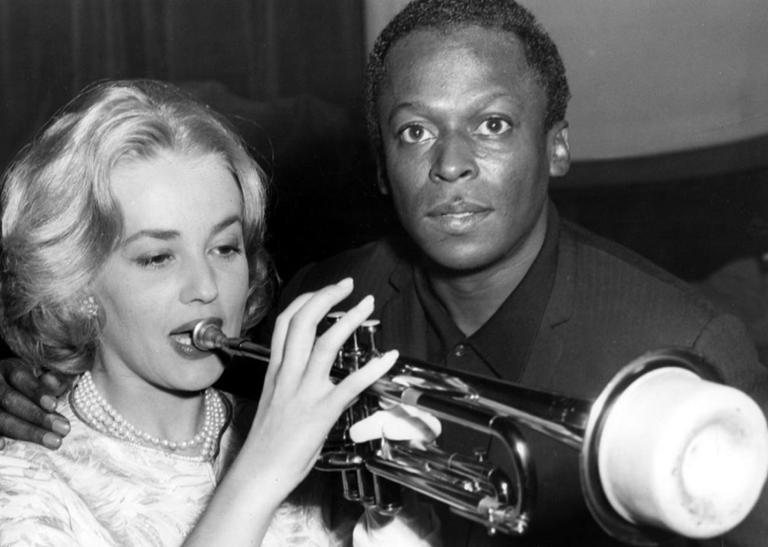
Figure 9: Nuit sur les Champs-Élysées (Miles Davis, 1957). Transcription of the basic musical architecture from page 212 of the author's monograph (Daniele, 2010). The layout explicitly traces the musical bars, demonstrating where the cuts of the filmic montage are structurally located directly upon the score (highlighted in gray and marked with asterisks).
Figure 10: (Appendix 1a): Falsa soggettiva. Key horizontal film frames in a double-column layout from frame 123, from page 197 of the author's monograph (Daniele, 2010). The layout traces Florence’s (Jeanne Moreau) physical and emotional descent through the neon-lit space while the external cityscape undergoes a total sonic erasure.
Figure 8: The Collaborative Encounter. Jeanne Moreau and Miles Davis during the historic nocturnal recording sessions for Ascenseur pour l'échafaud (1957) in Paris. The image captures the intimate and experimental atmosphere of the studio from which the sound experience of the film's soundtrack originates.
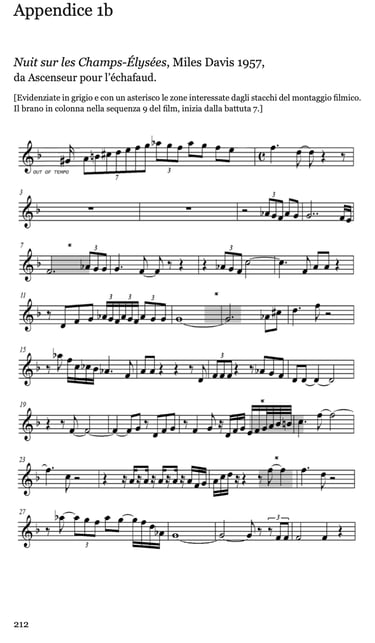
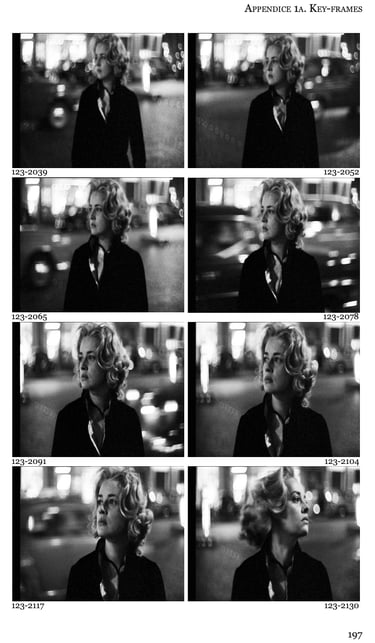
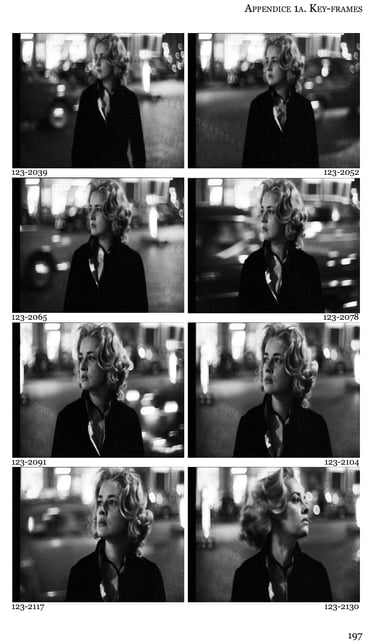
3. Analysis of Stylistic Marks and Musical Structure
This operation of subtraction, which formalizes impersonal enunciation through the sound vacuum of the metropolis (Daniele, 2010, p. 135), finds its counterpoint in three specific stylistic marks identified by the textual analysis of Sequence 9 («Nuit sur les Champs-Élysées»):
The «Subjectivity Without a Subject» of the False Subjective: The use of the false subjective (falsa soggettiva) determines the transition from a state of «imprecise subjectivity» to one of «apparent objectivity» (p. 139). In such a configuration, «the camera looks, but one cannot trace back who is behind it». It is precisely this rhetorical apparatus that visually translates the impersonal instance of enunciation, objectifying space.
The «Avoided Points of Synchronization»: From the perspective of audiovisual mixing, the absence of noises and words coordinates with a phrasing wherein Davis constructs musical sentences by «constantly delaying the first sound in relation to each shot and to the cut between one shot and another» (Daniele, 2010, p. 135). This structural non-synchronism generates a movement of anticipation that eludes linear alignments, delegating the articulation of the nexus directly to the mind of the viewer and displaying the constructed nature of the cinematic text.
The Depersonalization of Bodies in the Background: The geometric rigor of the urban container within which Florence’s isolated body moves is accentuated by the interaction with the environment. The analysis highlights how the representation of the modern world operates to the detriment of human individuality, canceling out differences: the protagonist’s action is constantly flanked by «human figures with depersonalized movement» occupying the background of the sequence (p. 146).
On the strictly musical-compositional level, enunciation and dramaturgical tension are fulfilled through the soloist’s treatment of time and form. Davis dilates and constricts the regular 4/4 meter (Daniele, 2010, p. 141) and, by resorting to the blues interval of the flatted fifth (A-flat) alternating with the perfect fifth (A-natural), develops a melodic curve that «prepares but continuously defers its cadence», systematically resolving into a «deceptive cadence» (falsa cadenza) (Daniele, 2010, p. 152).
Author’s Analytical Note: Frame 727 and the Disguised Auteur
In shot 121, the visual frame captures Florence in a lateral tracking shot along the Parisian sidewalk, with her profile positioned on the right side of the screen. The shop windows behind her transform into a complex tapestry, animated by the blurred (flou) reflections of neon lights, city traffic, and passersby.
Through a strict musicological deconstruction conducted frame-by-frame, a vital historical detail emerges within the reflection of the glass at Frame 727: two men are glimpsed observing the protagonist as she speaks to herself. While one of the two faces forward, the other—walking in profile parallel to Florence—closely matches the slender build and distinct physiognomy of a young Louis Malle.
Although official production documentation remains silent on the matter, the positive comparison with coeval archival photographs of Malle strongly supports our hypothesis that this is a deliberate and hidden cameo by the director. Just as in Alfred Hitchcock’s famous tradition of appearing disguised on the threshold of his stories, Malle subtly weaves his own physical imprint into the reflection of his debut film. In doing so, he anchors the site of authorial enunciation directly within the architectural textures of the concrete world, mirroring that very same structural friction that governs the entire soundtrack.
List of Figures
Figure 1. The place of enunciation and the dissimulated author. Film frame from Ascenseur pour l'échafaud(L. Malle, 1957) [cf. Daniele 2010, p. 211].
Figure 2. The shattering of Morlaix (The crisis of the post-digital code). Polyphonic fragmentation in Morlaix(J. Rosales, 2024).
Figure 3. Spatial typologies of confinement. Comparison between The Silence of the Lambs (J. Demme, 1991) and Ascenseur pour l'échafaud (L. Malle, 1957).
Figure 4. Confinement and material friction. Julien in the elevator shaft in Ascenseur pour l'échafaud (L. Malle, 1957).
Figure 5. Diagram of the prospective evolution from the structural analytical model (2010) to the «electroacoustic sense» (2026).
Figure 6. Diagram of the transition from profilmic space to the «electroacoustic sense» through the «para-acousmatic» filter.
Figure 7. The spatialization of the trace and tape notation. Luciano Berio and the score of Thema (Omaggio a Joyce) (1958).
Figure 8. The collaborative encounter. Jeanne Moreau and Miles Davis in the recording studio (Paris, 1957).
Figure 9. «Nuit sur les Champs-Élysées». Transcription of the musical architecture and editing cuts [cf. Daniele 2010, p. 212].
Figure 10. Appendix 1a: False point-of-view shot. Frame sequence from shot 123 [cf. Daniele 2010, p. 197].
Iconographic Credits and Source Notes
The original musicological transcriptions of Miles Davis's score (Figs. 9 and 10) are taken from R. Daniele (Ascenseur pour l'échafaud, RDM Records, 2010). The theoretical diagrams (Figs. 5 and 6) are the author's original elaborations. Film stills (Ascenseur pour l'échafaud © NEF; The Silence of the Lambs © Orion Pictures; Morlaix © J. Rosales) and archival materials concerning L. Berio (© Shipwreck Library / Joyce Music) are reproduced strictly for critical analysis, musicological research, and academic essayistic purposes (Fair Use / scientific use).
Bibliography
I. Monographs and Manifesto by the Author (Primary Literature)
Daniele, Romina (2008), Aisthànomai, il Dramma della Coscienza, theoretical line and aesthetic essay included in the CD booklet, Milan, RDM Records. URL: https://rominadaniele.com/aisthanomai-theoretical-line
Daniele, Romina (2010), Ascenseur pour l'échafaud: il luogo della musica nell'audiovisione, Milan, RDM Records, Edizioni Letterarie.
Daniele, Romina (2010), «Il dialogo con la materia disintegrata e ricomposta», un'analisi di Thema (Omaggio a Joyce) di Luciano Berio, Milan, RDM Records, Edizioni Letterarie.
Daniele, Romina (2011), At the beginning of Spannung, Introductory Essay and Program Notes for the Premio Arci for Musical Experimentation, Milan, RDM Records. URL: https://rominadaniele.com/at-the-beginning-of-spannung
Daniele, Romina (2011), Theoretical Analysis: Ejzenštejn's Montage and Electroacoustic Reality. ElectroAcoustics Magazine / Arts & Technologies Archive. Available at: https://rdmrecords.com/il-montaggio-di-sergej-ejzenstejn
Daniele, Romina (2010/2026). On the relationship between audio and image in the live music experience of July 17th 2010: the concert coincides with the screening of the film La chute de la Maison Usher (Jean Epstein, France, 1928) [Part III]. In: Daniele, Romina (2026). Audiovisual Short-Circuit: Sound, Image, and Time from Epstein to the Digital Era. ElectroAcoustics Magazine, 2026 Series, Art. 2026.07.en. (Selected for Arts & Technologies Print Edition). DOI: Pre-assigned (eam.2026.07.en). Available at: https://rdmrecords.com/audiovisual-short-circuit-epstein.
Daniele, Romina (2015). Spannung. Triple CD and Theoretical Essay. Milan: RDM Records.
Daniele, Romina (forthcoming). Voce Sola. Essay around the vocal discourse. Milan: RDM Records.
RDM Records Editorial Team & ElectroAcoustics Board. (2026). Research around Sound and Technologies. Arts & Technologies Manifesto. ElectroAcoustics Magazine, 2026 Series, Art. 2026.03.en. (Selected for Arts & Technologies Print Edition). DOI: Pre-assigned (eam.2026.03.en). Available at: https://rdmrecords.com/arts-and-technologies
Riccardo Sinigaglia Ensemble featuring Romina Daniele (2010/2026), The Echoes of Usher, Official Announcment, RDM Records, audio CD, Official Label Edition 2026. Available at: https://rdmrecords.com/new-release-the-echoes-of-usher.
II. Contemporary Historiographical and Theoretical Sources (Electroacoustics and Cinema)
Adorno, Theodor W. (1928/1969). «Der Formel der Schallplatte» / «Nadelkurven» [Eng. tr. The Form of the Phonograph Record / Curves of the Needle, trans. T. Y. Levin. October, Vol. 55, 1990, pp. 48–61].
Barnouw, Erik (1993). Documentary: A History of the Non-Fiction Film. Second Revised Edition. Oxford: Oxford University Press.
Berio, Luciano (1959/1976). «Poesia e musica — un’esperienza (1959)». In: H. Pousseur (Ed.), La musica elettronica, Milan: Feltrinelli, pp. 124–135 [Eng. tr. Poetry and Music: An Experience, trans. S. Bradshaw. The Musical Times, 100 (1391), 1959, pp. 16–19].
Cage, John (1961). Silence: Lectures and Writings. Middletown, CT: Wesleyan University Press.
Chion, Michel (1981). La voix au cinéma. Paris: Éditions de l’Étoile / Cahiers du Cinéma (Eng. trans. The Voice in Cinema, trans. C. Gorbman. New York: Columbia University Press, 1999).
Chion, Michel (1985). Écrire un scénario. Paris: Cahiers du Cinéma / INA (Updated ed. Paris: Cahiers du Cinéma, 2007).
Chion, Michel (1990). L’Audio-vision. Son et image au cinéma. Paris: Nathan (Eng. trans. Audio-Vision: Sound on Screen, trans. C. Gorbman. New York: Columbia University Press, 1994).
Chion, Michel (1991). L’Art des sons fixés ou La Musique concrètement. Metamorfosi di Parigi: Metamkine / INA-GRM (Eng. trans. The Art of Fixed Sounds, trans. C. Southworth. Paris: Metamkine, 2009).
Chion, Michel (1995). David Lynch. Paris: Cahiers du Cinéma (Eng. trans. David Lynch, trans. R. Julian. London: British Film Institute, 2006).
Chion, Michel (1995). La Musique au cinéma. Paris: Fayard (Eng. trans. Film Music, trans. C. Gorbman. New York: Columbia University Press, 2003).
Chion, Michel (1998). Le Son: Traité d’acoulogie. Paris: Armand Colin (Eng. trans. Sound: An Acoulogical Treatise, trans. C. Gorbman. Durham, NC: Duke University Press, 2016).
Chion, Michel (2003). Un art sonore, le cinéma: histoire, critique, esthétique. Paris: Cahiers du Cinéma [Eng. tr. Film, a Sound Art, trans. C. Gorbman. New York: Columbia University Press, 2009].
Chion, Michel (2015). «Seventies en folie». In: Entre deux images, no. 21, June 28, 2015. Michel Chion’s Blog: michelchion.com.
Chion, Michel (2026). Pour une histoire impossible du cinéma [For an Impossible History of Cinema]. Digital Monograph / Serialized Critical Essays. Paris / Online Reference: michelchion.com. Chapter 1: The Valley of Gwangi (Jim O'Connolly, 1969) & Morlaix (Jaime Rosales, 2024).Chapter 2: EO (Jerzy Skolimowski, 2022) & Anatomy of a Fall (Justine Triet, 2023). Chapter 3: The Silence of the Lambs (Jonathan Demme, 1991). Chapter 4 (June 2026): Blade Runner (Ridley Scott, 1982).
Debord, Guy & Wolman, Gil J. (1956). «Mode d’emploi du détournement». Les Lèvres Nues, no. 8 [Eng. tr. A User’s Guide to Detournement. In: K. Knabb (Ed.), Situationist International Anthology, Berkeley: Bureau of Public Secrets, 2006, pp. 14–21].
Debord, Guy (1958). «Thèses sur la révolution culturelle». Internationale Situationniste, no. 1, pp. 20–21 [Eng. tr.Theses on Cultural Revolution. In: K. Knabb (Ed.), Situationist International Anthology, Berkeley: Bureau of Public Secrets, 2006, pp. 53–56].
Devlin, William J. & Biderman, Shai (Eds.) (2011). The Philosophy of David Lynch. Lexington: The University Press of Kentucky.
Di Scipio, Agostino (2000). «Da un’esperienza in ascolto tra phoné e logos. Testo, suono e musica in "Thema (Omaggio a Joyce)" di Berio». Il Saggiatore Musicale, VII(1), pp. 120–138.
Hainge, Greg (2013). Noise Matters: Towards an Ontology of Noise. Bloomington: Indiana University Press.
Isou, Isidore (1947). Introduction à une nouvelle poésie et à une nouvelle musique. Paris: Gallimard.
Mitry, Jean (1963–1965). Esthétique et psychologie du cinéma. Vol. 1: Les structures (1963); Vol. 2: Les formes (1965). Paris: Éditions Universitaires [Eng. tr. The Aesthetics and Psychology of the Cinema, trans. C. King. Bloomington: Indiana University Press, 1997].
Pasolini, Pier Paolo (1972). Empirismo eretico. Milan: Garzanti, pp. 9–28 [Eng. tr. Heretical Empiricism, trans. B. Lawton & L. K. Barnett. Bloomington: Indiana University Press, 1988, pp. 3–28].
Pontara, Tobias (2019). Andrei Tarkovsky’s Sounding Cinema: Music and Meaning from Solaris to The Sacrifice. London / New York: Routledge.
Russolo, Luigi (1913). L’arte dei rumori. Milan: Edizioni Futuriste di «Poesia»[(Eng. tr. The Art of Noises, trans. B. Barclay. Pendragon Press, 1986].
Schaeffer, Pierre (1966). Traité des objets musicaux. Paris: Éditions du Seuil [Eng. tr. Treatise on Musical Objects: An Essay across Disciplines, trans. C. North & J. Dack. Berkeley: University of California Press, 2017].
Sterne, Jonathan (2003). The Audible Past: Cultural Origins of Sound Reproduction. Durham, NC: Duke University Press.
Tarkovsky, Andrei (1986). Sculpting in Time: Reflections on the Cinema, trans. K. Hunter-Blair. London: Bodley Head.
Truppin, Andrea (1992). «And Then There Was Sound: The Films of Andrei Tarkovsky». In: R. Altman (Ed.), Sound Theory/Sound Practice, New York: Routledge, pp. 235–248.
Varèse, Edgard (1966). «The Liberation of Sound». Lectures 1936–1962 compiled by Chou Wen-chung. Perspectives of New Music, Vol. 5, no. 1, pp. 11–19.
Von Trier, Lars & Vinterberg, Thomas (1995). Dogme 95: Le vœu de chasteté [Dogme 95: The Vow of Chastity]. Manifesto. Copenhagen.
Wolman, Gil J. (1952). L’Anticoncept. Paris: Allia, 1994.
Zavagna, Paolo (1992). «"Thema (Omaggio a Joyce)" di Luciano Berio. Un’analisi». Quaderni della Civica Scuola di Musica, XI(21–22), pp. 58–64.
III. Philosophy, Text and Film Theory
Aumont, Jacques (1983). «Le point de vue». Communications, no. 38, pp. 193–210 (Eng. trans. The Point of View, trans. P. Drummond. Quarterly Review of Film Studies, 10(4), 1985, pp. 289–302).
Aumont, Jacques (1989). L’œil interminable. Cinéma et peinture. Paris: Librairie Séguier [Eng. tr. The Endless Eye: Cinema and Painting, trans. B. Holmes. Bloomington: Indiana University Press, 1997].
Bazin, André (1945/1958). «Ontologie de l’image photographique». In: Qu’est-ce que le cinéma?, Paris: Éditions du Cerf, 1958 [Eng. tr. The Ontology of the Photographic Image. In: What Is Cinema? Vol. 1, trans. H. Gray. Berkeley: University of California Press, 1967, pp. 9–1]).
Benjamin, Walter (1936). Das Kunstwerk im Zeitalter seiner technischen Reproduzierbarkeit. Zeitschrift für Sozialforschung, V(1) [Eng. tr. The Work of Art in the Age of Its Technological Reproducibility. In: Selected Writings, Vol. 3: 1935–1938, Cambridge, MA: Harvard University Press, 2002, pp. 101–133].
Benveniste, Émile (1966). Problèmes de linguistique générale. Paris: Gallimard [Eng. tr. Problems in General Linguistics, trans. M. E. Meek. Coral Gables, FL: University of Miami Press, 1971].
Bernardi, Sandro (1998). «I regimi dello sguardo». In: Introduzione alla retorica del cinema, Milan: Franco Angeli, pp. 72–79.
Branigan, Edward (1984). Point of View in the Cinema: A Theory of Narration and Subjectivity in Narrative Film. Berlin / New York / Amsterdam: Mouton.
Casetti, Francesco (1986). Dentro lo sguardo. Il film e il suo spettatore. Milan: Bompiani [Eng. tr'. Inside the Gaze: The Fiction Film and Its Spectator, trans. N. Andrew & C. O’Brien. Bloomington: Indiana University Press, 1998].
Deleuze, Gilles (1983). Cinéma 1. L’image-mouvement. Paris: Éditions de Minuit [Eng. trans. Cinema 1: The Movement-Image, trans. H. Tomlinson & B. Habberjam. Minneapolis: University of Minnesota Press, 1986].
Deleuze, Gilles (1985). Cinéma 2. L’image-temps. Paris: Éditions de Minuit [Eng. tr. Cinema 2: The Time-Image, trans. H. Tomlinson & R. Galeta. Minneapolis: University of Minnesota Press, 1989].
Derrida, Jacques (1967). L’écriture et la différence. Paris: Éditions du Seuil [contains «Force et signification», originally published in Critique, no. 193–194, 1963] [Eng. tr. Writing and Difference, trans. A. Bass. Chicago: The University of Chicago Press, 1978].
Eco, Umberto (1968). La struttura assente. La ricerca semiotica e il metodo strutturale. Milan: Bompiani.
Eco, Umberto (1975). Trattato di semiotica generale. Milan: Bompiani [Eng. tr. A Theory of Semiotics. Bloomington: Indiana University Press, 1976].
Ejzenštejn, Sergei M. (1940/2000). Montaž [«Montage»]. Original Russian edition ed. by N. I. Kleiman, Moscow: Muzej Kino, 2000 [Eng. tr. Towards a Theory of Montage, trans. M. Glenny. London: British Film Institute, 1991].
Ejzenštejn, Sergei M. (1949). Film Form: Essays in Film Theory. Ed. and trans. by Jay Leyda. New York: Harcourt, Brace & World.
Ejzenštejn, Sergei M., Pudovkin, Vsevolod I., & Aleksandrov, Grigori V. (1928). «Buduščee zvukovogo fil’ma. Zajavka» [A Statement on Sound]. Žizn’ Iskusstva, no. 32 [Eng. tr. A Statement on Sound. In: S. M. Eisenstein, Film Form: Essays in Film Theory, ed. and trans. J. Leyda. New York: Harcourt, Brace & World, 1949, pp. 257–260].
Epstein, Jean (1921). Bonjour cinéma. Paris: Éditions de la Sirène (Eng. trans. In: Sarah Keller & Jason N. Paul (Eds.), Jean Epstein: Critical Essays and New Translations, Amsterdam: Amsterdam University Press, 2012).
Epstein, Jean (1946). L’Intelligence d’une machine. Paris: Jacques Melot [Eng. tr. The Intelligence of a Machine, trans. C. Wall-Romana. Minneapolis: Immaterial Books, 2014].
Epstein, Jean (1955). Esprit de cinéma. Paris: Jeheber.
Godard, Jean-Luc (1971). Jean-Luc Godard per Jean-Luc Godard. Ed. by J. Narboni. Rome: Bulzoni [Eng. tr. Godard on Godard, ed. J. Narboni & T. Milne. New York: Da Capo Press, 1972].
Heidegger, Martin (1927). Sein und Zeit. Tübingen: Max Niemeyer Verlag (Eng. trans. Being and Time, trans. J. Stambaugh. Albany, NY: State University of New York Press, 1996).
Lacan, Jacques (1975). Le Séminaire, Livre XX: Encore (1972-1973). Paris: Éditions du Seuil (Eng. trans. The Seminar of Jacques Lacan, Book XX: On Feminine Sexuality, the Limits of Love and Knowledge (Encore), trans. B. Fink. New York: W. W. Norton & Company, 1998).
Manovich, Lev (2001). The Language of New Media. Cambridge, MA: MIT Press.
Metz, Christian (1968). Essais sur la signification au cinéma, Tome I. Paris: Éditions Klincksieck (Eng. tr.Film Language: A Semiotics of the Cinema, trans. M. Taylor. New York: Oxford University Press, 1974].
Metz, Christian (1971). Langage et cinéma. Paris: Larousse [Eng. tr. Language and Cinema, trans. D. Umphrey. The Hague: Mouton, 1974].
Metz, Christian (1977). Le signifiant imaginaire. Psychanalyse et cinéma. Paris: Union Générale d’Éditions [Eng. tr. The Imaginary Signifier: Psychoanalysis and the Cinema, trans. C. Britton et al. Bloomington: Indiana University Press, 1982].
Metz, Christian (1991). L’énonciation impersonnelle, ou le site du film. Paris: Éditions Klincksieck [Eng. tr.Impersonal Enunciation, or the Place of Film, trans. C. Cormick. New York: Columbia University Press, 2016].
Miccichè, Lino (1975). Il neorealismo cinematografico italiano. Venice: Marsilio.
Morris, Charles W. (1938). Foundations of the Theory of Signs. Chicago: The University of Chicago Press.
Panofsky, Erwin (1932). Die Perspektive als «symbolische Form». Vorträge der Bibliothek Warburg 1924-1925, Leipzig/Berlin [Eng. tr. Perspective as Symbolic Form, trans. C. S. Wood. New York: Zone Books, 1991].
Sainati, Augusto (1998). «Supporto, soggetto, oggetto: forme di costruzione del sapere dal cinema ai nuovi media». In: Costruzione e appropriazione del sapere nei nuovi scenari tecnologici, Naples: CUEN.
Sainati, Augusto (2001). La regia cinematografica. Rome: Editori Riuniti.
Sainati, Augusto (2011). Il cinema oltre il cinema. Rome: Carocci.
Sainati, Augusto & Gaudiosi, Massimiliano (2007). Analizzare il film. Rome: Carocci.
IV. Filmography
2001: A Space Odyssey — Directed by Stanley Kubrick. USA/UK, 1968. Music by György Ligeti, Richard Strauss, Johann Strauss.
Anatomie d'une chute [Anatomy of a Fall] — Directed by Justine Triet. France, 2023.
Ascenseur pour l’échafaud — Directed by Louis Malle. France, 1957. Music by Miles Davis.
Blade Runner — Directed by Ridley Scott. USA, 1982. Music by Vangelis. Sound Design by Graham V. Hartstone.
C’era una volta il West — Directed by Sergio Leone. Italy/USA, 1968. Music by Ennio Morricone.
EO — Directed by Jerzy Skolimowski. Poland/Italy, 2022. Music by Paweł Mykietyn.
Eraserhead — Directed by David Lynch. USA, 1977. Sound Design: David Lynch, Alan Splet. Music/Sound Effects: Fats Waller, Peter Ivers.
La Chute de la maison Usher — Directed by Jean Epstein. France, 1928.
Le Cercle rouge — Directed by Jean-Pierre Melville. France/Italy, 1970. Music by Éric Demarsan.
Morlaix — Directed by Jaime Rosales. Spain, 2024.
Salesman — Directed by Albert Maysles, David Maysles, Charlotte Zwerin. USA, 1969.
Sedmikrásky [Daisies] — Directed by Věra Chytilová. Czechoslovakia, 1966.
Stalker — Directed by Andrei Tarkovsky. USSR, 1979. Music and Electronic Synthesis: Eduard Artemyev.
Teorema — Directed by Pier Paolo Pasolini. Italy, 1968. Music by Wolfgang Amadeus Mozart, Ted Curson.
The Silence of the Lambs — Directed by Jonathan Demme. USA, 1991. Music by Howard Shore.
The Valley of Gwangi — Directed by Jim O’Connolly. USA, 1969. Music by Jerome Moross.
Titicut Follies — Directed by Frederick Wiseman. USA, 1967.
Vivre sa vie: Film en douze tableaux — Directed by Jean-Luc Godard. France, 1962. Music by Michel Legrand.
How to Cite this Essay
APA 7th Edition: Daniele, Romina (2026). The Resonance of the «Déjà-Là»: Correspondences, Inversions, and Material Frictions Between Chion’s Impossible History and the «Elettroacoustic Imperative». ElectroAcoustics Magazine (Continuous Digital Publication) / Arts & Technologies, Issue #01 «The Electroacoustic Imperative», Vol. 1 (Selected for Print Edition), RDM Records, 2026 Series, Art. 2026.05.en.DOI: Pre-assigned (eam.2026.05.en). Available at: https://rdmrecords.com/the-resonance-of-the-deja-electroacoustic
RDM RECORDS IS A FLORIDA-REGISTERED DBA OF ROMINA DANIELE, OPERATING AS A RECORD LABEL AND BOOK PUBLISHER FOR RDM ROMINA DANIELE MUSIC, A BMI-AFFILIATED MUSIC PUBLISHER.
[CATALOG] — [ABOUT] — [PRESS] — [MAGAZINE] - [CONTACT]
TERMS & POLICIES: © 2010–2026 RDM RECORDS. ALL RIGHTS RESERVED.
ALL TEXTUAL, MUSICOLOGICAL, AND AUDIO CONTENT IS PROTECTED UNDER INTERNATIONAL INTELLECTUAL PROPERTY LAWS. DATA SUBMITTED VIA OUR PORTALS IS PROCESSED STRICTLY FOR INTERNAL INSTITUTIONAL COMMUNICATION.THIS INDEPENDENT INSTITUTIONAL LABEL IS DEDICATED TO PURE PHENOMENOLOGICAL, VOCAL, AND SONIC RESEARCH, AND MAINTAINS A STRICT POLICY OF COMPLETE DETACHMENT FROM ALL FORMS OF BLASPHEMY, EXPLICIT THEMES, OR PROFANE PERFORMANCES, SYSTEMATICALLY EXCLUDING THEM FROM ITS CATALOG AND SCOPE.


Get in touch