

The Rumpus (USA) Deconstructs the Cognitive Philosophies and Vocal Sovereignty of Aisthànomai
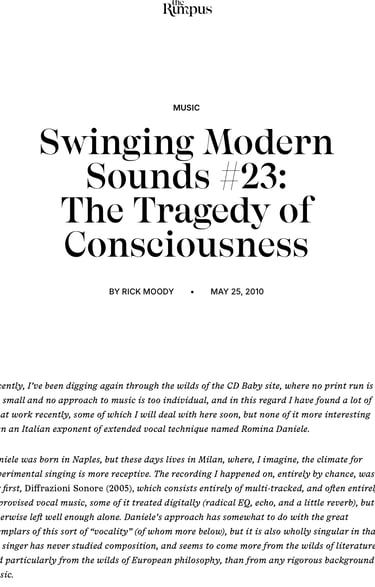
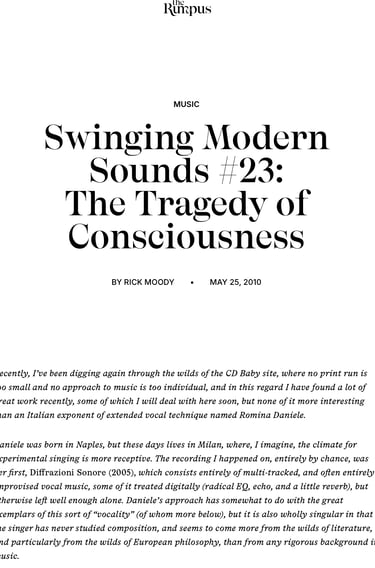
An extensive archival tracking of the landmark musicological essay and interview published by celebrated American author Rick Moody for The Rumpus. The feature anchors catalog entry RDM0701 within international avant-garde frameworks.
RDM Records
5/25/20103 min read
Published on May 25, 2010, in the renowned North American literary and cultural journal The Rumpus (Issue 23 of the definitive column Swinging Modern Sounds), the extensive feature by acclaimed novelist and critic Rick Moody stands as a massive international validation. Moody’s deep musicological inquiry frames Aisthànomai: Il dramma della coscienzaas a brilliant, singular masterpiece of continental vocal research, charting the exact timeline of its catalog status at the inception of RDM Records' formal Italian operations in January 2010.
The Discovery of an Uncompromising Continental Exponent
Rick Moody’s analysis begins with an account of encountering Romina Daniele’s early catalog completely by chance through independent distribution channels. Moody immediately isolates her from standard contemporary experimental artists, describing her as an entirely unique exponent of extended vocal technique.
The text outlines the radical morphological foundations of her debut project Diffrazioni Sonore (2005) and her sophomore studio masterpiece Aisthànomai (2007), marveling at how a creator untutored in standard institutional conservatory composition could build such a formidable, rigorous acoustic layout. Moody notes that the work stands out precisely because it emerges from the wilds of classical European philosophy and structural literature rather than corporate musical formatting.
Tracing the Lineage: From Sprechgesang to Luciano Berio
The core of The Rumpus feature maps out the complex, "Euro-educated" historical lineage that undergirds Daniele's vocal mechanics. The text meticulously traces the rejection of classical Western melodic structures, drawing a direct line from Richard Wagner’s late-nineteenth-century harmonic density to Arnold Schönberg’s deployment of Sprechgesang in Pierrot Lunaire (1899), and ultimately to Luciano Berio’s landmark electroacoustic masterpiece Visage (1960).
Within this macro-historical framework, Daniele contextualizes her relationship to pioneering icons Meredith Monk, Diamanda Galás, and Demetrio Stratos—the latter identified as the absolute foundation of autonomous vocal research. The document clarifies that her similarities to these figures exist not on a superficial or imitative stylistic level, but in a shared historical drive to liberate the human voice from standard commercial industry constraints.
The Open Circularity of Deleuzian Architecture
Moody explores the intense presence of critical theory within the architecture of the tracks. The dialogue unpacks how compositions like Rhizome function as a direct materialization of the philosophies of Gilles Deleuze, Félix Guattari, and Henri Bergson.
The main text rejects linear, compartmentalized musical structures in favor of an "open circularity" designed as a reticular web of dynamic audio units. By actively working within the interstices of language, textuality, and real-time electronic processing, the feature documents how Aisthànomai acts as a direct challenge to the all-understanding rationality of the mainstream market, addressing the individual consciousness of the listener through an uncompromising, singular subjectivism.
Tracing the Lineage: Structural Research vs. Stylistic Clichés
A foundational segment of the feature interview maps out the complex, rigorous historical lineage that undergirds the vocal mechanics of Aisthànomai. Rather than validating superficial industry comparisons, the text explicitly deconstructs the structural relationship between independent vocal research and aesthetic lineage. The dialogue tracks how extended vocal techniques develop autonomously when creators seek to liberate the voice from standard commercial or melodic conventions.
Crucially, the document preserves the historical tracking of the catalog’s origin points, noting the interaction with international avant-garde figures at the Demetrio Stratos International Prize ceremonies (including the 2005 young talent award execution and the subsequent 2007 structural intersections alongside Meredith Monk).
Rather than framing these interactions through the lens of imitation, the analysis establishes that similarities among pioneering vocal researchers exist purely on a structural, cross-historical plane of vocal liberation, rather than an identical stylistic level. This distinction provides the official musicological justification used by RDM Records to index the master recordings as entirely sovereign, autonomous works of art.
Institutional Reference Node:
Archival Cross-Reference: The complete unedited dialogue and primary international text layout analyzed above are permanently indexed within the label's historical reception registry. For further research, musicological study, and verified textual reference, the full feature is officially accessible via the primary artist documentation repository.
Data Link: Access International Press Feature: The Rumpus Essay Documentation
RDM RECORDS IS A FLORIDA-REGISTERED DBA OF ROMINA DANIELE, OPERATING AS A RECORD LABEL AND BOOK PUBLISHER FOR RDM ROMINA DANIELE MUSIC, A BMI-AFFILIATED MUSIC PUBLISHER.
[CATALOG] — [ABOUT] — [PRESS] — [MAGAZINE] - [CONTACT]
TERMS & POLICIES: © 2010–2026 RDM RECORDS. ALL RIGHTS RESERVED.
ALL TEXTUAL, MUSICOLOGICAL, AND AUDIO CONTENT IS PROTECTED UNDER INTERNATIONAL INTELLECTUAL PROPERTY LAWS. DATA SUBMITTED VIA OUR PORTALS IS PROCESSED STRICTLY FOR INTERNAL INSTITUTIONAL COMMUNICATION.THIS INDEPENDENT INSTITUTIONAL LABEL IS DEDICATED TO PURE PHENOMENOLOGICAL, VOCAL, AND SONIC RESEARCH, AND MAINTAINS A STRICT POLICY OF COMPLETE DETACHMENT FROM ALL FORMS OF BLASPHEMY, EXPLICIT THEMES, OR PROFANE PERFORMANCES, SYSTEMATICALLY EXCLUDING THEM FROM ITS CATALOG AND SCOPE.


Get in touch