Film Analysis: The Digital Cadaver — A Critique of Loving Vincent
Beyond the 65,000 hand-painted frames lies a profound semiotic disconnect. This critical study explores how «stylistic taxidermy» and a narrative of social assassination turn Van Gogh’s revolutionary tools into a monument for his death rather than a temple for his spirit.
ELECTROACOUSTICS MAGAZINE ARTICLES2026 SERIESFILM THEORY & AUDIO-VISUAL MEDIA
Romina Daniele & Jadys Daniele
4/29/202623 min read
Online Journal Title: ElectroAcoustics Magazine
Print Series Destination: Arts & Technologies (Annual Print Selection)
Classification / Category: 2026 Official Series · Film Theory & Audio-Visual Media / Film Analysis Essay
Article Identifier: Art. 2026.02.en
Publishing Model: Continuous Digital Publication · Peer-Review Selected for Print
Issue #01 «Electroacustic Imperative»
Indexing & Registrations
ISSN (Online): Application in Progress
ISBN (Print): Reserved for Arts & Technologies 2027
DOI: Pre-assigned (eam.2026.02.en)
Publication Date: April 29, 2026
Editorial and Typographical Note: To bridge European philosophical traditions with international indexing standards in bilingual contexts, Arts & Technologies / ElectroAcoustics Magazine utilizes a hybrid APA 7/Chicago Notes citation framework embedded seamlessly within footnotes. Rather than using parenthetical in-text citations, each footnote pairs the original work's chronological origin with complete translation and pagination metadata [e.g., Metz, C. (1991), ... [Eng. tr. ..., p. XX]]. Readers will also note our signature European typographic hierarchy: guillemets («...») designate core theoretical concepts and primary quotes, double quotation marks ("...") mark nested citations, and single quotes ('...') frame metaphors or scare quotes, with foreign terms uniformly italicized.
A Crisis Between Technological Superstructure and Artistic Truth: Introducing Loving Vincent. Through the use of digital rotoscoping applied to oil painting, the film transforms Van Gogh’s tools into a form of «stylistic taxidermy» that sterilizes the genius by reducing it to a «true crime» case. The analysis extends its critique to the receptive dimension and the electroacoustic setup of the screening at the SoundScape Park in Miami Beach, drawing a theoretical parallel with the bourgeois-inflected cinematic treatments suffered by Pier Paolo Pasolini.
Film Analysis: The Digital Cadaver – A Critique of Loving Vincent
Annotated Index & Reading Guide
Critical Framework And Technical-Parodic Fiche
Introduces the semiotic and aesthetic short-circuit of the film Loving Vincent (2017); summarizes in an analytical fiche the production parameters, dramaturgical roles, the oil rotoscoping structure, and theconditions of outdoor acoustic reception at the SoundScape Park in Miami Beach
Analytical Paragraphs And Critical Development
Develops the theoretical examination of the work divided into five argumentative stages:
I. The Uncanny Valley of the Digital Brush — Analysis of the technological paradox between static oil painting and digital interpolation at 24 fps; critique of «stylistic taxidermy», the loss of the original vibration, and the friction between the live-action skeletal structure and the painted surface.
II. The Narrative of Death and The Legacy of Life — Dismantling of the bourgeois clinical and psychoanalytic approach to genius; critique of reducing the artist to a passive victim and the use of anachronistic language and expressions.
III. The Players and the Rebus: Disconnections Between Facts and Vacuum — Refutation of the true crime drift centered on the figures of Armand Roulin and René Secrétan; critical parallel with the historiographical distortion of Pier Paolo Pasolini's life and death, and a recall to the theatrical dignity of Vincent Price.
IV. Electroacoustic Critique: The Soundscape Experience — Examination of the performance of the park's sound reinforcement system; analysis of the «Audibility Gap» and Clint Mansell's ghost soundtrack, incapable of engaging in dialogue with the materiality of the visual impasto.
V. Conclusion: Not a Signature — Critique of the fictitious letter from Johanna van Gogh-Bonger as an attempt to historically legitimize the Naifeh-Smith thesis; synthesis on the commercial sterilization of artistic genius.
Appendix: Historical, Theoretical, And Archival References
Offers a unified conceptual framework linking the genesis of the Naifeh-Smith investigative thesis on Van Gogh (2011) and the dramaturgical construction of the character of Armand Roulin to the counter-narrative surrounding the death of Pier Paolo Pasolini. The analysis weaves together David Grieco's testimony (La Macchinazione, 2016), the theft of the Salò film reels, and the insights of Petrolio, contrasting the documentary rigor of archives (Museum Folkwang in Essen for visual materials on Van Gogh, and the Centro Studi - Archivio Pier Paolo Pasolini at the Cineteca di Bologna) with the fictitious spectacle of the media. The section closes with an editorial bridge note to the companion essay on electroacoustic critique (Daniele, 2026).
Includes extended figure captions, the fiche of framing and index of illustrations, the note of theoretical contextualizationwith the companion essay, and an annotated bibliography articulated into five thematic sections: filmography and audiovisual works; film theory, criticism, literature, and epistolary sources; discography and soundtracks; museum sources, archives, and institutional resources; published journal articles (ElectroAcoustics Magazine).


Fig. 1: Armand Roulin. Comparison between the original oil portrait painted by Vincent van Gogh (1888) and its digital rotoscoping re-elaboration within the film Loving Vincent (2017). The transition from the material stroke to the dynamic replica highlights the phenomenon of «stylistic taxidermy» and entry into the Uncanny Valley.
Technical-Parodic Datasheet
Title: Loving Vincent (2017)
Directorial Vision: Dorota Kobiela, Hugh Welchman
Technological Framework: Digital Rotoscope / Oil-on-canvas interpolation (65,000 frames)
Score: Clint Mansell (the «Ghost Soundtrack»)
The Subject of Legacy: Vincent van Gogh (absent/interrogated)
The Protagonist of Death: Armand Roulin (the «Detective» in the yellow jacket)
The Historical Antagonist: René Secrétan (the source of the «Bad Story»)
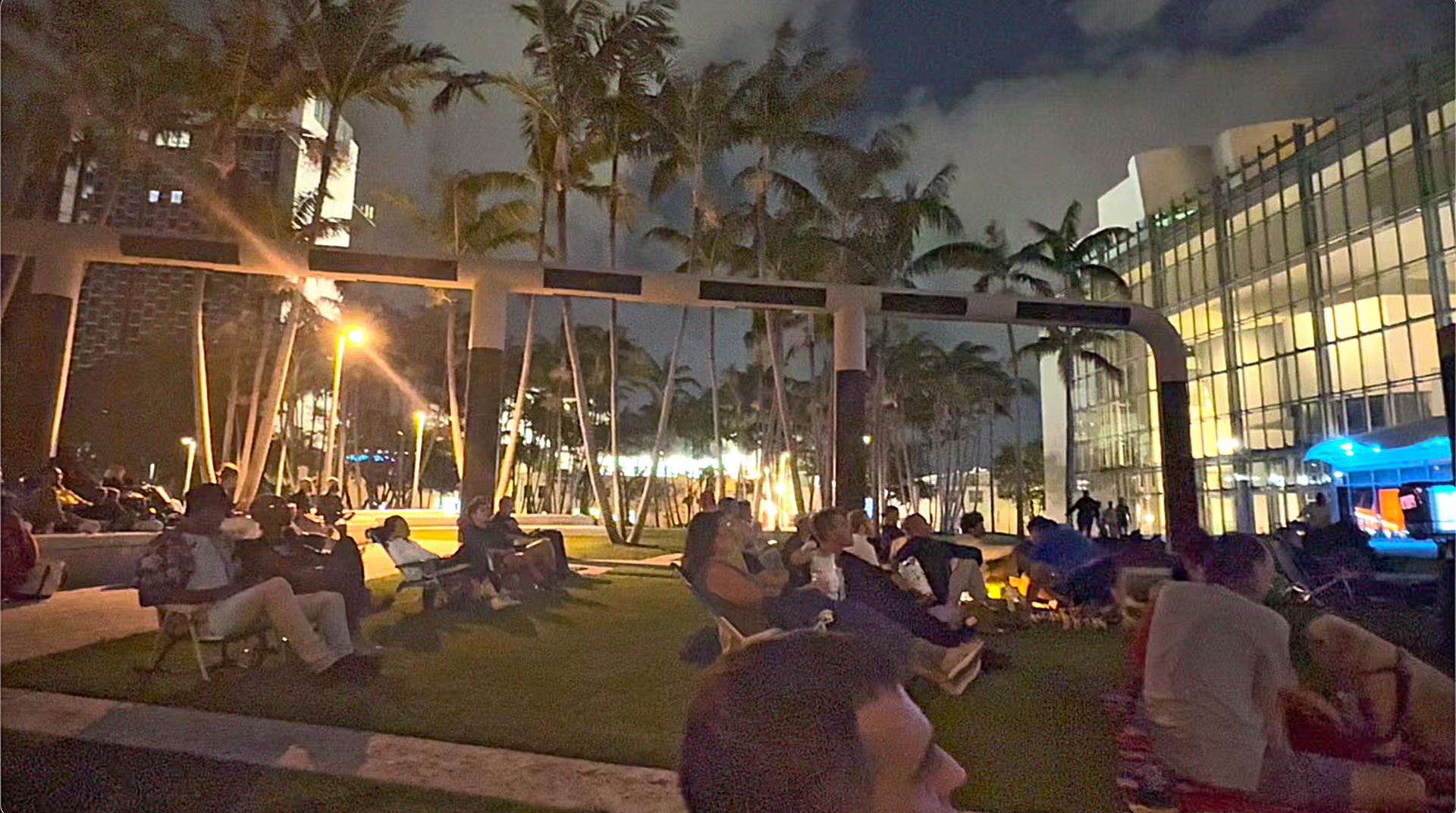
Screening Environment: SoundScape Cinema Park, Miami Beach (open-air acoustic crossover)
To witness Loving Vincent [1] at Miami Beach’s SoundScape Park is to experience a profound semiotic disconnect. While the screen attempts to dazzle with a «mastery of copying»—reanimating Van Gogh’s brushstrokes through the labor of 125 painters—the result is not a resurrection, but a digital cadaver.
By choosing to focus exclusively on the mechanics of his death through the eyes of a fictionalized detective (Armand Roulin), the film strips the subject of his agency and his legacy. We are presented with a «flash of bones»—flesh and blood models wearing a digital mask of Van Gogh’s style—while the man himself remains a «strange, distant personality», interrogated even on his deathbed. In this «invented space,» the vibrant soul of the artist is replaced by modern language anachronisms and a narrative that refuses to let him rest in peace, resulting in a «bad story» told poorly through the lens of digital tourism.
It is our opinion that Loving Vincent represents a dangerous intersection where a tendentious technological mastery overpowers artistic and narrative truth. By utilizing an extrapolation of Van Gogh’s own aesthetic tools—his revolutionary brushstrokes and color palettes—only to serve a narrative that isn't his, the film performs a sort of «stylistic taxidermy». This is the «\textit{uncanny valley}» of art: when they used his tools (the paintings) to tell a story that isn't his (the death investigation), the tools of a genius are used to build a monument to his death rather than a temple to his spirit.
While many critics have noted the film’s descent into the Uncanny Valley [2]. I find that this term only scratches the surface. It is not merely a technical glitch in our perception; rather, it is a «flash of bones»—a moment where the spirit is evicted to make room for a purely anatomical mimicry.
I. The Uncanny Valley of the Digital Brush
The central technological paradox of Loving Vincent lies in its bold attempt to animate a support that was never meant to move: the static, textured oil painting. While the film is marketed as a feat of manual labor, the final result is unequivocally and technically a victim of «stylistic taxidermy». This would not be the case if the work had been conceived directly as digital painting; rather, the transaction from a historical style such as Van Gogh’s renders the operation not only bold but clumsy, despite the indisputable technical mastery of digital tools that remain helpless before the task that the artist masters of copying were called to perform: beginning with the mimicry of Van Gogh’s style, the storyboard drawings upon which the digital operation is built were commissioned.
Indeed, the «original sin» of the film is not the use of digital technology, but the forced transition (the 'relocation') of a historical soul into a synthetic and alien body: the fault lies not at all with the machine, but with the initial «commission» that transformed art into a task of copying.
The Friction of Interpolation: There is a jarring friction between the 125 painters’ manual work and the digital interpolation used to smooth the animation. In Van Gogh’s original oeuvre, the brushstroke is the soul: it is a physical record of a specific moment of a specific man. In the film, these strokes are executed by a certain category of artists who are not creating something new but are mastering a lesson (Van Gogh’s). These strokes are then subjected to digital rotoscoping (tracing over live-action footage), creating a «subtle yet insidious effect» where the movement feels too fluid for the support. The result is a «mastery of copying» that lacks an origin—a recreation that exists in a technological void rather than an artistic one.
Flesh, Blood, and the «Flash of Bones»: By using live actors as the underlying skeletal structure for the paintings, the movie enters the «uncanny valley». Instead of the expressive distortion found in Vincent’s actual portraits, we see «blood and flesh models» wearing a digital mask of his style. The faces possess the correct proportions, but they lack the spiritual resonance of the original subjects. It is like looking at a «flash of bones»—the structural remains of a human being without the light of the spirit. One recognizes the skeletal structure of the layers of skin, which is not deep enough to sustain the truth of the first layer instead. Even if Van Gogh’s original work hummed with life, that frequency does not resonate here; it has become a physical record on the support of a person who is no longer present—the structural remains of a human being without that light of the spirit that Van Gogh fought so hard to capture. In this absence of the original spiritual resonance, the lack of a real creator—replaced by masters of copying—becomes the primary model. They may have captured the physical movement (the layers of skin and bones), but they lost the original vibration; they may have captured the remains of Van Gogh without capturing his vital force.
With the missing resonance or «spirit» of Van Gogh, it must be specified that, despite talk of an admirably executed copy, in truth this is not even essentially true. At the very level of figurative execution, the alleged technical skill is constantly «smoothed over» by a certain sense of Hollywood-style costume—where the original expressive charge is bent toward a slick, polished, and domesticated rendering for the screen. All the tension, the waves, the physiognomic character, and the «good ruggedness» of the facial expressions and skin—typical of Northern Europe and Vincent's painting—are here rendered with this taxonomic presumption made of lines straight and clean of any flaw. What on canvas was dramatic vibration and living matter is cleaned up in the film and converted into an 'ordered' graphic perfection, where even the roughness of the faces undergoes a form of stylistic cosmetics. At times, the waves are entrusted to the continuous movement of the animation on screen, which constitutes the true substance of this technocratic operation they have called a film [3].
Matter Without Space: Ultimately, the film uses modern technical experience to justify and flaunt a placement of matter that Van Gogh never inhabited, and which he would never have inhabited even if he had lived in a digital or «copy-paste» era. By forcing his style not only into the 24-frames-per-second requirements of modern cinema, but into high-quality replication and copying, the filmmakers have built a polished, digital simulation. It is a monumental achievement in coordination, but a failure in legacy, and in the true sense of making art.
II. The Narrative of Death and The Legacy of Life
When one analyzes a genius, the most depreciating recognition they can receive is to be treated as a 'clinical case'. This is particularly true for artists of the late nineteenth century, as psychoanalysis was invented shortly thereafter; on the other hand, it provides us—living after 2000—with a way to justify a society that cannot and could not have accepted them. This mechanism fails doubly on the screen of this film, in a mainstream diabolical circus that struggles to suppress the natural artistic flow of life.
The clinical investigation is not merely a medical tool, but a social filter used to sanitize not only genius, but ultimately anyone who—along the line of genius—can be recognized and thus live. By keeping Vincent as an absent protagonist—a 'strange, distant personality'—the film disconnects the audience from any primary subject. This focuses the narrative on a bad story of victimhood rather than the story of a person living in the true flow of natural art.
The use of modern language and anachronistic phrasing—such as discussions regarding 'credit'—further shatters the historical illusion. We are left watching a detective in a yellow jacket hunt for a ghost, while the actual Vincent is pushed far away—distanced by millennia from true human and artistic history, silenced by a script that prefers mystery over a masterpiece.
III. The Players and the Rebus: Disconnections Between Facts and Vacuum
The film’s narrative engine relies on a true crime investigation led by Armand Roulin, but as a viewer, one cannot help but notice the cracks in this role. How could a 'detective' wear such a conspicuous, lemon-yellow jacket? The reality is that Armand was never a detective at all, but simply the son of a postman. By forcing him into the role of a private investigator, the film indulges in a narrative convenience that makes his attire and actions stylistically false or anachronistic.
This investigative lens also distorts the figure of René Secrétan, the sixteen-year-old bully who tormented Vincent in Auvers [4]. Although the film leans into the theory that René was the source of the bullet, this choice provides a type of modern alibi that present society applies to great men and geniuses who were never reconciled to the rules of the system. The writer believes neither in the suicide nor in the bully murderer. This is a very sad connection to the saddest case ever: that of Pier Paolo Pasolini [5]. The actualization of the story with a contingent killer element and a passive murder is the ultimate low-quality cliché we can trace on this screen.
When Loving Vincent applies this scheme to Van Gogh—as other bad films have done with Pasolini—it reduces the life of this genius to a true crime episode. It is a formula; a way to distract the public from the fact that society itself—its rules and its 'unsettled space'—destroyed the true artists, not just a boy with a gun. And they continue to kill them every day, polluting their history in this way.
By aiming for the 'René Secrétan' theory, the film attempts to bypass the official version—the one long defended by the Van Gogh Museum, which is suicide: namely, that Vincent shot himself in the wheat field. It is as if they wanted to create a provocative act in this; however, the final result for a skilled eye is nothing more than a cinematic 'alibi'. In doing so, the film treats the artist's inner struggle as a solvable crime rather than an existential reality. Yet, the work occasionally stumbles into a few seconds of recalled greatness, particularly in the dialogue between the Roulins. The 'best scene'—the exchange of memories about Vincent—echoes the theatrical dignity of a performer like Vincent Price [6]. -- This can be seen as the 'best scene' or as a moment that establishes reference connections, instead of those deliberately constructed self-references that dominate the entire viewing, from the technique itself used to the plot of the story. -- This is a brilliant cinematic callback. We refer to the scene where the postman Joseph Roulin (Armand’s father) drinks and nostalgically recalls Vincent. The 'Price' Echo: In the 1956 film Lust for Life [7], Vincent Price famously voiced the letters of Van Gogh, and there is a specific theatrical gravity inherent to that era of acting. The reference to the dignity of Vincent Price conveys here, without a doubt, a fleeting moment of human weight.
Furthermore, the emotional stakes of the film often blur historical lines to create continued feelings of disconnection. The subplot involving Marguerite Gachet as a 'fiancée' is largely a cinematic invention, and the confusion regarding a 'missing child' highlights the careless handling of the artist's legacy. While Vincent had no children of his own, the movie likely conflates his intense family ties with the figure of his infant nephew, Vincent Willem (Theo’s son), who was only a child at the time of the artist's death. By using modern financial language—and centering the final 'answers' on Dr. Paul Gachet—the film prioritizes a contemporary emotional return over the stark, nineteenth-century reality. The result is merely an attempt to beautifully paint a 'bad story', yet full of contradictions, which appears disconnected from the artist's true expression and an effective historical representation of his final days. Finally, the brother Theo is painted as Van Gogh’s counter-ego. And it is frustrating that this brother is the only one treated as the protagonist of a plot in which the real main actor is a false detective, one year after the genius died.
IV. Electroacoustic Critique: The Soundscape Experience
The environmental context of the screening at Miami Beach SoundScape Park acted as a secondary, unintentional layer of failure. This is due to the continuous gap—active across all the film series we have witnessed over the last three or four years—between the technical 'potential' of the system and its actual performance.
It is paradoxical that in a program titled Soundscape Cinema Series, the complex audio setup is reduced to its bare bones: only the front speakers are active, canceling out any spatial depth [8]. This technical choice merely confirms the sensation of a sound that exists in a vacuum, devoid of that resonance necessary to support the visual materiality of Van Gogh.
For an 'immersive' audiovisual venue, the park's speaker system appeared tragically underutilized; the crossover between the film's audio and the general situation of blankets, chairs, and picnics—the ambient noise of the city and park maintenance sounds—created a jarring disconnect. Instead of commanding the space, the soundscape was thinned out.
This Audibility Gap exposed the irrelevance of the score. One could describe Clint Mansell’s score [9] as a «ghost soundtrack»—music that haunts the background but fails to synchronize with the visual «flash of bones» on screen. The music appeared too polite, too safe for the aggressive and textured visual style of the reconstructed paintings. It failed to bridge the gap between the digitized imagery and any historical reality of the 1890s—or totally indulged its absence, serving as a sterile backdrop without a visceral partner for the movement of the impasto. This lack of sonic authority further thinned out the 'soul' of the experience, leaving the viewer trapped in a vacuum where sound and spirit never meet. A sonic layer that exists in a void.
While the visual apparatus aggressively mimics Van Gogh's materiality, the music remains a standard cinematic background, confirming it has nothing powerful to compare or contrast with. Finally, the ghost was further weakened by the open-air acoustics, leaving the audience with the «flash of bones» of a man, but none of his resonance.
V. Conclusion: Not a Signature
In the final sequence, the film attempts a grand emotional synthesis through the 'letter reveal'. The scene is framed by a letter from Theo’s widow, Johanna van Gogh-Bonger, to Armand Roulin, thanking him for his investigative efforts. By inserting Vincent’s quote—«In the life of the painter, death may perhaps not be the most difficult thing...» [10]—the film attempts to graft a philosophical depth onto an uncertain narrative of a true crime mystery.
The letter from Johanna van Gogh-Bonger to Armand Roulin is a narrative invention and not a historical document. It is an attempt to grant a semblance of historical legitimacy to a recent theory (the manslaughter hypothesis advanced in 2011), bending Vincent’s actual words to a true crime plot that does not belong to him. Although Johanna was the fierce protector of Vincent’s legacy and maintained correspondence with many people to organize his exhibitions, there is no record of her 'thank-you note' sent to Armand for investigating a crime. On the contrary, there is a controversial biography: Van Gogh: The Life (2011) by Steven Naifeh and Gregory White Smith. They are the Pulitzer Prize-winning authors who first popularized the 'homicide/accidental shooting' theory involving René Secrétan. The filmmakers took this recent (and highly debated) 2011 theory and tried to 'anchor' it to the past by creating a fictitious exchange with Johanna. By using Johanna—the most authoritative figure in Van Gogh's history—to validate Armand’s journey, the film attempts to make it seem as if the 2011 theory had already been discovered or suspected at the time. It is a trick to make a true crime plot appear as 'a true story'. The quote—«In the life of the painter, death may perhaps not be the most difficult thing...»—is real, but it comes from a letter Vincent wrote to Theo (Letter 641). In that passage, Vincent was talking about the stars and the infinite nature of the universe; he was certainly not providing clues for a detective story [11].
This framing is a further, hollow appropriation. The transition to the iconic Self-Portrait with Palette from 1889, followed by the fade-out to a modern cover of Vincent (Starry Starry Night) [12], confirms the status of the film as a contemporary emotional product rather than a historical or artistic truth. Pairing the «flash of bones» visuals with such a «polite» and radio-friendly soundtrack choice means preferring the safety of the cliché over the raw, unresolved reality of the artist's spirit.
Ultimately, Loving Vincent is a film about the death of Van Gogh. It uses his own tools—his brushstrokes, his letters, and even the voice of his widow—to validate a story that does not belong to him. Just like the terrible cinematic treatments of Pasolini observed in Milan in 2014, this film proves that when society cannot reconcile itself with a non-conforming genius, it simply chooses to domesticate them through a «beautifully painted lie». The result may fascinate the less experienced fringes, but it remains an emotionally sterile actualization that 'stretches' history until nothing remains but its most marketable parts.
Notes
[1] See Kobiela, D., & Welchman, H. (Directors) (2017), Loving Vincent [Animated Film], UK/Poland: BreakThru Productions / Trademark Films.
[2] The term Uncanny Valley was coined by the roboticist Masahiro Mori in 1970 to describe the sense of revulsion triggered by near-perfect human imitations (cf. Mori, M., 1970, «Bukimi no Tani» [The Uncanny Valley]. Energy, vol. 7, no. 4, pp. 33–35 [Eng. tr. «The Uncanny Valley», trans. Karl F. MacDorman & Norri Kageki, IEEE Robotics & Automation Magazine, vol. 19, no. 2, 2012, pp. 98–100]. In the context of Loving Vincent, this phenomenon and the aesthetic fatigue of «stylistic taxidermy» have been extensively analyzed both by Anglo-American criticism (cf. Scott, A. O., 2017, «Review: "Loving Vincent" Animates van Gogh’s Works. But to What End?», The New York Times, September 21; Mintzer, J., 2017, «"Loving Vincent": Film Review | Annecy 2017», The Hollywood Reporter, June 13) and by European and Italian film criticism and essayistics. In the Italian domain, specialized criticism has highlighted how the hybridization between live-action and painting generates a slick surface and an expressive paralysis that projects the subjects into the Uncanny Valley (cf. Masoni, T., 2017, «Loving Vincent: Il museo animato e i suoi limiti» [Loving Vincent: The Animated Museum and Its Limits], Cineforum, 57[10], pp. 45–48; Rossi, G., 2017, «La pittura congelata: "Loving Vincent" e il paradosso del rotoscopio» [Frozen Painting: "Loving Vincent" and the Paradox of Rotoscoping], Lo Sguardo Blanco, October 18). In the Francophone sphere, Cahiers du Cinéma similarly remarked on the loss of the original painterly gesture in favor of a mere mechanical simulation (cf. Malausa, V., 2017, «Loving Vincent: Le faux tableau» [Loving Vincent: The Fake Painting], Cahiers du Cinéma, no. 737, p. 52).
[3] The relationship between Loving Vincent and the Hollywood model goes far beyond the mere adoption of «proven stylistic trademarks» or a slick aesthetic: it concerns the production structure, the logic of the cultural industry, and the operation through which an attempt is made in every way to «re-modulate» the aesthetics of art. Although Loving Vincent was publicized and perceived as an independent, artisanal, and European auteur operation (a British-Polish co-production that created the first feature film painted entirely in oil), its structural relationship with Hollywood unfolds on three fundamental levels: the «Fordist assembly-line» paradigm applied to painting; the narrative genre structure (the procedural whodunit); and the live-action starring Hollywood actors with concealed rotoscoping. Hollywood is founded on the rational division of labor and industrial standardization. Loving Vincent borrowed precisely this technocratic logic: it enlisted over 125 painters, transforming them into worker-executors subject to a rigid protocol of visual replicability to guarantee the continuity of the figurative brand. -- For data and details on the painter selection process and assembly line, see the official production documentary and notes (Kobiela, D., & Welchman, H., 2017, Loving Vincent: The Impossible Dream, BreakThru Films, UK/Poland, BreakThru Films / Trademark Films) as well as technical archive documentation on LovingVincent.com. -- Painting, which for Van Gogh was a visceral gesture, an unrepeatable uniqueness, and a neuro-psychic struggle with the canvas, is converted by Hollywood/BreakThru into a digital assembly-line workflow, where the human factor is functional only to achieving the desired asset. The Hollywood industry has always worked toward telling the story of art by reducing it to its standardized, mythological narrative structures. To make Van Gogh 'salable' to a global audience, the direction employs the structure of the classic mystery/investigative thriller — namely Orson Welles's dramaturgical model of inquiry (Welles, O., 1941, Citizen Kane, RKO), whose technical-aesthetic innovation (deep focus, unconventional low-angle framing, and non-linear temporal montage) is here reduced to a mere procedural mystery device in black-and-white flashbacks — where Armand Roulin becomes the archetypal 'detective' who goes around with a letter to deliver, interrogating witnesses and reconstructing the death through black-and-white flashbacks. Hollywood reduces the discourse on art to a mere worldly question: «Who killed him?». The film was first shot entirely in traditional live-action in London with a cast of well-known actors (Saoirse Ronan, Chris O'Dowd, Eleanor Tomlinson, Robert Gulaczyk) according to Western theatrical acting conventions (cf. LovingVincent.com – Production & Cast Notes). Subsequently, the paintings were overlaid onto the actors' faces via rotoscoping. The «Hollywood» operation lies in using painting as a digital acting mask: Van Gogh's original wrinkles, shadows, and Northern European physiognomies were «smoothed over» and adapted to the facial structures of well-known contemporary film actors. As we have seen, mainstream criticism (USA/UK)—see the reviews that appeared in publications such as The New York Times (Scott, A. O., 2017, «Review: "Loving Vincent" Animates van Gogh’s Works. But to What End?», cit.) or The Hollywood Reporter (Mintzer, J., 2017, «"Loving Vincent": Film Review | Annecy 2017», cit.)—limited itself to praising the «technical feat» or pointing out, sui generis, that the mystery narrative plot was weak or a commercial gimmick. Industry-specific European criticism (Cahiers du Cinéma, Cineforum), with Vincent Malausa in Cahiers (Malausa, V., 2017, «Loving Vincent: Le faux tableau», cit.) and Tullio Masoni in Cineforum (Masoni, T., 2017, «Loving Vincent: Il museo animato e i suoi limiti», cit.), highlighted the limit of the «animated museum» and the Uncanny Valley effect (Mori, M., 1970, «The Uncanny Valley», cit.). Such readings halted, however, at a generic observation regarding the static nature of rotoscoping or the loss of the painterly gesture. If we turn at this point to evaluate the diagnosis proposed by us of «physiognomic cosmetics» and the «stripping of honest ruggedness» (supported by the visual comparison with Fig. 1), one easily realizes that the technical mastery is not even a true copy, but a domesticating of lines. The myth of "fidelity" to Van Gogh's stroke is debunked: the original painting was sterilized to meet the parameters of a standardized, consumer-oriented beauty. This is directly tied to the observed artistic failure of the film, to the loss of the original artist's ontological «frequency» and «vibration», and to the concept defined by us as «flash of bones». If one considers once more that crucial technical-aesthetic details such as the 'waves' and dynamism do not belong to the painting, but were delegated to the mechanical movement of 24 frames per second, one directly frames the mechanism by which digital capitalism and Hollywood logic replace authentic creation with a high-definition simulation.
[4] Cf. Naifeh, S., & Smith, W. G. (2011), Van Gogh: The Life, New York: Random House [It. tr. Van Gogh. La vita, Milan: Bompiani, 2013].
[5] Cf. the cinematic treatments of the figure of Pier Paolo Pasolini. This refers specifically to the narrative distortion observed during the theatrical release and festival premiere in September 2014 of Abel Ferrara's Pasolini (2014). That film serves as a fitting example of the reduction of a complex existence to a sordid true crime obsession—a portrait further weakened by Willem Dafoe's disconnected performance. This stands in sharp contrast to David Grieco's La Macchinazione [The Machination] (2016); Grieco, having personally known Pasolini and assisted him in his work, avoids the low-quality cliché of the 'passive victim' and focuses instead on the systemic and political «machination» that sought—and seeks—to erase a «non-conforming» genius by disparaging him (cf. Pasolini, P. P., 1992, Petrolio, Turin: Einaudi [Eng. tr. Petrolio, trans. Ann Goldstein, New York: Pantheon Books, 1997]).
[6] Vincent Price (1911–1993) famously provided his voice and acting performance to Van Gogh's letters in Minnelli's classic; the recall of his stage presence evokes the dramatic weight of mid-twentieth-century acting craftsmanship.
[7] See Minnelli, V. (Director) (1956), Lust for Life [Film], USA: Metro-Goldwyn-Mayer.
[8] For a detailed technical analysis regarding the electroacoustic setup, frequency management, and speaker configuration in this series, see Daniele, R. (2026), The Ghost in the Garden: An Electroacoustic Critique of Miami Beach SoundScape Park], ElectroAcoustics Magazine, Series 2026, Art. 2026.03.en, DOI: eam.2026.03.en. Available at: Available at: https://rdmrecords.com/the-ghost-in-the-garden
[9] See Mansell, C. (2017), Loving Vincent (Original Motion Picture Soundtrack) [CD/Album], Los Angeles: Milan Records.
[10] See Van Gogh, V. (1889, July), Letter 641 to Theo van Gogh, Saint-Rémy-de-Provence. Amsterdam: Van Gogh Museum Letters Database (Online edition: vangoghletters.org/vg/letters/let641/letter.html) [Eng. tr. in Jansen, L., Luijten, H., & Bakker, N. (Eds.), Vincent van Gogh – The Letters: The Complete Illustrated and Annotated Edition (6 vols.), London: Thames & Hudson / Van Gogh Museum, 2009].
[11] Ibid.
[12] See McLean, D. (1971), «Vincent (Starry Starry Night)», on American Pie [LP], Los Angeles: United Artists Records.
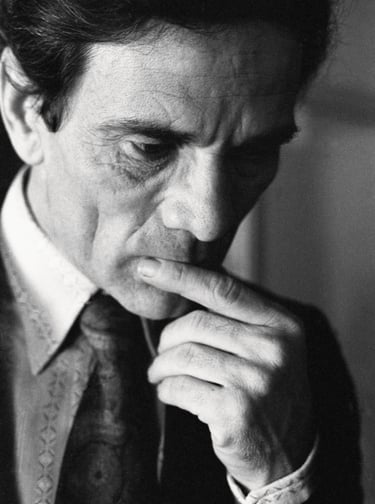
Fig. 2. Pier Paolo Pasolini. Archival portrait of the author and filmmaker. His theoretical and existential figure is invoked as a critical parallel against true crime biographical reductions and the spectacular mystifications of the genius's life.

Appendix: Historical & Theoretical References
1. Historical Accuracy & Theory: Loving Vincent
The Investigative Thesis (René Secrétan): While the film dramatizes René Secrétan as the potential shooter, this stems from the research of Pulitzer Prize-winning historians Steven Naifeh and Gregory White Smith in their 2011 biography, Van Gogh: The Life. Their proposal—that Vincent was accidentally shot by a local teenager he was protecting—is the technical foundation for the 'social assassination' theme.
The Protagonist’s Evolution (LovingVincent.com – The Armand Roulin Story): This resource details the choice of Armand Roulin as the «indifferent» observer who transitions from skepticism to being haunted by Vincent’s «mystery and magic»
.
2. The Pasolini Connection: La Macchinazione
The Witness (David Grieco): It is vital to note that director David Grieco was a close personal friend of Pasolini and among the first to arrive at the Idroscalo crime scene in 1975. His film, La Macchinazione [The Machination] (2016), is an adaptation of his own investigative journalism.
«Petrolio»: Grieco’s research links the assassination to the theft of the Salò film reels and Pasolini’s work on his unfinished novel Petrolio, which aimed to expose the systemic corruption within the Italian oil industry (ENI) and Eugenio Cefis.
Institutional Verification (Golden Globes – The Ploy [La Macchinazione]): This critique verifies the «alculated death» theory, framing Pasolini as a victim of combined political and financial powers.
3. Material & Institutional Sources: 'Yellow' vs. 'Black & White'
The 'Software' Origin (Vincent): Museum Folkwang, Essen. This institution houses the original 1888 portrait Armand Roulin (Portrait of Armand Roulin in the Yellow Jacket), which served as the primary aesthetic and narrative blueprint for the film’s investigation.
The 'Archive' Reality (Pasolini): Cineteca di Bologna – Centro Studi - Archivio Pier Paolo Pasolini. This is the official institutional home of Pasolini’s legacy. It represents the 'black & white' historical reality that stands in stark opposition to the sanitized or «beautifully painted» myths created by modern domesticators of art.
Editorial Note
These primary and institutional references provide the conceptual bridge between the two twin studies in this series. The technical failure of the electroacoustic framework examined in The Ghost in the Garden: An Electroacoustic Critique of Miami Beach SoundScape Park (Daniele, 2026) operates as a material echo of the historical and institutional failure to protect and listen to the authentic voices of the artists, as critiqued in this essay.
List of Figures and Sheets
Archival Photographs and Documentation
Fig. 1. Armand Roulin. Comparative study between the original painterly surface and the dynamic oil-painting interpolation for the film frame.
Fig. 2. Pier Paolo Pasolini. Archival portrait of the author and filmmaker. His theoretical and existential figure is invoked as a critical parallel against true crime biographical reductions and the spectacular mystifications of the genius's life.
Conceptual Overview Sheets
Technical-Parodic Overview Sheet. Synopsis and chart of production parameters, characters, and acoustic reception context.
Iconographic Credits and Source Notes
Fig. 1: Detail from the painting Portrait of Armand Roulin (1888, oil on canvas, Museum Folkwang, Essen) and promotional film frame from Loving Vincent (© 2017 BreakThru Productions / Trademark Films).
Fig. 2: Archival documentation / Public domain vintage photograph reproduced for purposes of critical analysis and scientific research.
Technical-Parodic Overview Sheet: Original analytical compilation by Romina Daniele & Jadys Daniele.
All archival documents and photographs are reproduced under scientific fair use and fair dealing provisions for musicological and film research.
Bibliography
1. Filmography and Audiovisual Works
Ferrara, Abel (Director) (2014). Pasolini [Film]. France/Italy: Capricci Films / Urania Pictures.
Grieco, David (Director) (2016). La Macchinazione (The Ploy) [Film]. Italy: Propaganda Italia / Toent Film.
Kobiela, Dorota, & Welchman, Hugh (Directors) (2017). Loving Vincent [Animated Film]. UK/Poland: BreakThru Productions / Trademark Films.
Minnelli, Vincente (Director) (1956). Lust for Life [Film]. USA: Metro-Goldwyn-Mayer.
Kobiela, Dorota, & Welchman, Hugh (2017), Loving Vincent: The Impossible Dream, UK/Poland, BreakThru Films / Trademark Films.
Welles, Orson (1941), Citizen Kane, USA, RKO Radio Pictures [35mm format, 1.37:1].
2. Film Theory, Criticism, Literature, and Epistolary Sources
Malausa, Vincent (2017). «Loving Vincent: Le faux tableau». Cahiers du Cinéma, no. 737, p. 52.
Masoni, Tullio (2017). «Loving Vincent: Il museo animato e i suoi limiti» [Loving Vincent: The Animated Museum and Its Limits]. Cineforum, vol. 57, no. 10, pp. 45–48.
Mintzer, Jordan (2017). «"Loving Vincent": Film Review | Annecy 2017». The Hollywood Reporter, June 13.
Mori, Masahiro (1970). «Bukimi no Tani» [The Uncanny Valley]. Energy, vol. 7, no. 4, pp. 33–35 [Eng. tr. «The Uncanny Valley», trans. Karl F. MacDorman & Norri Kageki, IEEE Robotics & Automation Magazine, vol. 19, no. 2, 2012, pp. 98–100].
Naifeh, Steven, & Smith, Gregory White (2011). Van Gogh: The Life. New York: Random House [It. tr. Van Gogh. La vita, Milan: Bompiani, 2013].
Pasolini, Pier Paolo (1992). Petrolio. Turin: Einaudi [Eng. tr. Petrolio, trans. Ann Goldstein, New York: Pantheon Books, 1997].
Rossi, Giancarlo (2017). «La pittura congelata: "Loving Vincent" e il paradosso del rotoscopio» [Frozen Painting: "Loving Vincent" and the Paradox of Rotoscoping]. Lo Sguardo Blanco, October 18.
Scott, Anthony Oliver (2017). «Review: "Loving Vincent" Animates van Gogh’s Works. But to What End?». The New York Times, September 21.
Van Gogh, Vincent (1889, July). Letter 641 to Theo van Gogh, Saint-Rémy-de-Provence. Amsterdam: Van Gogh Museum Letters Database (Online edition: vangoghletters.org/vg/letters/let641/letter.html) [Eng. tr. in Jansen, L., Luijten, H., & Bakker, N. (Eds.), Vincent van Gogh – The Letters: The Complete Illustrated and Annotated Edition (6 vols.), London: Thames & Hudson / Van Gogh Museum, 2009].
3. Discography and Film Scores
Mansell, Clint (2017). Loving Vincent (Original Motion Picture Soundtrack) [Album]. Los Angeles: Milan Records.
McLean, Don (1971). «Vincent (Starry Starry Night)». On American Pie [LP]. Los Angeles: United Artists Records.
4. Museum Collections, Archives, and Institutional Resources
Cineteca di Bologna (n.d.). Centro Studi - Archivio Pier Paolo Pasolini. Bologna: Cineteca di Bologna. Available at: https://cinetecadibologna.it
LovingVincent.com (2017), Official Production Documentation, Painter’s Process & Cast Notes, BreakThru Films / Trademark Films.
Museum Folkwang (1888). Portrait of Armand Roulin (Portrait of Armand Roulin in the Yellow Jacket) [Oil on canvas painting by Vincent van Gogh]. Essen: Museum Folkwang. Available at: https://www.museum-folkwang.de
Van Gogh Museum (n.d.). Official Collection and Research on Vincent van Gogh's Death. Amsterdam: Van Gogh Museum. Available at: https://www.vangoghmuseum.nl
5. Journal Publications (ElectroAcoustics Magazine)
Daniele, Romina (2026). The Ghost in the Garden: An Electroacoustic Critique of Miami Beach SoundScape Park. ElectroAcoustics Magazine, Series 2026, Art. 2026.03.en. DOI: eam.2026.03.en. Available at: https://rdmrecords.com/the-ghost-in-the-garden
How to Cite this Essay
APA 7th Edition: Daniele, Romina, & Daniele, Romina Jadys (2026). Film Analysis: The Digital Cadaver — A Critique of Loving Vincent. ElectroAcoustics Magazine, 2026 Series, Art. 2026.02.en. (Selected for Arts & Technologies Print Edition). DOI: Pre-assigned (eam.2026.02.en). Available at: https://rdmrecords.com/film-analysis-the-digital-cadaver
RDM RECORDS IS A FLORIDA-REGISTERED DBA OF ROMINA DANIELE, OPERATING AS A RECORD LABEL AND BOOK PUBLISHER FOR RDM ROMINA DANIELE MUSIC, A BMI-AFFILIATED MUSIC PUBLISHER.
[CATALOG] — [ABOUT] — [PRESS] — [CONTACT]
TERMS & POLICIES: © 2010–2026 RDM RECORDS. ALL RIGHTS RESERVED.
ALL TEXTUAL, MUSICOLOGICAL, AND AUDIO CONTENT IS PROTECTED UNDER INTERNATIONAL INTELLECTUAL PROPERTY LAWS. DATA SUBMITTED VIA OUR PORTALS IS PROCESSED STRICTLY FOR INTERNAL INSTITUTIONAL COMMUNICATION.THIS INDEPENDENT INSTITUTIONAL LABEL IS DEDICATED TO PURE PHENOMENOLOGICAL, VOCAL, AND SONIC RESEARCH, AND MAINTAINS A STRICT POLICY OF COMPLETE DETACHMENT FROM ALL FORMS OF BLASPHEMY, EXPLICIT THEMES, OR PROFANE PERFORMANCES, SYSTEMATICALLY EXCLUDING THEM FROM ITS CATALOG AND SCOPE.

Get in touch