
The Ghost in the Garden: An Electroacoustic Critique of the Miami Beach SoundScape Park
Welcome to a fragment of «media archaeology». From the perception of an elusive presence in the Miami Beach SoundScape Park to the chronicle of one listening experience and a thousand possible listenings: the account of a monumental architecture of sound confronting its own ghost, where the power of technology refuses to transcend the worldly fragility of sense.
ELECTROACOUSTICS MAGAZINE ARTICLES2026 SERIESSOUND RESEARCHFILM THEORY & AUDIO-VISUAL MEDIA
Romina Daniele
4/29/202656 min read
Online Journal Title: ElectroAcoustics Magazine
Print Series Destination: Arts & Technologies (Annual Print Selection)
Classification / Category: 2026 Official Series · Sound Research & Film Theory / Theoretical-Critical Essay
Article Identifier: Art. 2026.03.en
Publishing Model: Continuous Digital Publication · Peer-Review Selected for Print
Issue #01 «Electroacustic Imperative»
Indexing & Registrations
ISSN (Online): Application in Progress
ISBN (Print): Reserved for Arts & Technologies 2027
DOI: Pre-assigned (eam.2026.03.en)
Publication Date: April 29, 2026
Editorial and Typographical Note: To bridge European philosophical traditions with international indexing standards in bilingual contexts, Arts & Technologies / ElectroAcoustics Magazine utilizes a hybrid APA 7/Chicago Notes citation framework embedded seamlessly within footnotes. Rather than using parenthetical in-text citations, each footnote pairs the original work's chronological origin with complete translation and pagination metadata [e.g., Metz, C. (1991), ... [Eng. tr. ..., p. XX]]. Readers will also note our signature European typographic hierarchy: guillemets («...») designate core theoretical concepts and primary quotes, double quotation marks ("...") mark nested citations, and single quotes ('...') frame metaphors or scare quotes, with foreign terms uniformly italicized.
A shadow zone opens between the acoustic sculpture of the urban landscape and the total apparatus of cinema. This essay goes beyond the analysis of a single projected event — a specific viewing of Loving Vincent (Kobiela & Welchman, 2017) at the Miami Beach SoundScape Park on April 22, 2026 [1] — to explore the threshold where technological infrastructure fails not through a mechanical breakdown, but through a suspension of the thought that inhabits it. Through the empirical experience of the Miami Beach SoundScape Park, electroacoustic critique transforms here into an archaeology of the perceptible: an inquiry into the boundary between the vibrant space of the city, the cinematic apparatus, and the sonic ghost haunting a silenced and unfulfilled garden of metal.
Annotated Index & Reading Guide
A concise contextualization of the April 22, 2026 event (the screening of Loving Vincent at SoundScape Park) as a case study on the rift between monumental high-fidelity electroacoustic infrastructure and its functional reductivism in public outdoor screenings serves as an opening to the critical development paragraphs:
I. The Electroacoustic Infrastructure of SoundScape Park. Architectural-acoustic genesis of the project by Frank Gehry and Yasuhisa Toyota designed to overcome the rigidity of the traditional concert hall; analysis of the 72-channel hardware and over 160 loudspeakers (elevated Ballet Bars structures and ground-level Media Hydrants emitters); operational mechanics of the Meyer Sound Constellation active acoustic architecture for WALLCAST events, and the onset of spatial coherence loss in «Cinema Bypass» mode during the Cinema Series.
II. Theoretical Genealogies: The North American Model and European Tradition. Comparative historiographical examination between the European tradition of the Acusmonium (François Bayle, GRM, Eraldo Bocca with SATOR and AUDIOR) based on live manual performance and the «grain» of the loudspeakers, and the North American soundscape model (Raymond Murray Schafer, Alvin Lucier, Maryanne Amacher, Bill Fontana) grounded in acoustic sculpture and pervasive urban infrastructure.
III. Operational Criticalities of the Cinema Series: The Epurated Sound. Analysis of Bill Fontana’s installation Sonic Dreamscapes (2018–2020) as the highest expressive vocation of the system; the 2020 pandemic suspension and the daytime mode featuring the Northern Mockingbird; technical decrease in Safe Mode during the Cinema Series; onset of «comb filtering», the phenomenon of «crossover bleed» with urban background noise, and the genesis of the «ghost soundtrack».
IV. The Aesthetic-Technological Fracture: Between Cinema and Electroacoustic Apparatus. An examination of the conceptual paradox between ordinary, recreational outdoor viewing and the nature of cinema as a total and aesthetic-technological apparatus; the «electroacoustic imperative» as an epistemological nexus of the work of art; a comparison with models of listening and spatial immersion in the United States (Sphere Immersive Sound in Las Vegas, Dolby Atmos Cinema, Envelop SF).
V. Empirical Analysis and Field Findings. Field recordings from three pivotal moments: the biophonic integration of Sonic Dreamscapes (August 18, 2020); the immersive gold standard utilizing VBAP techniques during the Dvořák concert (November 15, 2025); the acoustic collapse, phase cancellation, and the «audibility gap» recorded during the screening of Loving Vincent (April 22, 2026).
Notes to the Text. Includes contextualization and background notes: references to the twin study on Loving Vincent and the institutional framework of the Cinema Series. Historical and architectural-acoustics notes: utopian roots of the New World Center (Gehry, Toyota, Bauhaus, Walter Gropius, Iannis Xenakis); urban antecedents and North American precedents (Max Neuhaus, Jay Pritzker Pavilion, EMPAC); and an in-depth focus on the 2018–2020 iterations of Bill Fontana’s Sonic Dreamscapes. Technical-electroacoustic notes: specifications of Meyer Sound, D-Mitri matrix, Constellation system, and a comparative table of spatialization models (Acusmonium and SoundScape Park); cinematic physical-acoustics, ISO 2969 X-curve, «comb filtering», 72-channel decoding, and the Haas effect.
Critical Apparatus. Includes the descriptive media index and credits: frames hardware figures (Ballet Bars, «crossover bleed», and «audibility gap»), the audio-video archive of field recordings (Fontana 2020, Antonin Dvořák 2025, Loving Vincent 2026), attributions to the Daniele Archive / RDM Records, and the scholarly Fair Use notice. Includes the annotated bibliography, structured into five thematic sections (1. Electroacoustics, Phase Control, and DSP Architectures; 2. Soundscape Studies, Acoustic Ecology, and Urban Sound Art; 3. Architectural Acoustics, Open Spaces, and Spatialization Theories; 4. Film Theories, Audio Reproduction, Philosophy, and Media Semiotics; 5. Institutional Documentation, Reports, Primary Sources, and Case Studies) and the filmography.
The Ghost in the Garden: An Electroacoustic Critique of the Miami Beach SoundScape Park
Editorial Note. The initial draft of this essay was finalized for publication on April 30, 2026. Its critical, informational, and bibliographical apparatus was subsequently expanded and finalized on September 1, 2026, in view of its definitive editorial layout and scheduled print publication.


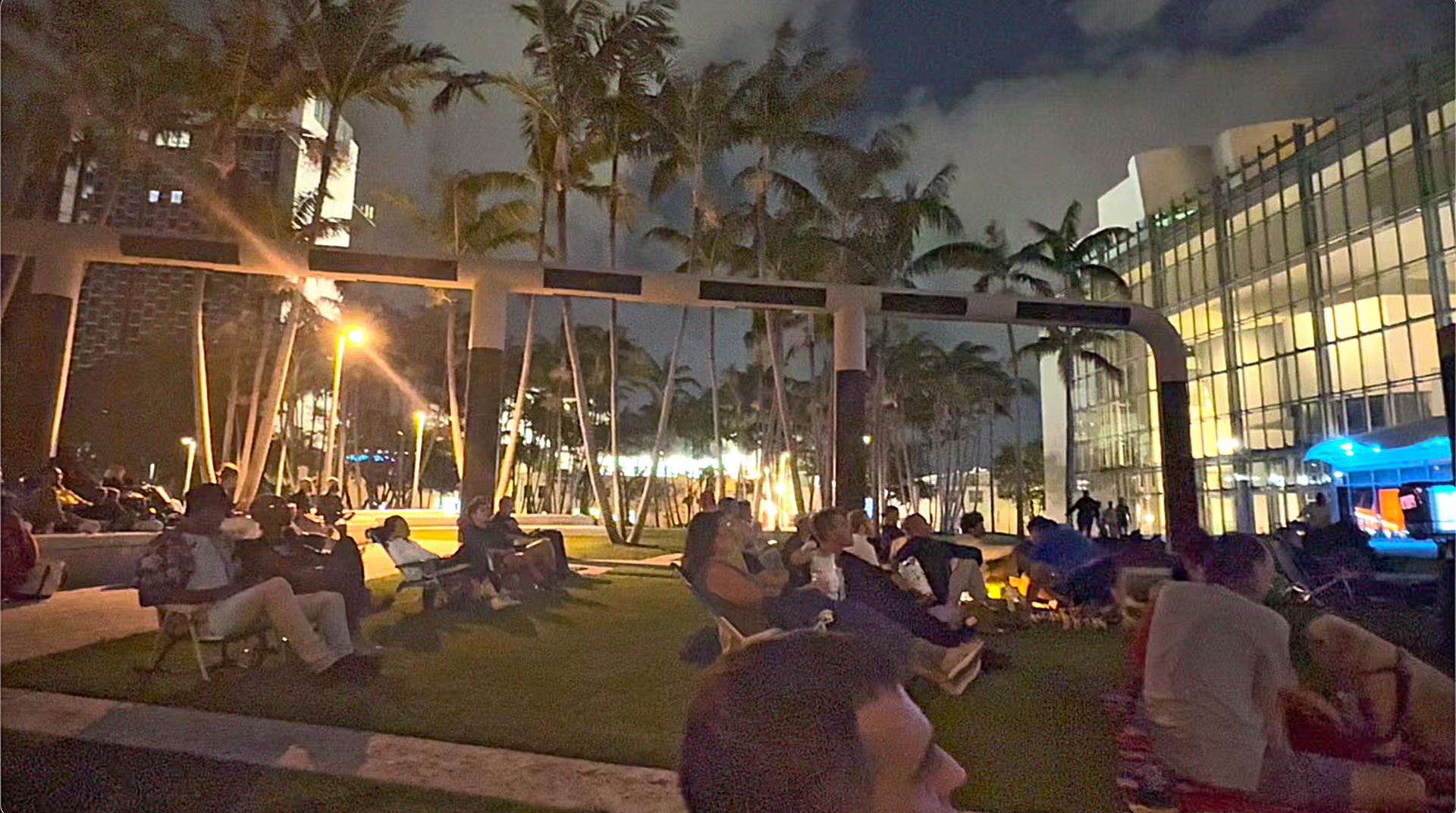
Fig. 1 — Night view of the Miami Beach SoundScape Park. In the foreground on the right, one of the steel pylons of the Ballet Barshousing the suspended Meyer Sound loudspeakers; on the left, the projection wall of the New World Center with the base acoustic bunkers.
I. The Electroacoustic Infrastructure of SoundScape Park
The SoundScape Park in Miami Beach was created as an architectural-acoustic extension of the New World Center — designed by Frank Gehry with the theoretical intent of dismantling the rigidity of the traditional concert hall through a structural continuity between internal and external space [2] —, with the objective of overcoming the two-dimensionality and spectral thinness of conventional outdoor systems, replacing them with a 360-degree immersive sound field. The infrastructure features a 72-channel instrument and over 160 Meyer Sound loudspeakers integrated into the landscape via the suspended array of the Ballet Bars (the vertical white structures) and the capillary network of Media Hydrants (ground-level proximity emitters, Fig. 1) [3].
Inaugurated in January 2011 with a major public event that attracted the attention of the international press and industry critics — celebrated on the cover of «Landscape Architecture Magazine» for its urban design and in reviews by «The New York Times» as an unprecedented invention of acoustic urbanism —, the park was conceived from the outset as an open-air community listening arena. The synergy between the internal hall and the outdoor infrastructure made it possible to «democratize» the experience of great symphonic music through high-definition «WALLCAST» projections, extending musical enjoyment far beyond the traditional auditorium audience [4].
Designed primarily for the enjoyment of «WALLCAST» concerts, the park utilizes the Meyer Sound Constellation active acoustic architecture system [5] in order to 'virtually translate' the perimetric boundaries of the concert hall into the open space. While during the standard delivery of «WALLCAST» broadcasts dedicated to the flagship productions of the New World Symphony engineers activate the presets of the Constellation algorithm — configurations meticulously calibrated to simulate the reflections and impulse response of an enclosed environment, preventing phase cancellation phenomena —, during the Cinema Series [6] and conventional film playback, the system defaults to «Cinema Bypass» mode [7] or a simplified 'stereo distribution' [8]. In the absence of specific electroacoustic expertise in the control room, the audio signal is frequently routed 'in parallel' across all physical zones of the park. Deprived of the supervision of the Constellation algorithm — tasked with the dynamic management of phase delays (delay time) and the temporal alignment of the entire array of over 160 loudspeakers —, the environment forfeits its nature as a SoundScape to regress into a mere high-density diffusion system lacking spatial coherence, wherein the listener perceives a chaotic and muddled overlap of the identical signal.
II. Theoretical Lineages: The North American Model and the European Tradition
From a theoretical and historiographical perspective, the design of SoundScape Park belongs to the North American matrix of the «soundscape» [9] and of permanent immersive infrastructure, wherein acoustic architecture merges with the urban environment to transform public space into a site-specific resonance field. This is fundamentally distinct from the European tradition of the Acousmonium (from Schaeffer and Bayle through to Eraldo Bocca’s research with SATOR and AUDIOR). Created in 1974 by François Bayle as a «loudspeaker orchestra», the Acousmonium evolved through specific and pivotal theoretical and structural milestones [10]. In this context, sound projection functions as a true «second-degree writing» and a live interpretation grounded in the manual modulation of registers and the «grain» of individual loudspeakers. Here, the figure of the performer is indispensable: through spatial control at the console, the performer projects and sculpts the phono-fixed material, turning loudspeakers into differentiated, dynamic sound sources capable of articulating the signal with precise timbral and spatial calibration.
In the American context, space is not 'interpreted live' as an open text; rather, it is engineered as an 'acoustic sculpture' integrated into the architecture, wherein technological infrastructure serves to redefine the perception of the urban ecosystem. In the Acousmonium, spatial control operates as a live compositional-performative interpretation of a phono-fixed page: the performer (the «acousmate») acts on the faders in real time to «play» space as an instrument, dynamically selecting the timbral options of the various loudspeakers. In SoundScape Park, spatial control using dedicated consoles and control systems [11] performs instead a function of real-time spatialization and acoustic-environmental compensation engineering for the live concert, designed to translate the dynamic range and impulse response of the indoor concert hall into the open-air space.
Alongside this primary symphonic-concert function, the system fulfills a second structural role tied to urban and environmental «sound art». In this dimension, the immersive infrastructure connects to R. Murray Schafer’s urban soundscape and to experiments in permanent, site-specific spatial installation (within a specific trajectory featuring Alvin Lucier, Maryanne Amacher, and Bill Fontana). Environmental «sound art» is not, however, mere signal diffusion, but a sort of anatomy of space: it engages the symphonic and polymorphic function of an intricate constellation of loudspeakers and signal nodes to make the system an 'active', resonant filter, wherein the urban acoustic landscape liquefies into a living web of psychoacoustic phenomena and environmental perception [12].
Compared to historical North American precedents in urban sound art and synthetic diffusion — which were historically confined to temporary gallery settings, academia, or pure summer spectacle —, SoundScape Park stands out for an obvious structural singularity. It represents the sole large-scale, permanent civic-institutional infrastructure in which active acoustic compensation technology is transformed into a constitutive element of contemporary urbanism, daily extending the experience of the grand symphonic hall into public urban space [13].
The anomaly of SoundScape Park occurs when a system built for this complex, immersive architectural vocation is reduced to a simple, flat 'PA system' for commercial or entertainment film screenings.
III. Operational Criticalities of the Cinema Series: The Epurated Sound
The actual operational efficacy of this concept was empirically evaluated on August 17, 2020, during the public reception of Bill Fontana’s permanent sound installation Sonic Dreamscapes [14]. Utilizing hydrophones and piezoelectric vibration transducers, Fontana captured the inaudible frequencies and internal resonances of Miami Beach’s urban infrastructure (hydraulic pumping systems, avian micro-fauna, coastal hydrodynamics), re-articulating them within the park into a high-spectral-definition «sound choreography». Although to a casual and disinterested public—detached from the logic of structured electronic music—this intervention might have appeared as an 'extemporaneous' acoustic decor or a high-tech charm operation for tourist consumption, the installation nevertheless documented the system’s utmost expressive vocation. On the other hand, if Sonic Dreamscapes represents the permanent software asset of the venue, August 2020 constituted a privileged «threshold» juncture for site analysis: the suspension of activities due to pandemic lockdowns temporarily removed the park from the logic of the mass event, restoring it to its original identity as an acoustic sculpture.
During that summer, Fontana indeed launched a specific 2020 iteration of his research entitled Sonic Dreamscapes 2020 [15]. The project was grounded in a meditation on the «quality of timelessness» and the disruption of ordinary reality during the crisis. The «random contemporary sounds» experienced in the late afternoon, around 7:00 PM, constituted the system’s daytime mode. This mode employs the calls of the Northern Mockingbird (Mimus polyglottos) together with hydrophonic recordings (underwater sounds from the bay) to structure a sculptural environment. The acoustic condition revealed itself as uniquely singular and responsive. Because the city was quieter in August 2020, Sonic Dreamscapes operated with greater expressive efficacy as an installation than in its current setup, allowing the listener to perceive the 'unbounded space' of the park in the absence of the dense ambient noise floor typical of Miami Beach tourism.
SoundScape Park is a masterpiece of hardware that frequently translates into a failure of software. Although its infrastructure (boasting over 160 Meyer Sound loudspeakers) is engineered to fascinate as a daytime 'sound sculpture' breathing alongside the city, the system is in fact rarely active. Such a condition of full operational capability—which we had the privilege to experience, notably during the 2020 iteration of Bill Fontana’s Sonic Dreamscapes—remains exceedingly rare, and its absence during the Cinema Series reveals a profound institutional gap. In this technical reality, the 'full resources' of the loudspeaker array are relegated to a seasonal or event-bound tool. In terms of operational practice and real usage frequency, SoundScape Park’s ten-million-dollar-plus infrastructure lies for the vast majority of the time in a state of 'acoustic dormancy'. The full-scale activation of the electroacoustic architecture — via the Meyer Sound Constellation algorithm, 3D spatialization through Vector Based Amplitude Panning (VBAP), and the dynamic deployment of the Media Hydrants — constitutes a narrow exception restricted almost exclusively to the New World Symphony’s «WALLCAST» Concerts season (approximately 7 dates per season compared to over 30 screenings for the Cinema Series [16]), sound art commissions for major institutions, or special projects presented during selected editions of the contemporary art fair Art Basel Miami Beach [17]. This fair takes place annually in early December at the adjacent Miami Beach Convention Center. During Art Basel, SoundScape Park is occasionally transformed into the centerpiece for Public Art and Sound Art Programming. Beyond Bill Fontana’s fundamental Sonic Dreamscapes installation (in its 2018–2020 iterations), the park has expressed its three-dimensional phonic matrix on only a few select occasions. These include commissions under the City of Miami Beach’s Art in Public Places program, curatorial programming led by David Gryn (founder of Daata Editions and curator of the Film & Sound sector for Art Basel Miami Beach from 2011 to 2019) [18], and the video art project DAATA X THE BASS: Voluntary Associations (December 4–6, 2020) [19].
As anticipated, the system's peak performance resides in the «WALLCAST» Special Live Simulations—live-to-park multimedia performances and productions in which the orchestra performs the repertoire live inside the auditorium of the New World Center, while the audio direction applies active three-dimensional spatialization, real-time wind compensation, and the Vector Based Amplitude Panning (VBAP) technique for outdoor diffusion. Specifically, VBAP is a psychoacoustic positioning algorithm that calculates and distributes amplitude gains across adjacent triplets of loudspeakers—in a three-dimensional configuration between elevated Ballet Bars and ground-level Media Hydrants—allowing a sound source to be 'anchored' and virtually panned with extreme sharpness. This architecture emerged in an emblematic manner during the simultaneous live-to-park projection and diffusion of symphonic performances by Antonín Dvořák [20]. Within this framework of institutional management, the key figure and true 'insider' guiding the sound operations is Roberto Toledo, Director of Audio Services for the New World Center and the New World Symphony, who manages the audio direction and transmission protocols of the park operating via DiGiCo Quantum consoles alongside Meyer D-Mitri and NADIA processing matrices [21].
Outside these narrow temporal windows and special events entrusted exclusively to expert audio engineering, the most frequent mode through which the public interacts with the installation is the weekly Cinema Series screening (every Wednesday from October to May). In these ordinary cinematic contexts, the system is systematically downgraded to «Cinema Bypass» or a 'lazy', uncalibrated stereophonic Safe Mode, leaving over 80% of the 167 loudspeakers inactive or phase-incoherent [22], and confining the extraordinary potential of the sound sculpture to a marginal fraction (estimated between 10% and 15%) of total programming hours. The result is an institutional and urban paradox: world-renowned acoustic engineers—from Yasuhisa Toyota to Bryan A. Edens's integration team and Roberto Toledo’s in-house crew—devote millimeter-precise calibration protocols (culminating in the upgrade to NADIA processors in February 2026) to adapt the 167-speaker matrix to the micro-climatic variations of the Miami Beach coast; yet, this precision engineering remains completely silenced for over 80% of public viewings, where the urban infrastructure is reduced to an elementary drive-in projector with stripped-down stereo audio.
When an infrastructure boasting an array of 167 loudspeakers operates in Safe Mode during the Cinema Series—whose eleventh season restarted in autumn 2020 with lawn social-distancing circles—it exposes the operational laziness of the setup, caused by the lack of adequate delay compensation and the refusal to employ the system's spatial capabilities. The audio mixing restricts itself to using the elevated Ballet Bars for front-channel delivery, leaving the Media Hydrants at ground level substantially underutilized. Under this setup, acoustic «crossover bleed» and a profound antagonism between hardware and software emerge. Urban ambient noise and audience clutter—the micro-environment of picnic blankets and lawn chairs (Fig. 2, Fig. 3)—bleed into the listening field because the film’s audio signal is treated as a «secondary transmission» rather than a «primary acoustic event», in keeping with an advanced audiovisual conception. While Bill Fontana’s Sonic Dreamscapes installation is designed to stretch the Meyer Sound electroacoustic architecture to its maximum dynamic and spatial capacity [23], cinematic projection treats sound as functional background noise, failing to activate the very capillary diffusion system that defines the site's spatial identity.
The problem with this deployment is intrinsically functional. The majority of screened films are mixed in conventional stereo or 5.1 formats [24]. Merely routing such a signal across an array of 167 speakers without a dedicated decoding and spatialization algorithm inevitably generates «comb filtering» phase cancellation and degrades speech intelligibility [25]. To bypass these issues without calibrating an ad hoc mix, production teams default to conservative routing aimed solely at the main front speakers, converting 80% of the park's footprint into an 'acoustically dead zone'. Nevertheless, even without a native immersive multichannel mix (Atmos or Ambisonics), proper electroacoustic practice would dictate psychoacoustic upmixing techniques and reasoned signal distribution across all 72 individual processing channels [26]. In a facility equipped with a D-Mitri matrix like SoundScape Park, correct execution would entail routing ambient components, Foley, and original score to the rear Ballet Bars and perimeter Media Hydrants via rigorous delay compensation algorithms, guaranteeing that dialogue localization remains strictly locked to the front screen. Taking the shortcut—sending a simple L/R stereo feed exclusively to the front section—prevents echo-like phase delays (the Haas effect) [27], but surrenders spatial control.
Examining the critical analysis of Loving Vincent [28] from an electroacoustic perspective, this methodological failure—which generates the «audibility gap» and «urban crossover» of the surrounding ecosystem—acted as a secondary layer of failure for the film (and for cinema screenings in general within the Cinema Series): the 'unresolved space' of a genius like Van Gogh is bent and distorted when technology, meant to amplify its light, creates instead a hollow, phase-cancelled vacuum, thereby producing a «ghost soundtrack»; meanwhile, the previously noted aesthetic-linguistic deficiencies of the music score [29] correspond to an audio stream that is physically present, yet entirely incapable of 'possessing' and shaping the architectural space of the park.
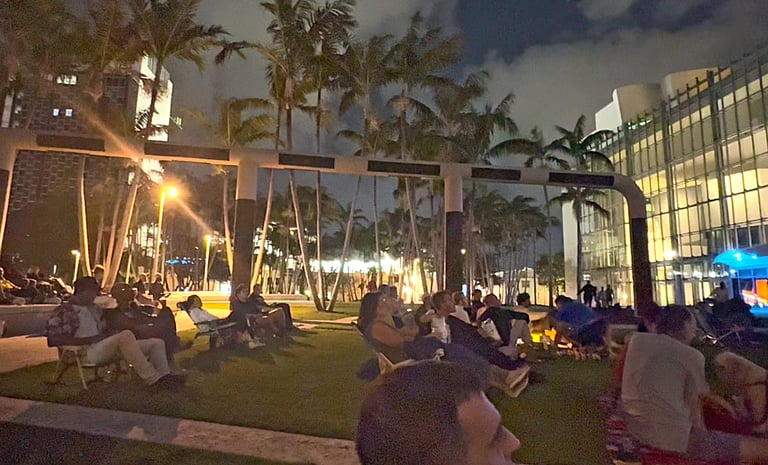
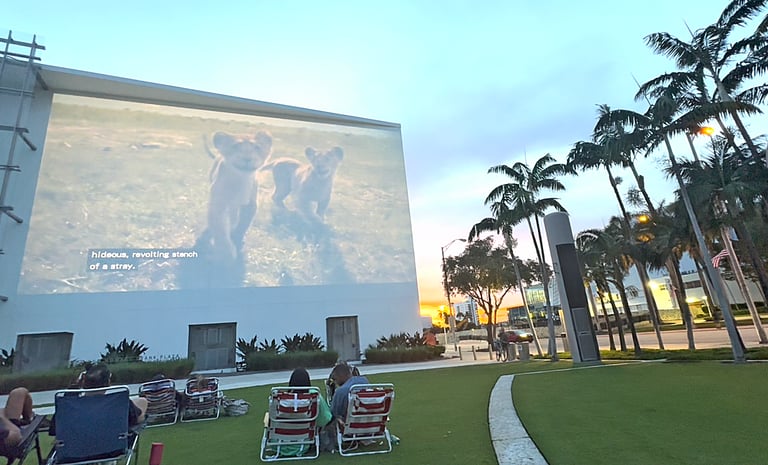
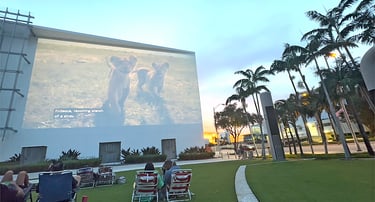
Fig. 2 — A view of the park's lateral perimeter and the surrounding urban ecosystem. The perspective highlights the arrangement of the audience in the green area and the presence of the Media Hydrants (the cylindrical proximity emitters), positioned directly in the lawn along the perimeter of the amphitheater.
Fig. 3 — Informal seating arrangement of the outdoor audience during a screening of the Cinema Series. Frontal view of the large 650 m2 projection wall, showing the layout of spectators on the lawn and the perimeter framing of the Ballet Bars and palm trees on the right.
IV. The Aesthetic-Technological Fracture: Between Cinema and the Electroacoustic Apparatus
It should be clarified that we are not suggesting here that the underutilization of the system during the Cinema Series is a mere logistical issue or a technical accident, but rather the symptom of a cultural and conceptual fracture. Outdoor film viewing is indeed framed through the Anglo-American perspective of community entertainment (drive-ins, recreational pop events, «picnic screenings»), wherein sound is reduced to a mere stereophonic «utility broadcast», downgraded to a simple intelligible component for passive consumption and managed for the sole purpose of minimizing technical complications.
Yet, this approach gives rise to at least two pervasive criticalities. In the first place, such outdoor cinema is hosted and conducted within a park that boasts one of the most advanced sound architectures in the world—whose technical details have been extensively described thus far—which inevitably suffers from non-use or an overt deficiency the moment it is paired with cinematic projection. Secondly and consequently, it is necessary to precisely frame the very nature of the cinematic apparatus. As a total apparatus and the privileged matrix in which all forms of expression converge and redefine themselves, cinema represents the historical-critical juncture at which the work of art definitively emancipates itself this side of traditional categories and genres of artistic practice: within a centuries-long continuity that intertwines reproducibility, ontological presence, poetic semiotics, linguistic deconstruction, and the philosophy of the image, cinema has established itself as the aesthetic-technological and historical-polyphonic art par excellence, capable of absorbing and transfiguring every preceding, present, or yet-undefined paradigm. If cinema has established itself as the privileged apparatus for a redefinition and re-origination of the work of art and its modes of generating signification within a transdisciplinary framework, this side of rigid disciplines and conceptual boundaries, the «electroacoustic imperative» constitutes the contemporary epistemological juncture of this reticular openness. To recognize the historical-artistic and aesthetic value of technological practice means understanding that sound and the audiovisual are not simple surface languages, but the very root of thought; within this transversal space, electroacoustic technology asserts itself not as a mere instrument of reproduction, but as the formal, processual, and ontological architecture of signification and infinite possible worlds [30].
From this perspective, sound in cinema is not a secondary accessory—not even when cinema is projected outdoors, and all the more so if diffusion occurs through one of the most advanced systems in the world—but rather a dimension that determines the signification of the event, contributing to the efficacy of the apparatus under every profile and, naturally, at the level of perception and the ontological resonance of space. When an installation of SoundScape Park's caliber applies its vast potential to cinematic sound reproduction, justice will be done not only to cinema and its acoustic dimension, but to the system itself, whose characteristics are the fruit of historical-aesthetic trajectories evolved through decades of sound art as much as pure algorithms. Dignity will thus be restored to its epistemological essence, strictly tied to the forms of awareness that, within technological art, only the theories and historical-artistic developments of cinema could have determined.
We are therefore not denying the excellence of North American audio engineering or the great tradition of cinematic sound design, nor the contribution of the great masters who have shaped the history of cinema worldwide, but rather highlighting the paradox between an extraordinary technological infrastructure and the absence of its actual deployment toward a genuine epistemological advancement of the arts. SoundScape Park in Miami Beach already possesses—permanently—an array of speakers and spatial processors (Meyer Sound Constellation / SpaceMap) comparable to, or even exceeding, that of many research centers and experimental events. The system is fully capable of decoding spatial Dolby Atmos tracks or performing real-time psychoacoustic upmixing for outdoor cinema.
To understand why this represents a missed opportunity in Miami, it suffices to observe how spatialized sound in cinema is instead deployed in other major U.S. contexts, such as the Sphere Immersive Sound in Las Vegas and New York, 3D object-based audio systems in Los Angeles, or the immersive experience of Envelop in San Francisco [31], where the visual and acoustic complexities of prominent contemporary filmmakers such as Alfonso Cuarón, Darren Aronofsky, Christopher Nolan, and Denis Villeneuve have been spatialized, demonstrating that sound in cinema—even at the level of contemporary awareness and not merely historical-critical understanding—has become a fundamental architectural, dramaturgical, and cognitive structure. The use of three-dimensional sound spatialization and the conception of sound as architectural material have featured filmmakers and major production projects collaborating directly with sound engineers to shape works specifically conceived for these vast contexts and audio architectures [32].
The absence from program lineups of masterpieces with complex phonic architectures—such as the works of David Lynch or Andrei Tarkovsky—utilizing the aforementioned North American immersive technologies responds only in minimal part to the sheer technical difficulty of managing the multidimensional reticle of their audio tracks. Ultimately, it reflects the broader hermeneutic and formal «difficulty» of such works, within which the ultra-avant-garde treatment of sound is situated in a structural and indissociable manner [33].
However, the hypothesis of full activation for SoundScape Park's 167 loudspeakers does not presuppose an exclusive or necessary application reserved for experimental or avant-garde cinema. On the contrary, the spatial vocation of the system would find immediate and effective justification even in mainstream or animated cinema (from Disney productions to major saga cinema such as Star Wars), whose soundtracks are inherently born with layers of Foley, ambient effects, and orchestral scores designed to envelop the viewer. Such an operational decision aligns seamlessly with the founding mission of these parks: to extend the engagement with the work of art to the community without the economic barrier of expensive indoor theater tickets, while simultaneously elevating the level of the collective audiovisual experience across any genre or category of cinematic product.
The critical issue of the Cinema Series therefore does not reside in the selection of programmed titles, but in the a priori refusal to distribute the signal across the park's entire acoustic surface, choosing instead to restrict projection to a simple L/R stereo front, thereby relinquishing the opportunity to transform public outdoor viewing into a genuine aesthetic-technological experience.
V. Empirical Analysis and On-Site Findings
The empirical analysis conducted on-site through direct acoustic recordings and evaluations clearly illustrates the gap between the structure’s potential and its operational criticalities. During the acquisition on August 18, 2020 (at approximately 6:47 PM), focused on Bill Fontana’s sound installation Sonic Dreamscapes (Video 1), the park demonstrates an intrinsic alignment between hardware architecture and software control. In the multilayered soundscape generated by the work of art, the synthetic textures of the hydrophone-derived drones merge with the organic emissions of the Northern Mockingbird (Mimus polyglottos). The Meyer Sound D-Mitri platform actively manages the 360-degree field, eliminating phase cancellation issues and imparting a clear three-dimensional depth to the sound. The integration is such that the high frequencies projected by the system are nearly indistinguishable from the actual bird calls among the palm trees, while the voices of passersby and children in the foreground coexist with the acoustic flow without conflicting overlap. Unlike conventional cinematic projections, the audio possesses a material friction and occupies the space organically: the Constellation system calculates the park’s reflections in real time, recreating a true virtual room capable of supporting and unifying the sonic message.
The performance «gold standard» of the New World Center was further documented during the performance of Antonín Dvořák’s concerto [34] on November 15, 2025 (Video 2). On this occasion, the system expressed its «true form» through a fully spatialized and immersive 3D sound, governed by complex algorithms capable of compensating for wind action and urban background noise. Visual and acoustic observation of the Media Hydrants — the gray cylindrical bollards distributed across the lawn — revealed their function as surround and ambient channels: through calibrated digital delays, they diffused the reverberant tail and acoustic 'bloom' typical of the internal auditorium. Concurrently, the suspended Ballet Bars ensured correct source localization via Vector Based Amplitude Panning (VBAP) technique, projecting the sound in precise alignment with the musician’s image on the large projection wall. In the concrete bunkers located at the base of the wall, the subwoofers vigorously restored the low-frequency resonance of cellos and timpani, testifying to hardware pushed to the maximum of its potential (whereas, in ordinary film screenings, these units often remain underutilized or entirely deactivated).
Conversely, the empirical analysis of the screening of Loving Vincent, recorded on April 22, 2026 (Video 3), provides clear evidence of the structural failure of the «Cinema Bypass» mode. In this context, the «audibility gap» emerges with stark clarity: despite a potential array of over 160 active loudspeakers, the acoustic signal appears flat and chromatically impoverished, remaining rigidly crushed against the front wall without any spatial expansion. The absence of a dedicated sound field managed by the Media Hydrants forces the soundtrack to compete directly with «urban crossover» (the ambient noise of the city), whose decibel sound pressure matches that of the dialogue. The lack of necessary phase corrections creates a hollow acoustic vacuum, transforming what should be high-fidelity sound into an overstretched stereo signal marked by obvious «comb filtering» phenomena. The technology designed to enhance the work of art ultimately dematerializes it, originating a true «ghost soundtrack»; the aesthetic and theoretical implications of this dematerialization of the artist’s voice are critically discussed within the critical analysis [35].
In this unconditional surrender to minimal technical effort, the park’s imposing steel scaffold ceases to be a resonant architecture and becomes a cage. Enormous machines of silent metal objectify the sound, reducing it to identical tracks or summing channels in parallel, incapable even of rendering the basic original stereophonic spatiality of the film. The signal is thus brutally flattened against the front wall alone: over one hundred and sixty loudspeakers — a phonic cathedral among the most advanced in the world — confine a depleted, crushed, and absent sound. While the mechanical actors of this monumental machine lie inert or degraded to mere proximity amplifiers — this side of the undeniable, ideological, and technical-aesthetic greatness of its creators —, the audiospectator finds themselves trapped in a cage of threatening and unnatural silence. It is an absence that transforms the promise of an unprecedented experience of acoustic envelopment and pure immersion into the metallic presence of an inert prison, foreign to living matter.
Video 1 — Empirical analysis of Bill Fontana’s sound installation Sonic Dreamscapes (August 18, 2020). Documentation of the ideal alignment between Meyer Sound hardware and the Constellation algorithm: hydrophone drones and the song of the Northern Mockingbird (Mimus polyglottos) merge into a three-dimensional sound field free of phase cancellations.
Video 2 — The acoustic «Gold Standard»: Performance of the Dvořák concert (November 15, 2025). Demonstration of the system in full 3D spatialization: coherent activation of the Media Hydrants for reverberant bloom, deployment of the Ballet Bars using the VBAP technique, and active bunker subwoofers.
Video 3 — Evidence of the «Ghost Soundtrack» (April 22, 2026). Screening of Loving Vincent in «Cinema Bypass» mode: flattened and impoverished stereo signal, absence of phase compensation, and a drastic «audibility gap» when confronting «urban crossover».
Notes
[1] Daniele, R., & Daniele, J. (2026), «Film Analysis: The Digital Cadaver — A Critique of Loving Vincent», in ElectroAcoustics Magazine (Continuous Digital Edition) / Arts & Technologies, Issue #01 «The Electroacoustic Imperative», Vol. 1 (Annual Print Selection), RDM Records, 2026 Series, Art. 2026.02.en. DOI: eam.2026.02.en. Available at: https://rdmrecords.com/film-analysis-the-digital-cadaver The screening of Loving Vincent (2017) at the Miami Beach SoundScape Park took place on April 22, 2026, as part of the official programming of the Cinema Series.
[2] Frank Gehry (born in Toronto in 1929), among the leading exponents of Deconstructivism in architecture, is renowned for the decomposition of volumes and for his dynamic structures clad in titanium and steel (see: Friedman, M., 2001, Frank Gehry, Architect, New York: Guggenheim Museum Publications; van Bruggen, C., 1997, Frank O. Gehry: Guggenheim Museum Bilbao, New York: Guggenheim Museum Publications). In the New World Center in Miami Beach (2011), Gehry overcomes self-referential monumentality in favor of a structural and social approach, conceiving it not as a closed hall but as an open place of aggregation (cf. Webb, M., 2011, «New World Center, Miami Beach», in Architectural Review, 229, pp. 42–49). Designed in close collaboration with Japanese acoustician Yasuhisa Toyota and under the artistic direction of Michael Tilson Thomas, the building is distinguished by its 700-square-meter glass facade directly facing SoundScape Park, a 2.5-acre area designed by the landscape architecture firm West 8 (cf. West 8, 2011, Miami Beach SoundScape / Lincoln Park Project Case Study, Rotterdam / New York: West 8 Urban Design & Landscape Architecture, URL: https://www.west8.com/projects/miami-beach-soundscape/). The large 650-square-meter exterior projection wall and the phonic infrastructure translate the intention to extend listening beyond the boundaries of the building. Yasuhisa Toyota (born in 1952), engineer and director of Nagata Acoustics (a company founded in 1971 by Minoru Nagata, cf. nagata.co.jp), applied complex computational models to integrate the physics of indoor acoustics with outdoor sound diffusion (cf. Nagata Acoustics, 2011, New World Center Concert Hall Project Portfolio, Tokyo / Los Angeles: Nagata Acoustics, URL: https://www.nagata-i.com/portfolio/new-world-center-concert-hall/). The hiring of Frank Gehry and Yasuhisa Toyota stems from the personal and formative connection between Gehry and artistic director Michael Tilson Thomas (who share an acquaintance dating back to the latter’s childhood in Los Angeles). Tilson Thomas intended to found a musical institution capable of overcoming the elitist rigidity of traditional closed auditoriums, opening symphonic fruition to the public space of the city, entrusting the project to Gehry and partnering him with Toyota — with whom Gehry had already perfected the acoustic response of the Walt Disney Concert Hall in Los Angeles (on its typological precedents and comparison with other American urban pavilions, see infra, Notes [11-12]) — to replicate in Miami Beach a perfect synergy between architectural avant-garde, 'community listening', and sound physics (cf. Gehry Partners, LLP, 2011, New World Center: A Social Laboratory for Classical Music, Architectural Statement, Miami Beach: New World Symphony; Sonitus Consulting, 2017, Miami SoundScape / Lincoln Park Project, URL: http://www.sonitusconsulting.com/project/miami-soundscape-lincoln-park/). The theoretical precedents of the idea of a «democracy of listening» trace back to the intuitions of the Bauhaus and to the «Total Theater» theorized by Walter Gropius in 1927 (see Gropius, W., 1955, Scope of Total Architecture, New York: Harper & Brothers), up to the realizations of Iannis Xenakis for the 1958 Philips Pavilion and his subsequent Polytopes (cf. Xenakis, I., 1971, Musique. Architecture, Tournai: Casterman [Eng. tr. Music and Architecture, Stuyvesant, NY: Pendragon Press, 1992]). In the American adaptation of Miami Beach, this idealism translates into a pragmatic synthesis between the extension of public space and the fruition of «WALLCAST» events. The continuity between European avant-gardes and modern American acoustic spaces is confirmed by a precise architectural and acoustic historiography. As documented by Sigfried Giedion (1941, Space, Time and Architecture: The Growth of a New Tradition, Cambridge: Harvard University Press) and Kenneth Frampton (1980, Modern Architecture: A Critical History, London: Thames & Hudson), the European concept of «social space for all» and theories on the democratization of the arts — imported into the U.S. by Walter Gropius at Harvard and Mies van der Rohe in Chicago — were assimilated by American architecture in the second half of the 20th century through the elaboration of the Gesamtkunstwerk and the visions of the Bauhaus. On the plane of spatialization, Jonathan Sterne (2003, The Audible Past: Cultural Origins of Sound Reproduction, Durham: Duke University Press) and Barry Blesser with Linda-Ruth Salter (2007, Spaces Speak, Are You Listening? Experiencing Aural Architecture, Cambridge: MIT Press) trace the transition from early European experiments in sound envelopment — from the Philips Pavilion by Iannis Xenakis and Charles-Édouard Jeanneret-Gris (Le Corbusier) (1958) to Hans Scharoun's Berlin Philharmonie (1963) — to the genesis of DSP-controlled American urban pavilions, such as the Jay Pritzker Pavilion in Chicago and SoundScape Park in Miami Beach. Finally, the vineyard-style configuration devised by Hans Scharoun (cf. Scharoun, H., 1964, «Die Berliner Philharmonie», in Bauwelt, 55, pp. 1225-1232) to overcome the elitist rigidity of traditional shoebox halls constitutes the direct typological and acoustic matrix employed by Frank Gehry and Yasuhisa Toyota for the Walt Disney Concert Hall and for the New World Center itself.
[3] Meyer Sound Laboratories, founded in 1979 by John and Helen Meyer in Berkeley, California, constitutes a point of reference in the design of linear audio systems and phase control (cf. Meyer Sound Laboratories, n.d., official portal: https://meyersound.com/; Poletti, M. A., 2010, «Active Acoustic Systems for Concert Halls», Journal of the Audio Engineering Society, 58, no. 11, pp. 948–966; Everest, F. Alton, & Pohlmann, K., 2015, Master Handbook of Acoustics, 6th ed., New York: McGraw-Hill). The SoundScape Park installation integrates over 160 active loudspeakers distributed across two architectural levels. The first level comprises the so-called «Ballet Bars», white tubular frameworks integrated into the landscape design by the firm West 8, upon which suspended arrays are installed to cover the mid and far sound fields. The second level consists of the Media Hydrants, small modules integrated at ground level among the vegetation and pedestrian pathways, utilized as proximity emitters for the near field. This articulation ensures homogeneous coverage of the area without the need to resort to a single emission point of high acoustic pressure.
[4] On the critical reception and the urban-acoustic impact at the January 2011 inauguration, see: Ouroussoff, N. (2011, January 23), «Architecture Review: Gehry Design Plays Fanfare for the Common Man», in The New York Times (URL: https://www.nytimes.com/2011/01/24/arts/design/24gehry.html); Bennett, P. (2011, May), «Park of the Future», in Landscape Architecture Magazine, 101, no. 5, pp. 82–93. The conception and audio design concept of the outdoor electroacoustic infrastructure were led by Sonitus Consulting (with Fred Vogler), while system integration, cabling, and high-fidelity installation of the Meyer Sound equipment were handled by Pro Sound & Video and Solotech under the direction of senior integrator Bryan A. Edens (cf. Live Design, 2011, June 13, «Meyer Sound Constellation Revolutionizes Outdoor Music Presentation at Miami Beach SoundScape», URL: https://www.livedesignonline.com/meyer-sound-constellation-revolutionizes-outdoor-music-presentation-at-miami-beach-soundscape).
[5] The Meyer Sound Constellation system is an active acoustic architecture platform that utilizes a dense network of ambient microphones, digital signal processors, and distributed loudspeakers. Unlike traditional sound reinforcement systems, Constellation acts upon the impulse response of the open space. Through regenerative reverberation algorithms and sound field synthesis, the technology detects the signal originating from the stage and calculates in real time the early reflections and reverberant tail characteristic of a high-profile auditorium, reproducing them outdoors in order to recreate the spatiality typical of an enclosed concert hall (cf. Meyer Sound Laboratories, n.d., official portal, cit.; Poletti, M. A., 2010, «Active Acoustic Systems for Concert Halls», cit.; New World Symphony, n. d., WALLCAST® Concerts Series Schedule, URL: https://www.nws.edu/tickets/wallcast-concerts).
[6] The SoundScape Cinema Series is a free-admission film showcase promoted and presented by the City of Miami Beach in collaboration with the New World Symphony. The weekly screenings—mounted on the 650-square-meter exterior projection wall—are curated directly by the City of Miami Beach Department of Tourism and Culture (Cultural Affairs Division). The series programming ranges from classics of film history to auteur cinema and commercial entertainment titles (cfr. City of Miami Beach, 2011–present, SoundScape Cinema Series: Program, Tourism and Culture Department, Miami Beach: City of Miami Beach, official series URL: https://www.miamibeachfl.gov/soundscape-cinema-series/; see also Peikert, M., 2025, October 23, «This beloved outdoor movie series is back: here is the full lineup of films to catch», in Time Out Miami, URL: https://www.timeout.com/miami/news/this-beloved-outdoor-movie-series-is-back-here-is-the-full-lineup-of-films-to-catch-102325).
[7] The expression «Cinema Bypass» is adopted here by borrowing and translating into a diagnostic-critical key a well-known function of audio engineering and hi-fi preamplifiers (where 'bypass' or 'HT Bypass' indicates the exclusion of internal processing/DSP circuits to route the direct signal solely to the main outputs). In the context of SoundScape Park, the designation defines the operational practice of disabling the 360° immersive matrix and the Meyer Sound Constellation algorithm during the screenings of the Cinema Series, reducing the system to a mere parallel stereophonic safety distribution on the main front.
[8] The technological audio control of the park is managed by the Meyer Sound D-Mitri digital processing platform, a distributed computing architecture over an Ethernet AVB network designed for routing 72 audio channels and microsecond-level delay alignment (cf. Meyer Sound Laboratories, n.d., official portal, cit.; Meyer Sound Laboratories, 2010, D-Mitri User Guide, Berkeley, CA: Meyer Sound Laboratories). During «WALLCAST» performances, the platform operates in synergy with Constellation, calculating active delay compensation based on the physical location of each loudspeaker. In «Cinema Bypass» mode, employed for conventional film screenings, spatialization and time-alignment algorithms are disabled. The cinematic signal (generally stereo or 5.1) is routed in parallel to the loudspeakers without the necessary phase corrections, inducing comb filtering phenomena, frequency response distortions, and the formation of broad non-coherent listening zones. More precisely, from an electroacoustic standpoint, activating «Cinema Bypass» mode entails converting the control room signal (whether an original L/R stereophonic track or a 5.1 mix) into a cascaded parallel channel distribution or an unprocessed dual mono sum. In the absence of an active decoding matrix capable of calculating delay compensation relative to the physical distances of the 160 loudspeakers across the park's 2.5 acres, the system merely duplicates the L and R signals passively across multiple lines. Such a 'brute' architecture nulls the original stereophonic or multichannel separation, causing the out-of-phase overlap of wavefronts, phase cancellation due to incoherent delivery, and the consequential flattening of the dramaturgical and spatial front designed for the film.
[9] The notion of «soundscape» finds its theoretical formalization in the work of Raymond Murray Schafer and in the research conducted within the World Soundscape Project at Simon Fraser University in Vancouver (cf. Schafer, R. M., 1977, The Soundscape: Our Sonorous Environment and the Tuning of the World, New York: Knopf). The North American approach defines the acoustic environment as a dynamic ecosystem articulated through the categories of geophony, biophony, and anthrophony, surmounting the hierarchical separation of the traditional concert hall (cf. also Truax, B., 1984, «Acoustic Communication», Norwood: Ablex Publishing). Parallel to the physical and installational explorations of Alvin Lucier, Maryanne Amacher, and Bill Fontana (see Notes [11]–[13]), this model conceives technology as a permanent spatial prosthesis capable of reorganizing the perception of territory and the community dimension of urban space (cf. Sterne, J., 2003, The Audible Past: Cultural Origins of Sound Reproduction, Durham: Duke University Press).
[10] Devised by François Bayle in 1974 at the Groupe de Recherches Musicales (GRM) in Paris, the Acousmonium is defined as a «loudspeaker orchestra» designed for the public projection of fixed-sound music (cf. Bayle, F., 1993, Musique acousmatique, propositions... positions, Paris: Buchet/Chastel [Acousmatic Music: Proposals... Positions]). The genealogy of spatialization in Europe dates back to the research of Pierre Schaeffer and Jacques Poullin with the Pupitre de relief (1952), the integrated systems of Iannis Xenakis for the Philips Pavilion (1958), and the Gmebaphone developed by Christian Clozier in 1973, leading to the theoretical systematizations formulated by Annette Vande Gorne in Belgium (cf. Vande Gorne, A., 2002, L'interprétation spatiale, Ohain: Musiques & Recherches [Spatial Interpretation]). In Italy, the tradition of spatial interpretation found significant theoretical and constructive development in the electroacoustic lutherie of Eraldo Bocca and Dante Tanzi. Bocca addressed loudspeaker design by transcending technical neutrality, conferring a specific timbral and dynamic personality upon each speaker. His creations include the Acusmonium SATOR—inaugurated in 2012 at the San Fedele Auditorium in Milan, employing dipolar loudspeakers and Bessel configurations to shape environmental response—and the mobile AUDIOR infrastructure, consisting of 80 loudspeakers driven by high-fidelity analog amplification (cf. Daniele, R. (2012). Acousmonium Sator Opening. ElectroAcoustics Magazine / Arts & Technologies Archive. Available at: https://rdmrecords.com/acousmonium-sator-opening Bocca, E., & Tanzi, D., 2018 June 20–23, «Showing the Acousmatic Sounds through the Mobile Acousmonium AUDIOR». Proceedings of the Electroacoustic Music Studies Network Conference (EMS18), Firenze. URL: http://www.ems-network.org/IMG/pdf_BOCCA_TANZI_EMS18.pdf).
Table 1.1 — Comparative Outline of Electroacoustic Spatialization Paradigms.


[11] See Paragraph III.
[12] The theoretical foundations of SoundScape Park are connected to several central figures in North American sound art and acoustic ecology. Raymond Murray Schafer (1933–2021), Canadian composer and founder of the World Soundscape Project, introduced the concept of «soundscape» and established acoustic ecology, defining the sound environment as a complex assemblage of natural and anthropic sounds (cf. Schafer, R. M., 1977, The Soundscape: Our Sonorous Environment and the Tuning of the World, New York: Knopf). Alvin Lucier (1931–2021), in his experiments on the physics of space (including his famous 1969 work I Am Sitting in a Room), demonstrated how architecture acts as an active filter on the propagation of frequencies (cf. Lucier, A., 1980, Chambers: Scores by Alvin Lucier, Middletown: Wesleyan University Press). Maryanne Amacher (1938–2009), with her architectural installations entitled Music for Sound-Joined Rooms, utilized the physical structure of buildings as an acoustic conduit to stimulate psychoacoustic phenomena and otoacoustic emissions in the listener (cf. Amacher, M., 2020, Sound Joined Rooms: Selected Writings, New York: Blank Forms Edition). Bill Fontana (born 1947), a student of John Cage and author of urban acoustic sculpture interventions, relocates the sounds of city infrastructure into different public contexts, highlighting the link between acoustic perception and architectural space (cf. Fontana, B., 2008, «The Relocation of Ambient Sound: Urban Sound Sculpture», Leonardo, vol. 41, no. 2, pp. 154–158; SFMOMA, 2010, Bill Fontana: Sonic Shadows [Curatorial sheet and archival materials], Curated by Rudolf Frieling, San Francisco: San Francisco Museum of Modern Art, URL: https://www.sfmoma.org/press-release/sfmoma-presents-bill-fontanas-sonic-shadows/).
[13] SoundScape Park is part of an established line of North American research dedicated to the integration of sound into public and university spaces. Among the primary references is Max Neuhaus’s permanent installation Times Square (also known as Hearing Array, created in 1977 and restored in 2002), located beneath the pedestrian pavement of Manhattan, considered the first urban work of invisible acoustic sculpture in the United States (cf. Neuhaus, M., 1994, Involuntarily, Ostfildern: Cantz; Cooke, L. et al., 2009, «Max Neuhaus: Times Square, Sightless Works», New York: Dia Art Foundation). On an architectural level, a direct antecedent is represented by the Jay Pritzker Pavilion in Millennium Park, Chicago (2004), also designed by Frank Gehry and equipped with an overhead trellis of loudspeakers integrated with a LARES/Talaske sound reinforcement system (cf. Talaske, R., 2005, «The Acoustics of the Jay Pritzker Pavilion: Acoustic Design of an Outdoor Venue», The Journal of the Acoustical Society of America, 117(4), p. 2498). In academic and research domains are the installations at the Curtis R. Priem Experimental Media and Performing Arts Center (EMPAC) in Troy, New York, and the experiments at Pioneer Works in Brooklyn, geared toward the use of Wave Field Synthesis for the creation of immersive environments (cf. Oldfield, R., & Shirley, B., 2010, «The Perception of Focused Sources in Wave Field Synthesis as a Function of Listener Angle», in Audio Engineering Society Convention 128, Paper No. 8053).
[14] Cf. Fontana, B., Sonic Dreamscapes (2018–permanent), urban electroacoustic installation and site-specific acoustic sculpture at Miami Beach SoundScape Park, Miami Beach (FL). The work represents the first permanent commission of pervasive sound art integrated into civil landscape architecture in the United States (cf. Fontana, B., 2008, «The Relocation of Ambient Sound: Urban Sound Sculpture», Leonardo, vol. 41, no. 2, pp. 154–158; Landscape Architecture Foundation [LAF], 2016/2021, SoundScape Park: Case Study Brief, Landscape Performance Series, ArcGIS StoryMaps / LAF, URL: https://storymaps.arcgis.com/stories/ea09d3176b0c4560ac1d9b306ad58aaa). Through a network of hydrophones placed in the waters of Biscayne Bay and high-sensitivity accelerometers fixed to city mechanical infrastructure, Fontana extracts the inaudible acoustic matter of the urban landscape, subjecting it to real-time algorithmic synthesis via the Meyer Sound D-Mitri computing matrix. The work translates into electroacoustic terms the notion of «invisible acoustic sculpture» inaugurated by Max Neuhaus with Times Square in 1977 (cf. Neuhaus, M., 1994, Involuntarily, cit.), transforming the listener into an active perceptive subject immersed in the sound continuum of the city (cf. Sterne, J., 2003, The Audible Past: Cultural Origins of Sound Reproduction, Durham: Duke University Press). The commissioning of Sonic Dreamscapes from Bill Fontana developed as part of the Art in Public Places program sponsored by the City of Miami Beach in synergy with the New World Symphony and park management entrusted to the West 8 design firm. Through an institutional call for proposals oriented toward the technological identity of the space, the scientific board selected Fontana for his proven track record in metropolitan-scale urban installations (such as the permanent intervention for the Dia Art Foundation at Times Square and works for the San Francisco Museum of Modern Art), assigning him the challenge of realizing the first pervasive sound artwork integrated into American civil architecture (Cf. West 8, 2011, Miami Beach SoundScape / Lincoln Park Project Case Study, cit.; City of Miami Beach, 2018, December 5, City of Miami Beach Unveils 'Sonic Dreamscapes' by Bill Fontana at SoundScape Park [Press release and acquisition sheet, Art in Public Places program], Miami Beach: City of Miami Beach Cultural Affairs Division / Art in Public Places, URL: https://www.miamibeachfl.gov/bill-fontana-sonic-dreamscapes/).
[15] Reference is made to the specific conceptual and executive variation Sonic Dreamscapes 2020, presented by Bill Fontana in the summer of 2020 during the acute phase of the COVID-19 pandemic. The work capitalized on the temporary rarefaction of urban anthropic noise to remodulate the dynamic response of the system (Harvestworks Digital Media Arts Center, 2020, August 11, Bill Fontana: Sonic Dreamscapes 2020 [Artistic research sheet and archive stream/performance], In collaboration with UCLA Art Sci Center, New York: Harvestworks, URL: https://archive.harvestworks.org/aug-11-sonic-dreamscapes-2020-by-bill-fontana/; see also Lucier, A., 1980, Chambers: Scores by Alvin Lucier, cit., for the theoretical value of silence and ambient resonance). The daytime mode, operating in the afternoon hours (from 12:00 PM to 8:00 PM), alternated and merged the hydrophonic recording of the bay's seabed with the songs of the Northern Mockingbird (Mimus polyglottos), processed through resonance filters that exploited the native impulse response of the park devoid of an audience. This variation responded to theoretical research on «temporal stasis» and the suspended timelessness of the pandemic crisis, translating the suspension of ordinary time into spatial form (cf. Amacher, M., 2020, Sound Joined Rooms: Selected Writings, cit.).
[16] An examination of the official New World Symphony schedules for the 2025–2026 and 2026–2027 seasons documents the seasonal distribution of full-scale electroacoustic WALLCAST® events. Specifically, the 2025–2026 season comprised seven overall dates: four in the autumn/winter of 2025—Mahler’s Symphony No. 9(November 1), Dvořák’s Symphony No. 9 "From the New World" conducted by Domingo Hindoyan (November 15), the Austrian Masterworks program conducted by Manfred Honeck (December 13), and Sounds of the Season (December 20)—and three in the spring of 2026 (January 31, February 21, and the season finale on May 2). Similarly, the 2026–2027 seasonal schedule presents a seven-date structure, with six events held between October and February—Beethoven’s Symphony No. 9 conducted by Stéphane Denève (October 10, 2026), Prokofiev's Violin (November 21), Brahms 3 (December 12), Sounds of the Season (December 19), Strange Magic: Ravel + Stravinsky (January 30, 2027), and Mahler 1 (February 20, 2027)—alongside the closing performance of Gershwin, Adams & Connesson on May 1, 2027. For official programming details, see: New World Symphony, WALLCAST® Concerts Series Schedule, cit. In contrast, the SoundScape Cinema Series, hosted by the City of Miami Beach at SoundScape Park with free weekly admission every Wednesday at 8:00 PM projected onto the New World Center wall, spans the full seasonal timeframe from October through May. By way of illustration, the complete schedules for the past and current seasons are detailed below (2025–2026 and 2026–2027 Seasons). Thunderbolts (directed by Jake Schreier, USA, 2025; screened on October 1, 2025); The Phoenician Scheme (directed by Wes Anderson, USA, 2025; October 8, 2025); Karate Kid: Legends (directed by Jonathan Entwistle, USA, 2025; October 15, 2025); Frankenstein (directed by James Whale, USA, 1931; October 22, 2025); Beetlejuice Beetlejuice (directed by Tim Burton, USA, 2024; October 29, 2025); Jurassic World Rebirth (directed by Gareth Edwards, USA, 2025; November 5, 2025); Superman (directed by James Gunn, USA, 2025; November 12, 2025); Perfect Days (directed by Wim Wenders, Japan/Germany, 2023; November 19, 2025); How to Train Your Dragon (directed by Dean DeBlois, USA, 2025; November 26, 2025); Lilo & Stitch (directed by Dean Fleischer Camp, USA, 2025; December 10, 2025); The Nightmare Before Christmas (directed by Henry Selick, USA, 1993; December 17, 2025); Shrek (directed by Andrew Adamson and Vicky Jenson, USA, 2001; January 7, 2026); It's Never Over, Jeff Buckley (directed by Amy Berg, USA, 2025; January 14, 2026); Freakier Friday (directed by Nisha Ganatra, USA, 2025; January 21, 2026); Mission: Impossible – The Final Reckoning (directed by Christopher McQuarrie, USA, 2025; January 28, 2026); Nickel Boys (directed by RaMell Ross, USA, 2024; February 4, 2026); Love & Basketball (directed by Gina Prince-Bythewood, USA, 2000; February 11, 2026); Crooklyn (directed by Spike Lee, USA, 1994; February 18, 2026); Devotion (directed by J. D. Dillard, USA, 2022; February 25, 2026); La Vie En Rose (directed by Olivier Dahan, France, 2007; March 4, 2026); Cabrini (directed by Alejandro Gómez Monteverde, USA, 2024; March 25, 2026); Shrek 2 (directed by Andrew Adamson, Kelly Asbury, and Conrad Vernon, USA, 2004; April 1, 2026); Captain America: Brave New World (directed by Julius Onah, USA, 2025; April 8, 2026); A Minecraft Movie(directed by Jared Hess, USA, 2025; April 15, 2026); Loving Vincent (directed by Dorota Kobiela and Hugh Welchman, Poland/UK, 2017; April 22, 2026); Shrek the Third (directed by Chris Miller and Raman Hui, USA, 2007; April 29, 2026); Past Lives (directed by Celine Song, USA/South Korea, 2023; May 6, 2026); The Ballad of Wallis Island (directed by James Griffiths, UK, 2025; May 13, 2026); Cunningham (directed by Alla Kovgan, Germany/France/USA, 2019; May 20, 2026); Shrek Forever After (directed by Mike Mitchell, USA, 2010; May 27, 2026). Selena (directed by Gregory Nava, USA, 1997; October 7, 2026); The Goonies (directed by Richard Donner, USA, 1985; October 14, 2026); Casper (directed by Brad Silberling, USA, 1995; October 21, 2026); The Addams Family (directed by Barry Sonnenfeld, USA, 1991; October 28, 2026); Project Hail Mary (directed by Phil Lord and Christopher Miller, USA, 2026; November 4, 2026); Flubber (directed by Les Mayfield, USA, 1997; November 11, 2026); Supergirl (directed by Craig Gillespie, USA, 2026; November 18, 2026); Creed (directed by Ryan Coogler, USA, 2015; November 25, 2026); The Nightmare Before Christmas(directed by Henry Selick, USA, 1993; December 9, 2026); Matilda (directed by Danny DeVito, USA, 1996; December 16, 2026); Elf (directed by Jon Favreau, USA, 2003; December 23, 2026); Hamnet (directed by Chloé Zhao, UK/USA, 2025; January 6, 2027); The Princess and the Frog (directed by John Musker and Ron Clements, USA, 2009; January 13, 2027); Warrior (directed by Gavin O'Connor, USA, 2011; January 20, 2027); Mean Girls (directed by Mark Waters, USA, 2004; January 27, 2027); King Richard (directed by Reinaldo Marcus Green, USA, 2021; February 3, 2027); Sarah's Oil (directed by Cyrus Nowrasteh, USA, 2025; February 10, 2027); The Pursuit of Happyness (directed by Gabriele Muccino, USA, 2006; February 17, 2027); Jump In! (directed by Paul Hoen, USA, 2007; February 24, 2027); Goat (directed by Tyree Dillahay, USA, 2026; March 24, 2027); Eternity (directed by David Freyne, USA, 2025; April 7, 2027); The Parent Trap(directed by Nancy Meyers, USA, 1998; April 14, 2027); Wicked: For Good (directed by Jon M. Chu, USA, 2025; April 21, 2027); Toy Story 5 (directed by Andrew Stanton, USA, 2026; April 28, 2027); The Hunger Games: The Ballad of Songbirds and Snakes (directed by Francis Lawrence, USA, 2023; May 5, 2027); The Muppets (directed by James Bobin, USA, 2011; May 12, 2027); Past Lives (directed by Celine Song, USA/South Korea, 2023; May 19, 2027), and Top Gun (directed by Tony Scott, USA, 1986; May 26, 2027). For official calendar listings and seasonal updates, see: City of Miami Beach, SoundScape Cinema Series: Program, cit.; Peikert, M., 2025, October 23, This beloved outdoor movie series is back: here is the full lineup of films to catch, cit.; Gulliksen, J., 2026, September 1, SoundScape Cinema Series: Free outdoor movies in Miami Beach, «Miami on the Cheap», URL: [https://miamionthecheap.com/free-movie-at-soundscape/.
[18] Specifically, between 2014 and 2017 within the Surround Sound program, Gryn coordinated the structure and ad hoc spatialization across 160+ loudspeakers of three-dimensional sound works conceived expressly for the park, such as NSD/TSD by Ain Bailey (a multichannel composition based on the internal and external ambient acoustics of the New World Center) and One Round by Zoë Buckman (focused on the spatialized rhythmicity of the sound of a punching bag), alongside immersive installations by A.K. Burns, Molly Palmer, and Susannah Stark. Cf. Art Basel in Miami Beach, 2016, November 30 – December 4, Surround Sound & Film Sector at SoundScape Park [Press release and official program], Directed by David Gryn, Daata Editions / Artprojx, Miami Beach: Art Basel / MCH Group; Gryn, D., 2012, «Artprojx Director David Gryn On Art Video at ABMB» [Interview], Whitewall Magazine, available at: https://whitewall.art/art/artprojx-director-david-gryn-on-art-video-at-abmb/; Gryn, D., 2016, «Surround Sound at Art Basel in Miami Beach 2016» [Archival technical and curatorial sheet], David Gryn Blog / Daata, available at: https://davidgryn.wordpress.com/2016/11/08/surround-sound-at-art-basel-in-miami-beach-2016/.
[19] The project DAATA X THE BASS: Voluntary Associations (December 4–6, 2020), co-curated by Gryn and Leilani Lynch, was characterized by the projection and diffusion of video-sound works by Claire Boucher (Grimes), Petra Cortright, and Jeremy Couillard. Cf. The Bass Museum of Art & Daata, 2020, DAATA X THE BASS: Voluntary Associations at SoundScape Park [Exhibition program and public screenings], Curated by David Gryn and Leilani Lynch, Miami Beach: The Bass / SoundScape Park, available at: https://thebass.org/art/voluntary-associations-soundscape-park/.
[20] Cf. Video 3, included in the materials presented among the case studies of this analysis, with the subsequent Section IV. Empirical Analysis and Field Findings.
[21] It should be noted that the infrastructure is periodically awakened during technical sessions of extraordinary maintenance, recalibration, and architectural updating conducted by the audio engineering teams of the New World Symphony, Solotech (under the leadership of senior integrator Bryan Anthony Edens), and Meyer Sound Laboratories, in continuity with the acoustic design and system integration specifications originally outlined by Sonitus Consulting. Evidence of these measurements and technological evolutions dates back to February 2026, when the system underwent a complete structural upgrade from the legacy platform D-Mitri to the new Constellation architecture based on Meyer Sound NADIA processors; on this occasion, impulse response and thermo-hygrometric compensation measurements for large-scale sound content were conducted under the direct coordination of Toledo and Solotech/Meyer technicians, inheriting the urban acoustics models originally mapped out by Yasuhisa Toyota of Nagata Acoustics and the audio systems design study by Sonitus Consulting (cf. Meyer Sound Laboratories ( Meyer Sound Laboratories, 2010, D-Mitri User Guide, Berkeley, CA: Meyer Sound Laboratories; Meyer Sound Laboratories, 2026, New World Symphony WALLCAST: Immersive Audio Upgrade, News & Technical Case Study, Berkeley, CA: Meyer Sound Laboratories, URL: https://meyersound.com/news/new-world-symphony-wallcast/; Sonitus Consulting, 2011-2017, Miami SoundScape / Lincoln Park Project Case Study & Audio Architecture Design, cit.; West 8, 2011, Miami Beach SoundScape / Lincoln Park Project Case Study, cit.).
[22] Cf. Meyer Sound Laboratories, 2010, D-Mitri User Guide, Berkeley, cit. The stationary structure of the park integrates a total of 167 high-fidelity loudspeakers, coordinated by the Meyer Sound D-Mitri digital processing matrix. The system includes 72 independent amplification and DSP processing channels, distributed between the perimeter truss structures (Ballet Bars) and the retractable ground units (Media Hydrants), designed to ensure Wave Field Synthesis and environmental acoustic simulation via the Constellation system.
[23] The Meyer Sound Constellation system employs regenerative reverberation algorithms and virtual space synthesis, allowing real-time modulation of the park's reverberation times (cf. Ahnert, W., & Steffen, F., 1999, Sound Reinforcement Engineering: Fundamentals and Practice, London/New York: Spon Press / Routledge, pp. 215–240; Poletti, M. A., 2010, «Active Acoustic Systems for Concert Halls», cit.). While Bill Fontana’s work leverages the processing matrix to distribute three-dimensional sound trajectories that negate the perception of a fixed point source, the technical management of the Cinema Series deactivates the algorithmic architecture, limiting itself to using the system as a conventional front-directed PA (Public Address) system.
[24] Cf. LoBrutto, V., 2002, Sound for Film and Television, Burlington: Focal Press, pp. 112–128. Standard 5.1 or Stereo encoding for commercial cinema is designed for enclosed spaces with controlled geometry in accordance with the ISO 2969 standard (X-Curve). Extrapolating such a mix into an open-air environment with free perimetry requires a redistribution of the channel matrix that accounts for sound wave propagation over medium-to-large distances.
[25] «Comb filtering» is defined as the constructive and destructive interference that occurs when two or more identical signals reach the listening point with microscopic phase differences (typically between 0.1 and 15 milliseconds). In the context of SoundScape Park, the incoherent summation produced by over 160 loudspeakers lacking dedicated time alignment causes the accidental cancellation of portions of the frequency spectrum (particularly in the mid-range and vocal frequencies), resulting in a drastic reduction in intelligibility and a 'hollowed-out' acoustic perception (cf. Everest, F. A., & Pohlmann, K. C., 2015, Master Handbook of Acoustics, cit.).
[26] Cf. Rumsey, F., 2001, Spatial Audio, Oxford: Focal Press, pp. 145–170. Extracting metadata and decomposing a stereo or 5.1 signal into a 72-channel independent sound field requires the use of phase correlation matrices and decorrelated decoding filters. These processes make it possible to separate direct components (dialogue) from diffuse components (environment and soundtrack), preventing the listener from perceiving the rear sound sources as doubling of the visual source.
[27] The Haas effect (or law of the first wave front) dictates that the human auditory system localizes a sound source in the direction of the first wave front that reaches the ear, provided that subsequent signals (reflected or secondary) arrive within a time window between 1 and 30 milliseconds with similar amplitude (cf. Haas, H., 1972, «The Influence of a Single Echo on the Audibility of Speech», Journal of the Audio Engineering Society, 20, no. 2, pp. 146–159). The absence of rigorous delay calculations along the rear Ballet Bars causes the sound originating from the perimeter structures to exceed the 30 ms threshold relative to the screen, resulting in its perception as an actual unstable acoustic echo.
[28] Cf. Daniele, R., & Daniele, J., 2026, Film Analysis: The Digital Cadaver — A Critique of Loving Vincent, cit. The analysis highlights how the drastic underutilization of the system—restricted solely to the front loudspeakers without delay management—produces a «ghost soundtrack» and a clear «audibility gap». The phonic incoherence of the space and the crossover with ambient urban noise and audience noise tame the dramatic charge of the film, stripping the painted surface of its ontological resonance and reducing the visual text to a sterile simulation.
[29] Ibidem.
[30] «This side of categories», a solid theoretical-philosophical interweaving connects the philosophy of Being, film semiotics, linguistic deconstruction, and the theories of technological listening. The adoption of the compound binomial «aesthetic-technological» embraces the convergence between Martin Heidegger’s thought (The Origin of the Work of Art, 1935/1950; The Question Concerning Technology, 1953) and Walter Benjamin’s examination. In this perspective, original téchne lies on this side of instrumental "technology," which for this reason is not original and is mere support and engineering calculation, but rather poíesis, to be understood as an opening and routing toward the production and un-concealment of the original sense of Being (Aletheia). Correlating the aesthetic (from Ancient Greek aísthesis, «sensory perception») to the technological demolishes the traditional dichotomy between «form» (content artistic in intent) and «medium» (hardware, loudspeakers, resolution), affirming that the technology of the apparatus (dispositif) is itself sensory matter, expressive architecture, and the substance of perception. Reducing the system to a passive stereo bypass thus directly impairs the work on an ontological and aesthetic level, degrading it to a standing-reserve and utility consumption (Gestell). Cf. Benjamin, W., 1936, Das Kunstwerk im Zeitalter seiner technischen Reproduzierbarkeit, Paris: Zeitschrift für Sozialforschung [Eng. tr. The Work of Art in the Age of Its Technological Reproducibility, and Other Writings on Media, Cambridge, MA: Harvard University Press, 2008]; Heidegger, M., 1950, «Der Ursprung des Kunstwerkes» (1935/1950), in Holzwege, Frankfurt am Main: Vittorio Klostermann [Eng. tr. «The Origin of the Work of Art», in Off the Beaten Track, Cambridge: Cambridge University Press, 2002, pp. 1–56]; Heidegger, M., 1953, «Die Frage nach der Technik», in Vorträge und Aufsätze, Pfullingen: Neske [Eng. tr. The Question Concerning Technology and Other Essays, New York: Harper & Row, 1977]. The «infinite possible worlds» directly evoke the «sense of possibility» (Möglichkeitssinn) theorized by Robert Musil in The Man Without Qualities (Der Mann ohne Eigenschaften, 1930–1943): an ethical and cognitive disposition capable of not yielding to the primacy of mere factual reality (Wirklichkeitssinn), discerning in what exists merely one among many provisionally actualized states. Applied to the electroacoustic apparatus, Musilian Möglichkeitssinn predisposes the capacity of the infrastructure to disclose submerged spatial and temporal tiles, liberating the sound event from the determinism of mechanical reproduction. Cf. Musil, R., 1930–1943, Der Mann ohne Eigenschaften, Berlin: Rowohlt [Eng. tr. The Man Without Qualities, New York: Knopf, 1995]. Between Pierre Schaeffer, André Bazin, and Michel Chion, it is possible to navigate the nexus between the ontological imprint, the «apport de réel», and acousmatic listening. Bazinian theory of the image as an imprint and presence of reality achieves fulfillment in the analysis of Michel Chion, who demonstrates how the visual imprint remains a two-dimensional phantom if devoid of the «apport de réel» provided by the sound body. This evolution dialogues with the revolution of «reduced listening» and the sound object, and with the Acousmonium as a spatial orchestra. Cf. Bazin, A., 1958, Qu'est-ce que le cinéma? I. Ontologie et Langage, Paris: Éditions du Cerf [Eng. tr. What Is Cinema? Vol. 1, Berkeley: University of California Press, 1967]; Chion, M., 1988, La Toile trouée. La parole au cinéma, Paris: Cahiers du Cinéma [Eng. tr. The Voice in Cinema, New York: Columbia University Press, 1999]; Chion, M., 1990, L'Audio-Vision. Son et image au cinéma, Paris: Nathan [Eng. tr. Audio-Vision: Sound on Screen, New York: Columbia University Press, 1994]; Schaeffer, P., 1966, Traité des objets musicaux, Paris: Éditions du Seuil [Eng. tr. Treatise on Musical Objects, Berkeley: University of California Press, 2017]; Bayle, F., 1993, Musique acousmatique: propositions... positions, Paris: Buchet/Chastel. «Linguistic deconstruction» recalls Jacques Derrida’s thought on différance and the trace, applied to Jean-Luc Godard’s sound montage practice, wherein the audio track decomposes and unhinges visual continuity. This horizon intertwines with the semiotics of the «cinema of poetry», the psychoanalysis of the cinematic signifier, and the taxonomy of the «sound-image» liberated from action, proving that sound is an entirely autonomous formal and temporal structure. Cf. Derrida, J., 1967, De la grammatologie, Paris: Éditions de Minuit [Eng. tr. Of Grammatology, Baltimore: Johns Hopkins University Press, 1976]; Derrida, J., 1967, La voix et le phénomène, Paris: Presses Universitaires de France [Eng. tr. Speech and Phenomena, Evanston: Northwestern University Press, 1973]; Pasolini, P. P., 1972, Empirismo eretico, Milano: Garzanti [Eng. tr. Heretical Empiricism, Bloomington: Indiana University Press, 1988]; Metz, C., 1977, Le Signifiant imaginaire. Psychanalyse et cinéma, Paris: Union Générale d'Éditions [Eng. tr. The Imaginary Signifier: Psychoanalysis and the Cinema, Bloomington: Indiana University Press, 1982]; Metz, C., 1991, L'énonciation impersonnelle, ou le site du film, Paris: Méridiens Klincksieck [Eng. tr. Impersonal Enunciation, or the Place of Film, New York: Columbia University Press, 2016]; Deleuze, G., 1985, Cinéma 2: L'image-temps, Paris: Éditions de Minuit [Eng. tr. Cinema 2: The Time-Image, Minneapolis: University of Minnesota Press, 1989]. For the theorization of the primacy of sound, transdiegetic spatialization, and the «electroacoustic imperative», see specifically the theoretical framework outlined in the contributions composing the entirety of Issue 01 of this journal («The Electroacoustic Imperative»), of which this essay forms a part.
[31] A synthetic overview of the three aforementioned spatialization models in the USA is provided here. Developed by Sphere Entertainment in collaboration with HOLOPLOT, the WFS / Beamforming system (Sphere Immersive Sound) employs approximately 1,600 X1 Matrix Array modules and 167,000 individually controlled loudspeaker drivers. The technology leverages the algorithmic processing of Wave Field Synthesis and 3D Audio-Beamforming to project coherent sound beams at a distance without acoustic decay (cf. Sphere Entertainment Co. & HOLOPLOT, 2023, July, Sphere Immersive Sound Unveiled [Press Release], Las Vegas, URL: https://www.prnewswire.com/news-releases/sphere-entertainment-unveils-the-most-advanced-concert-grade-audio-system-in-the-world-sphere-immersive-sound-powered-by-holoplot-301883641.html). Developed by Dolby Laboratories, Dolby Atmos Cinema (a «cinematic object-based» audio system) allows the independent management of 128 audio tracks and up to 64 discrete loudspeaker feeds, moving beyond physical channel mixing via dynamic vector positioning in space (X, Y, Z) (cf. Robinson, B., 2012, «Dolby Atmos: Next Generation Audio for Cinema», Journal of the Audio Engineering Society, vol. 60, no. 11, pp. 1002–1014, URL: https://www.dolby.com/technologies/dolby-atmos/). Finally, Open-Source and Pop-Up Immersive Spaces (Envelop SF) are permanent (32 loudspeakers at The Midway, San Francisco) and mobile (Envelop Pop-Up) listening platforms, based on the Envelop for Live software for real-time Ambisonics and spatial encoding (cf. Envelop Acoustic Space Project, Envelop SF: 32-Channel Spatial Audio Environment, San Francisco, CA, URL: https://www.envelop.us/envelop-sf/). On a philological level, it should be highlighted that the European context also possesses advanced acoustic spatialization architectures applied to cinema and audiovisual media—ranging from auditoriums equipped with 3D object matrices (Dolby Atmos and Meyer Sound Cinema systems) to Wave Field Synthesis experiments conducted by research centers such as IRCAM or TU Berlin. However, while in Europe such solutions historically remain restricted to the domain of specialized post-production, international festivals, or academic institutions, the North American model has attempted—despite the contradictions analyzed here—to translate these architectures into civic infrastructures and permanent open-air urban spaces (cf. Brandenburg, K., Brix, S., & Sporer, T., 2004, «Wave Field Synthesis: From Research to Applications», in Proceedings of the 12th European Signal Processing Conference (EUSIPCO), Vienna: EURASIP, pp. 1369–1376; Berkhout, A. J., de Vries, D., & Vogel, P., 1993, «Acoustic Holography by Wave Field Synthesis», The Journal of the Acoustical Society of America, 93(5), Melville: Acoustical Society of America / AIP, pp. 2764–2778; Caussé, R., Bresson, J., & Warusfel, O., 2004, Wave Field Synthesis at IRCAM: Open-Source Software and Applications for Spatial Audio, Paris: IRCAM / Centre Pompidou; Daniel, J., 2001, Représentation de champs acoustiques, capture-transmission et rendu de scènes sonores 3D dans le cadre de l'Ambisonie, PhD Thesis, Paris: Université Paris 6 / France Télécom R&D).
[32] For the analytical-critical foundations and testimonies regarding the cited directors and sound designers, consider the following cases. Alfonso Cuarón (Gravity, 2013)—theorization and application of the «immersive point-of-audition» via Dolby Atmos. The absence of air in cosmic space is transfigured by moving the sound perspective and music in close alignment with the subjective viewpoint of the astronauts' helmets (cf. Idrovo, R., & Pauletto, S., 2019, «Immersive Point-of-Audition: Alfonso Cuarón’s Three-Dimensional Sound Design Approach», Music, Sound, and the Moving Image, vol. 13, issue 1, Liverpool: Liverpool University Press, pp. 35–58, DOI: 10.3828/msmi.2019.3). Darren Aronofsky (Postcard from Earth, 2023)—first filmic work natively designed for presentation within Las Vegas's Sphere Immersive Sound, in which object mixing and the 16K audio-visual matrix were spatially mapped onto the building's architecture (cf. Giardina, C., 2023, «Darren Aronofsky on Making 'Postcard from Earth' for the Sphere in Las Vegas», The Hollywood Reporter, URL: https://www.hollywoodreporter.com/movies/movie-news/darren-aronofsky-postcard-from-earth-1235610029/). Christopher Nolan and Denis Villeneuve (Dunkirk, Dune)—use of acoustic mass, psychoacoustic illusions (such as the Shepard Tone), and home/theatrical Atmos architectures conceived in direct synergy with sound designers Richard King and Mark Mangini to render sound a properly sculptural and sensory material (cf. Beck, J., 2016, Designing Sound: Noise, Aesthetics, and Film Performance, New Brunswick: Rutgers University Press).
[33] Cf. Schafer, R. M. (1977), The Tuning of the World, cit.; Chion, M. (1990), Audio-Vision: Sound on Screen, cit.; Chion, M. (1992), David Lynch, Paris: Cahiers du Cinéma [Eng. tr. David Lynch, London: British Film Institute, 2006]; Devlin, W. J., & Biderman, S. (eds.), 2011, The Philosophy of David Lynch, Lexington: The University Press of Kentucky; Pontara, T. (2020), Andrei Tarkovsky's Sounding Cinema: Music and Meaning from Solaris to The Sacrifice, London/New York: Routledge; Sergi, G. (2004), The Dolby Era: Film Sound in Contemporary Hollywood, Manchester: Manchester University Press; Tarkovsky, A. (1986), Sculpting in Time: Reflections on the Cinema, London: Bodley Head; Whittington, W. (2007), Sound Design & Science Fiction, Austin: University of Texas Press; Wissner, R. A., & Reed, K. M. (eds.), 2021, Music in Twin Peaks: Listen to the Sounds, London/New York: Routledge.
[34] The relevance of Antonín Dvořák (1841–1904) within the concert programming of the New World Center resides in the programmatic value of the Symphony No. 9 in E minor, Op. 95 "From the New World" (1893). Dvořák’s masterpiece synthesizes the moment in which the European symphonic tradition codifies a distinctly North American sound identity for the first time, integrating spiritual roots, Native chants, and the vast evocations of the Western landscape. Its performance by the New World Symphony—an institution conceived to train the cadre of 21st-century orchestral performance—constitutes a direct call to the construction of a «New World» musical aesthetic, mirroring the architectural and cultural mission of the building designed by Frank Gehry. From a technical and electroacoustic standpoint, the score stands as an ideal testbed for the Meyer Sound Constellation DSP architecture: its wide dynamic ranges (from the pianissimos of the woodwinds in the Largo to the timbral peaks of brass and percussion in the Allegro con fuoco), alongside the contrapuntal density and timbral layering, require the 72-channel spatialization system to deliver a perfectly linear frequency response and rigorous phase coherence. The November 15, 2025 performance demonstrated the infrastructure's capacity to render the depth and acoustic-spatial perspective of the symphonic orchestra in the open-air environment of SoundScape Park, positioning itself as a benchmark gold standard of performance relative to the limitations that emerged during cinematic broadcasts. (Cf. Beckerman, M., 2003, New Worlds of Dvořák: Searching in America for the Composer's Inner Life, New York: W. W. Norton & Company, pp. 45–52; Horowitz, J., 2003, Classical Music in America: A History of Its Rise and Fall, New York: W. W. Norton & Company, pp. 112–118; Clapham, J., 1979, Dvořák, New York: W. W. Norton & Company, p. 134; Gehry Partners, LLP, 2011, New World Center: A Social Laboratory for Classical Music, cit.; Webb, M., 2011, «New World Center, Miami Beach», cit.; New World Symphony, 2025, Program Notes for WALLCAST® Concert: Antonín Dvořák – Symphony No. 9 "From the New World", Miami Beach: New World Center; Meyer Sound Laboratories, 2026, New World Symphony WALLCAST: Immersive Audio Upgrade, News & Technical Case Study, cit.).
[35] Cf. Daniele, R., & Daniele, J., 2026, Film Analysis: The Digital Cadaver — A Critique of Loving Vincent, cit.
Figures and Iconographic Apparatus
Fig. 1. Night view of the Miami Beach SoundScape Park and projection wall.
Fig. 2. Lateral perimeter of the park, Media Hydrants emitters, and urban ecosystem.
Fig. 3. Outdoor audience seating arrangement during a Cinema Series screening.
Conceptual Diagrams and Comparative Tables
Table 1. Comparative analysis of electroacoustic spatialization paradigms: Acousmonium and SoundScape Park.
Empirical Audio-Video Documentation and Media
Video 1. Bill Fontana, Sonic Dreamscapes (August 18, 2020).
Video 2. Performance of the Dvořák concert (November 15, 2025).
Video 3. Screening of Loving Vincent (April 22, 2026).
Bibliography
1. Electroacoustics, Phase Control, and DSP Architectures
Berkhout, A. John, de Vries, Diemer, & Vogel, Peter (1993). «Acoustic Holography by Wave Field Synthesis», in The Journal of the Acoustical Society of America, 93(5), Melville: Acoustical Society of America / AIP, pp. 2764–2778.
Brandenburg, Karlheinz, Brix, Sandra, & Sporer, Thomas (2004). «Wave Field Synthesis: From Research to Applications», in Proceedings of the 12th European Signal Processing Conference (EUSIPCO), Vienna: EURASIP, pp. 1369–1376.
Caussé, René, Bresson, Jean, & Warusfel, Olivier (2004). Wave Field Synthesis at IRCAM: Open-Source Software and Applications for Spatial Audio, Paris: IRCAM / Centre Pompidou.
Daniel, Jérôme (2001). Représentation de champs acoustiques, capture-transmission et rendu de scènes sonores 3D dans le cadre de l'Ambisonie, Doctoral dissertation, Paris: Université Paris 6 / France Télécom R&D.
Everest, F. Alton, & Pohlmann, Ken (2015). Master Handbook of Acoustics. 6th ed. New York: McGraw-Hill.
Haas, Helmut (1972). «The Influence of a Single Echo on the Audibility of Speech». Journal of the Audio Engineering Society, 20, no. 2, pp. 146–159.
Oldfield, Rob, & Shirley, Ben (2010). «The Perception of Focused Sources in Wave Field Synthesis as a Function of Listener Angle», in Audio Engineering Society Convention 128, Paper No. 8053.
Poletti, Mark A. (2010). «Active Acoustic Systems for Concert Halls». Journal of the Audio Engineering Society, 58, no. 11, pp. 948–966.
Robinson, Brett (2012). «Dolby Atmos: Next Generation Audio for Cinema». Journal of the Audio Engineering Society (JAES), Vol. 60, No. 11, pp. 1002–1014. URL: https://www.dolby.com/technologies/dolby-atmos/
Rumsey, Francis (2001). Spatial Audio. Oxford: Focal Press.
2. Soundscape Studies, Acoustic Ecology, and Urban Sound Art
Amacher, Maryanne (2020). Sound Joined Rooms: Selected Writings. New York: Blank Forms Edition.
Bayle, François (1993). Musique acousmatique, propositions... positions. Paris: Buchet/Chastel.
Bocca, Eraldo, & Tanzi, Dante (2018). «Showing the Acousmatic Sounds through the Mobile Acousmonium AUDIOR». Proceedings of the Electroacoustic Music Studies Network Conference (EMS18), Florence, June 20–23, 2018. URL: http://www.ems-network.org/IMG/pdf_BOCCA_TANZI_EMS18.pdf
Clozier, Christian (1973). Le Gmebaphone: instrument de projection sonore. Bourges: GMEB.
Fontana, Bill (2008). «The Relocation of Ambient Sound: Urban Sound Sculpture». Leonardo, vol. 41, no. 2, pp. 154–158.
Lucier, Alvin (1969). I Am Sitting in a Room. For voice and magnetic tape. LP/CD: Lovely Music, Ltd. (1981) [score and performance in
Lucier, Alvin (1980). Chambers: Scores by Alvin Lucier. Middletown: Wesleyan University Press.
Neuhaus, Max (1994). Involuntarily. Ostfildern: Cantz.
Poullin, Jacques, & Schaeffer, Pierre (1952). Démonstrations du Pupitre de relief. Paris: Groupe de Recherches Musicales (GRM) / INA.
Schafer, Raymond Murray (1977), The Soundscape: Our Sonorous Environment and the Tuning of the World, New York: Knopf.
Schaeffer, Pierre (1952). À la recherche d'une musique concrète. Paris: Éditions du Seuil.
Schaeffer, Pierre (1966). Traité des objets musicaux. Paris: Éditions du Seuil.
Sterne, Jonathan (2003). The Audible Past: Cultural Origins of Sound Reproduction. Durham: Duke University Press.
The Bass Museum of Art & Daata (2020, December 4–6). DAATA X THE BASS: Voluntary Associations at SoundScape Park [Exhibition and public screening program]. Curated by David Gryn and Leilani Lynch. Miami Beach: The Bass / SoundScape Park. Available at: https://thebass.org/art/voluntary-associations-soundscape-park/
Truax, Barry (1984). Acoustic Communication. Norwood: Ablex Publishing.
Vande Gorne, Annette (2002). L'interprétation spatiale. Ohain: Musiques & Recherches.
3. Architectural Acoustics, Open Spaces, and Spatialization Theories
Ahnert, Wolfgang, & Steffen, Frank (1999). Sound Reinforcement Engineering: Fundamentals and Practice. London/New York: Spon Press / Routledge.
Blesser, Barry, & Salter, Linda-Ruth (2007). Spaces Speak, Are You Listening? Experiencing Aural Architecture. Cambridge: MIT Press.
Cooke, Lynne et al. (2009). Max Neuhaus: Times Square, Sightless Works. New York: Dia Art Foundation.
Frampton, Kenneth (1980). Modern Architecture: A Critical History. London: Thames & Hudson.
Friedman, Mildred (2001). Frank Gehry, Architect. New York: Guggenheim Museum Publications.
Giedion, Sigfried (1941). Space, Time and Architecture: The Growth of a New Tradition. Cambridge: Harvard University Press.
Gropius, Walter (1955). Scope of Total Architecture. New York: Harper & Brothers.
Raimbault, Manon, & Dubois, Danièle (2005). «Urban Soundscapes: Experiences and Knowledge», in Applied Acoustics, 66(5), pp. 529–547.
Scharoun, Hans (1964). «Die Berliner Philharmonie», in Bauwelt, 55, pp. 1627
Talaske, Richard (2005). «The Acoustics of the Jay Pritzker Pavilion: Acoustic Design of an Outdoor Venue», The Journal of the Acoustical Society of America, 117(4), p. 2498.
Van Bruggen, Coosje (1997). Frank O. Gehry: Guggenheim Museum Bilbao. New York: Guggenheim Museum Publications.
Webb, Michael (2011). «New World Center, Miami Beach». Architectural Review, 229, pp. 42–49.
Xenakis, Iannis (1971). Musique. Architecture. Tournai: Casterman [Eng. tr. Music and Architecture, Stuyvesant, NY: Pendragon Press, 1992].
4. Film Theories, Audio Reproduction, Philosophy, and Media Semiotics
Bazin, André (1958). Qu'est-ce que le cinéma? I. Ontologie et Langage. Paris: Éditions du Cerf [Eng. tr. What Is Cinema? Vol. 1, Berkeley: University of California Press, 1967].
Beck, Jay (2016). Designing Sound: Noise, Aesthetics, and Film Performance. New Brunswick: Rutgers University Press.
Beckerman, Michael (2003). New Worlds of Dvořák: Searching in America for the Composer's Inner Life. New York: W. W. Norton & Company.
Benjamin, Walter (1936). Das Kunstwerk im Zeitalter seiner technischen Reproduzierbarkeit. Paris: Zeitschrift für Sozialforschung [Eng. tr. «The Work of Art in the Age of Its Technological Reproducibility», in Selected Writings, Vol. 3: 1935–1938, Cambridge, MA: Harvard University Press, 2002, pp. 101–133].
Chion, Michel (1988). La Toile trouée. La parole au cinéma. Paris: Cahiers du Cinéma [Eng. tr. The Voice in Cinema, New York: Columbia University Press, 1999].
Chion, Michel (1990). L'Audio-Vision. Son et image au cinéma. Paris: Nathan [Eng. tr. Audio-Vision: Sound on Screen, New York: Columbia University Press, 1994].
Chion, Michel (1992), David Lynch, Paris: Cahiers du Cinéma [Eng. tr. David Lynch, London: BFI Publishing, 2006].
Clapham, John (1979). Dvořák. New York: W. W. Norton & Company.
Daniele, Romina (2012). Acousmonium Sator Opening. ElectroAcoustics Magazine / Arts & Technologies Archive. Available at: https://rdmrecords.com/acousmonium-sator-opening
Daniele, Romina, & Daniele, Romina Jadys (2026). «Film Analysis: The Digital Corpse — A Critique of Loving Vincent». ElectroAcoustics Magazine (Continuous Digital Edition) / Arts & Technologies, Issue #01 «The Electroacoustic Imperative», Vol. 1 (Annual Print Selection), RDM Records, 2026 Series, Art. 2026.02.en. DOI: eam.2026.02.en. Available at: https://rdmrecords.com/film-analysis-the-digital-corpse
Deleuze, Gilles (1985). Cinéma 2: L'image-temps. Paris: Éditions de Minuit [Eng. tr. Cinema 2: The Time-Image, Minneapolis: University of Minnesota Press, 1989].
Derrida, Jacques (1967). De la grammatologie. Paris: Éditions de Minuit [Eng. tr. Of Grammatology, Baltimore: Johns Hopkins University Press, 1976].
Derrida, Jacques (1967). La voix et le phénomène. Paris: Presses Universitaires de France [Eng. tr. Speech and Phenomena, Evanston: Northwestern University Press, 1973].
Devlin, William J. & Biderman, Shai (eds.) (2011), The Philosophy of David Lynch, Lexington: The University Press of Kentucky.
Dvořák, Antonín (1893/1984). Symphony No. 9 in E Minor, Op. 95 "From the New World". Full Orchestral Score. New York: Dover Publications.
Heidegger, Martin (1950). Der Ursprung des Kunstwerkes (1935/1950), in Holzwege. Frankfurt am Main: Vittorio Klostermann [Eng. tr. «The Origin of the Work of Art», in Basic Writings, New York: Harper & Row, 1977, pp. 143–187].
Heidegger, Martin (1953). Die Frage nach der Technik, in Vorträge und Aufsätze. Pfullingen: Neske [Eng. tr. «The Question Concerning Technology», in The Question Concerning Technology and Other Essays, New York: Harper & Row, 1977, pp. 3–35].
Horowitz, Joseph (2003). Classical Music in America: A History of Its Rise and Fall. New York: W. W. Norton & Company.
Idrovo, René, & Pauletto, Sandra (2019). «Immersive Point-of-Audition: Alfonso Cuarón’s Three-Dimensional Sound Design Approach». Music, Sound, and the Moving Image, Vol. 13, Issue 1, Liverpool University Press, pp. 31–58. DOI: 10.3828/msmi.2019.3.
LoBrutto, Vincent (2002). Sound for Film and Television. Burlington: Focal Press.
Metz, Christian (1977). Le Signifiant imaginaire. Psychanalyse et cinéma. Paris: Union Générale d'Éditions [Eng. tr. The Imaginary Signifier: Psychoanalysis and the Cinema, Bloomington: Indiana University Press, 1982].
Metz, Christian (1991). L'énonciation impersonnelle, ou le site du film, Paris: Méridiens Klincksieck [Eng. tr. Impersonal Enunciation, or the Place of Film, New York: Columbia University Press, 2016].
Musil, Robert (1930–1943), Der Mann ohne Eigenschaften, Berlin: Rowohlt [Eng. tr. The Man Without Qualities, trans. S. Wilkins & B. Pike, New York: Alfred A. Knopf, 1995].
Pasolini, Pier Paolo (1972). Empirismo eretico. Milano: Garzanti [Eng. tr. Heretical Empiricism, Bloomington: Indiana University Press, 1988].
Pontara, Tobias (2020). Andrei Tarkovsky's Sounding Cinema: Music and Meaning from Solaris to The Sacrifice, London/New York: Routledge.
Sergi, Gianluca (2004). The Dolby Era: Film Sound in Contemporary Hollywood, Manchester: Manchester University Press.
Tarkovsky, Andrei (1986). Zapečatlënnoe vremja, Frankfurt am Main: Ullstein [Eng. tr. Sculpting in Time: Reflections on the Cinema, Austin: University of Texas Press, 1987].
Whittington, William (2007). Sound Design & Science Fiction, Austin: University of Texas Press.
Wissner, Reba A. & Reed, Katherine M. (eds.) (2021). Music in Twin Peaks: Listen to the Sounds, London/New York: Routledge.
5. Institutional Documentation, Reports, Primary Sources, and Case Studies
Art Basel in Miami Beach (2016, November 30 – December 4). Surround Sound & Film Sector at SoundScape Park [Press release and official program]. Curated by David Gryn (Daata Editions / Artprojx). Miami Beach: Art Basel / MCH Group.
Bennett, Paul (2011, May). «Park of the Future». Landscape Architecture Magazine, vol. 101, no. 5, pp. 82–93. JSTOR.
City of Miami Beach (n. d.). SoundScape Cinema Series: Program, Tourism and Culture Department. Miami Beach: City of Miami Beach. Official series URL: https://www.miamibeachfl.gov/soundscape-cinema-series/
City of Miami Beach (2018, December 5). City of Miami Beach Unveils 'Sonic Dreamscapes' by Bill Fontana at SoundScape Park [Press release and acquisition sheet, Art in Public Places program]. Miami Beach: City of Miami Beach Cultural Affairs Division / Art in Public Places. URL: https://www.miamibeachfl.gov/bill-fontana-sonic-dreamscapes/.
Envelop Acoustic Space Project (2020). Envelop SF: 32-Channel Spatial Audio Environment. San Francisco, CA. URL: https://www.envelop.us/envelop-sf/
Gehry Partners, LLP (2011). New World Center: A Social Laboratory for Classical Music. Architectural Statement, Miami Beach: New World Symphony.
Giardina, Carolyn (2023, October 6). «Darren Aronofsky Describes His Journey to Creating the First Movie for the Las Vegas Sphere», in The Hollywood Reporter. URL: https://www.hollywoodreporter.com/movies/movie-news/darren-aronofsky-postcard-from-earth-1235610029/
Gryn, David (2012, December 5). «Artprojx Director David Gryn On Art Video at ABMB» [Curatorial interview]. Whitewall Magazine. Available at: https://whitewall.art/art/artprojx-director-david-gryn-on-art-video-at-abmb/
Gryn, David (2016, November 8). «Surround Sound at Art Basel in Miami Beach 2016» [Archival technical and curatorial sheet]. David Gryn Blog / Daata. Available at: https://davidgryn.wordpress.com/2016/11/08/surround-sound-at-art-basel-in-miami-beach-2016/
Gulliksen, Josie (2026, September 1). SoundScape Cinema Series: Free outdoor movies in Miami Beach, «Miami on the Cheap». URL: https://miamionthecheap.com/free-movie-at-soundscape/
Harvestworks Digital Media Arts Center (2020, August 11). Bill Fontana: Sonic Dreamscapes 2020 [Artistic research sheet and archival performance/stream]. In collaboration with UCLA Art Sci Center. New York: Harvestworks. URL: https://archive.harvestworks.org/aug-11-sonic-dreamscapes-2020-by-bill-fontana/
Kobiela, Dorota, & Welchman, Hugh (2017). Loving Vincent [Animated film]. BreakThru Productions / Trademark Films.
Landscape Architecture Foundation [LAF] (2016/2021). SoundScape Park: Case Study Brief. Landscape Performance Series. ArcGIS StoryMaps / LAF. Available at: https://storymaps.arcgis.com/stories/ea09d3176b0c4560ac1d9b306ad58aaa
Live Design (2011, June 13). «Meyer Sound Constellation Revolutionizes Outdoor Music Presentation at Miami Beach SoundScape». Live Design Magazine. URL: https://www.livedesignonline.com/meyer-sound-constellation-revolutionizes-outdoor-music-presentation-at-miami-beach-soundscape
Meyer Sound Laboratories (n.d.). official portal: https://meyersound.com/
Meyer Sound Laboratories (2003). SIM 3 Audio Analyzer System User Guide. Berkeley, CA: Meyer Sound Laboratories.
Meyer Sound Laboratories (2010). D-Mitri User Guide. Berkeley, CA: Meyer Sound Laboratories.
New World Symphony (2025). Program Notes for WALLCAST® Concert: Antonín Dvořák – Symphony No. 9 "From the New World". Miami Beach: New World Center.
Meyer Sound Laboratories (2026). New World Symphony WALLCAST: Immersive Audio Upgrade. News & Technical Case Study. Berkeley, CA: Meyer Sound Laboratories. URL: https://meyersound.com/news/new-world-symphony-wallcast/.
Nagata Acoustics (2011), New World Center Concert Hall Project Portfolio, Tokyo/Los Angeles: Nagata Acoustics, URL: https://www.nagata-i.com/portfolio/new-world-center-concert-hall/
New World Symphony (n. d.). WALLCAST® Concerts Series Schedule, URL: https://www.nws.edu/tickets/wallcast-concerts
Ouroussoff, Nicolai (2011, January 23). «Architecture Review: Gehry Design Plays Fanfare for the Common Man». The New York Times. URL: https://www.nytimes.com/2011/01/24/arts/design/24gehry.html
Peikert, Mark (2025, October 23). This beloved outdoor movie series is back: here is the full lineup of films to catch, «Time Out Miami». URL: https://www.timeout.com/miami/news/this-beloved-outdoor-movie-series-is-back-here-is-the-full-lineup-of-films-to-catch-102325
SFMOMA (2010). Bill Fontana: Sonic Shadows [Exhibition curatorial sheet and archival materials]. Curated by Rudolf Frieling. San Francisco: San Francisco Museum of Modern Art. URL: https://www.sfmoma.org/press-release/sfmoma-presents-bill-fontanas-sonic-shadows/
Sphere Entertainment Co. & HOLOPLOT (2023, July). Sphere Immersive Sound Unveiled: The Most Advanced Concert-Grade Audio System in the World. Press Release, Las Vegas. URL: https://www.prnewswire.com/news-releases/sphere-entertainment-unveils-the-most-advanced-concert-grade-audio-system-in-the-world-sphere-immersive-sound-powered-by-holoplot-301883641.html
Sonitus Consulting (2017), Miami SoundScape / Lincoln Park Project. Sonitus Consulting project archives. URL: http://www.sonitusconsulting.com/project/miami-soundscape-lincoln-park/
West 8 (2011), Miami Beach SoundScape / Lincoln Park Project Case Study. Rotterdam / New York: West 8 Urban Design & Landscape Architecture. URL: https://www.west8.com/projects/miami-beach-soundscape/
Filmography
Kobiela, Dorota & Welchman, Hugh (2017). Loving Vincent [Animated motion picture], Gdańsk/London: BreakThru Productions / Trademark Films / Silver Screen.
Lucas, George (1977). Star Wars: Episode IV - A New Hope [Motion picture], Los Angeles: Lucasfilm / Twentieth Century Fox. Music: John Williams; Special Sound Effects & Sound Design: Ben Burtt; Sound Re-recording Mixers: Don MacDougall, Bob Minkler, Ray West.
Lynch, David (1977). Eraserhead [Motion picture], Los Angeles: American Film Institute / Libra Films. Sound Design & Sound Effects: Alan Splet; Music: David Lynch, Peter Ivers, Fats Waller.
Lynch, David (1992). Twin Peaks: Fire Walk with Me [Motion picture], Paris/Los Angeles: CiBy 2000 / New Line Cinema. Music: Angelo Badalamenti; Sound Design: Alan Splet; Supervised Sound Effects: David Lynch.
Lynch, David (2017). Twin Peaks: The Return [TV Series / Event Series], Los Angeles: Showtime / Lynch/Frost Productions. Sound Design & Sound Supervision: David Lynch; Sound Editor: Dean Hurley.
Tarkovsky, Andrei (1972). Solaris (Солярис) [Motion picture], Moscow: Mosfilm. Music: Eduard Artemyev; Sound: Semyon Litvinov.
Tarkovsky, Andrei (1979),.Stalker (Сталкер) [Motion picture], Moscow: Mosfilm. Music and ANS Synthesizer: Eduard Artemyev; Sound: Vladimir Sharun.
How to Cite this Essay
APA 7th Edition: Daniele, Romina (2026). The Ghost in the Garden: An Electroacoustic Critique of the Miami Beach SoundScape Park. ElectroAcoustics Magazine, 2026 Series, Art. 2026.03.en. (Selected for Arts & Technologies Print Edition). DOI: Pre-assigned (eam.2026.03.en). Available at: https://rdmrecords.com/the-ghost-in-the-garden
RDM RECORDS IS A FLORIDA-REGISTERED DBA OF ROMINA DANIELE, OPERATING AS A RECORD LABEL AND BOOK PUBLISHER FOR RDM ROMINA DANIELE MUSIC, A BMI-AFFILIATED MUSIC PUBLISHER.
[CATALOG] — [ABOUT] — [PRESS] — [CONTACT]
TERMS & POLICIES: © 2010–2026 RDM RECORDS. ALL RIGHTS RESERVED.
ALL TEXTUAL, MUSICOLOGICAL, AND AUDIO CONTENT IS PROTECTED UNDER INTERNATIONAL INTELLECTUAL PROPERTY LAWS. DATA SUBMITTED VIA OUR PORTALS IS PROCESSED STRICTLY FOR INTERNAL INSTITUTIONAL COMMUNICATION.THIS INDEPENDENT INSTITUTIONAL LABEL IS DEDICATED TO PURE PHENOMENOLOGICAL, VOCAL, AND SONIC RESEARCH, AND MAINTAINS A STRICT POLICY OF COMPLETE DETACHMENT FROM ALL FORMS OF BLASPHEMY, EXPLICIT THEMES, OR PROFANE PERFORMANCES, SYSTEMATICALLY EXCLUDING THEM FROM ITS CATALOG AND SCOPE.


Get in touch