Multi-page feature interview by Roberto Alessandro Filippozzi
An exhaustive feature interview unraveling the rigorous technical layouts, multi-track vocal layers, and acute psychological frameworks behind the studio creation of Aisthànomai.
RDM Records Archive
6/30/20084 min read
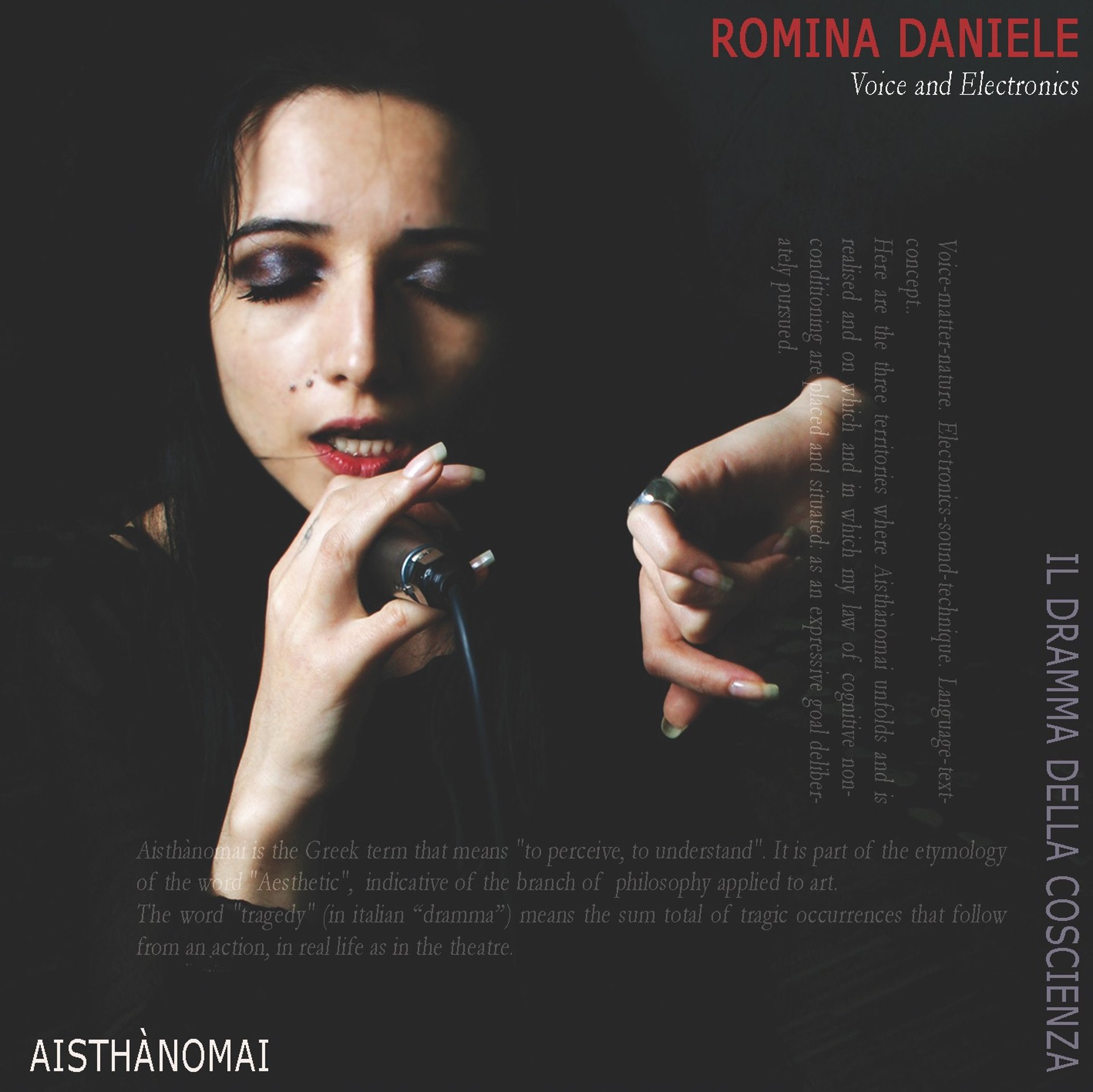
An exhaustive, highly analytical multi-page feature interview by Roberto Alessandro Filippozzi for Darkroom Magazine. The discussion unravels the rigorous technical layout, multi-track vocal layers, and acute philosophical frameworks defining the studio creation of Aisthànomai: Il dramma della coscienza. Daniele outlines her rejection of standard melodic commercialism, detailing her use of the voice as a raw, multi-tonal 'action-process' and live electronic environment—offering an essential primary source text for the aesthetic origins of the RDM Records catalog.
--------------------------------------------------------------------------
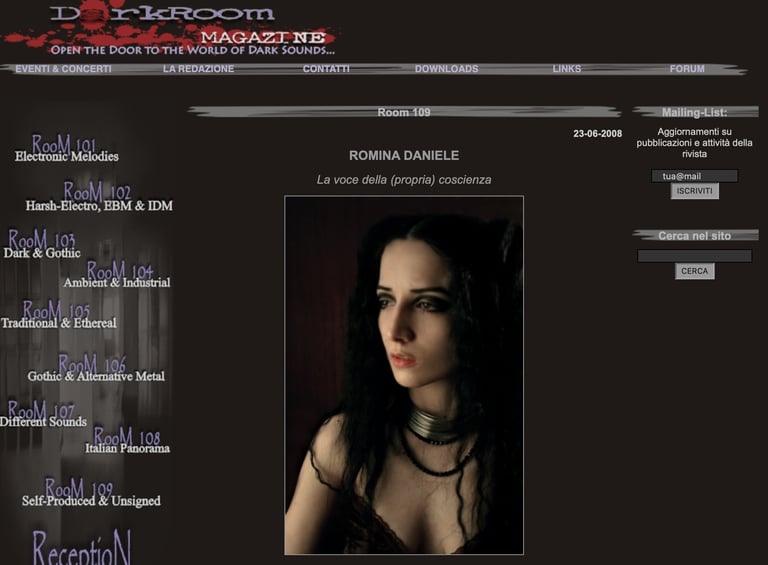
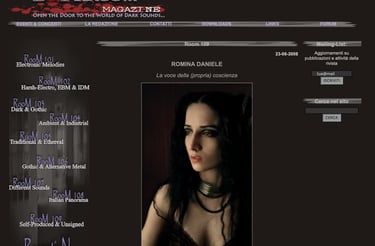
Headline: ROMINA DANIELE – Gothic / Italian Panorama
Interviewer: Roberto Alessandro Filippozzi
Source: Darkroom Magazine (Issue 19 — June/July 2008)
Read the full interview (In Italian) on DarkRoom Magazine.
Introduction by Filippozzi:
The approach to the artistic work of a figure like Romina Daniele, by necessity, cannot be the one that is usually utilized when relating to much of the contemporary music that reaches us as new. Romina’s work, so far composed of two albums, stands out in the panorama of self-productions and of Italian music in general precisely for its will and capacity for research—values present on multiple occasions in the history of our nation through the work of never-forgotten artists, starting with that Demetrio Stratos to whom Daniele is deeply bound. An artist who weighs every single word with enormous attention, for the purpose of making the message arrive in its most appropriate form: here is what the eloquent and kind Romina told us during this long and pleasant conversation...
[Page 1] On the Philosophy of Perception and Title Origins
Darkroom Magazine: Let's start with the title: Aisthanomai, from ancient Greek, means "to perceive through the senses," "to feel." What kind of perception are we talking about, and why is this perception defined as a "drama of consciousness"?
Romina Daniele: "Aisthanomai" is the etymology of philosophical aesthetics or art criticism. It refers to perception and understanding, which today, even at the level of the human sciences, is viewed through a fallacious conception—hence the drama of Consciousness, which reveals itself to be an absence of Consciousness. These phenomena are not to be traced back to psychology but to philosophy, not to rational thinking but to intuition.
The subtitle, "The Drama of Consciousness," signifies that the drama of Consciousness is the theatre of human events, deriving from this absence of awareness towards oneself and the world. The work maps this condition through different languages—music, poetry, writing—acting within a context of "undifferentiation." The voice fragments and shifts not as an embellishment for lyrics, but as a total metaphor of being there (dell'esserci) and of "saying": having the strength to express oneself vocally, even without the communicative tool par excellence: the word.
[Page 2] The Legacy of Demetrio Stratos and Vocal Research
Darkroom Magazine: In 2005 you won the Demetrio Stratos Prize. Stratos famously worked to liberate the voice from cultural control mechanisms. How do you view your relationship with his legacy?
Romina Daniele: The Stratos Prize represents the first degree of "gaining awareness" regarding the possibilities and developments of my work; it represents the recognition of "being in research." The works of Demetrio Stratos are the absolute highest with which I confront myself along my path. Stratos, in my vision, still represents today the extreme edge beyond which no one has exposed themselves.
In my work, the voice reclaims instinct and noise capable of operating transformations in the depths of human beings, refusing to let itself be dominated by the imperatives of a market society. The voice equals the relationship between being and creating. It is an immediate existential reality: the "voice-body," the "body that gives itself voice," and the "voice-action."
[Page 3] Studio Architecture, Cinematic Montage, and Electronics
Darkroom Magazine: Aisthanomai sounds incredibly dense and technically complex. Can you explain your methodology regarding electronics and composition?
Romina Daniele: The term "electronics" must be understood in its purest sense: of sound produced electronically, allowing for an articulation of the sound space where the movement and frequency of every single sound establishes a non-hierarchical relationship.
My multimedia, digital compositional conception relies entirely on montage. Montage is the composition itself of the tracks, not simple final editing, equalization, and mixing. It is composition understood in its strict etymological sense. In Aisthanomai, pure vocalizing interacts with electronic sounds and emblematic poetic texts, generating specific relationships within the "interstices" of these different layers to stimulate new perceptual states in the listener.
[Page 4] Multi-Disciplinary Roots: Cinema Theory, Textuality, and Absolute Independence
Darkroom Magazine: Your background includes extensive theoretical study in cinema and aesthetics. How do these distinct disciplines intersect inside your sound art, and why did you choose absolute independence?
Romina Daniele: My university studies culminated in multimedia and cinema from a theoretical, aesthetic, and linguistic point of view, specifically exploring the dialectical and coextensive relationship between music and image based on the difference between the two languages. This cinematic framework heavily dictates my compositional montage. Furthermore, "textual research" for me is not merely the text in itself, but the interaction and co-extension between different languages that gives rise to textuality: the level of discourse in its unfolding.
This uncompromising intellectual rigor is precisely why I chose absolute independence and self-production. Publication offers for Aisthanomai contained conditions that would have modified the general framework of the work. In my view, production is the technical and aesthetic process that constitutes the work itself, and it must exist in the complete absence of mediators. I forcefully refuse the current practice where an editor or publisher feels entitled to intervene to "present" an art piece as a mere consumer product. The work must stand strictly as a vehicle of its own internal meaning.
RDM RECORDS IS A FLORIDA-REGISTERED DBA OF ROMINA DANIELE, OPERATING AS A RECORD LABEL AND BOOK PUBLISHER FOR RDM ROMINA DANIELE MUSIC, A BMI-AFFILIATED MUSIC PUBLISHER.
[CATALOG] — [ABOUT] — [PRESS] — [MAGAZINE] - [CONTACT]
TERMS & POLICIES: © 2010–2026 RDM RECORDS. ALL RIGHTS RESERVED.
ALL TEXTUAL, MUSICOLOGICAL, AND AUDIO CONTENT IS PROTECTED UNDER INTERNATIONAL INTELLECTUAL PROPERTY LAWS. DATA SUBMITTED VIA OUR PORTALS IS PROCESSED STRICTLY FOR INTERNAL INSTITUTIONAL COMMUNICATION.THIS INDEPENDENT INSTITUTIONAL LABEL IS DEDICATED TO PURE PHENOMENOLOGICAL, VOCAL, AND SONIC RESEARCH, AND MAINTAINS A STRICT POLICY OF COMPLETE DETACHMENT FROM ALL FORMS OF BLASPHEMY, EXPLICIT THEMES, OR PROFANE PERFORMANCES, SYSTEMATICALLY EXCLUDING THEM FROM ITS CATALOG AND SCOPE.


Get in touch