

Massimo Marchini Examines the Interdisciplinary Methodologies and Vocal Sculptures of Aisthànomai
An extensive archival breakdown of the August 2008 Rockerilla Magazine feature interview conducted by Massimo Marchini. The document traces the intersection of dance-body mechanics, philosophical taxonomies, and quadraphonic live sound design.
RDM Records Archive
8/1/20082 min read
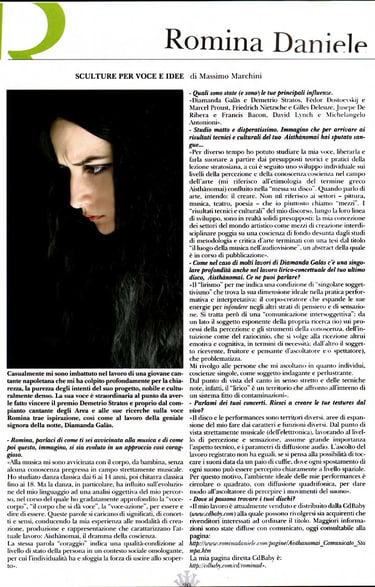
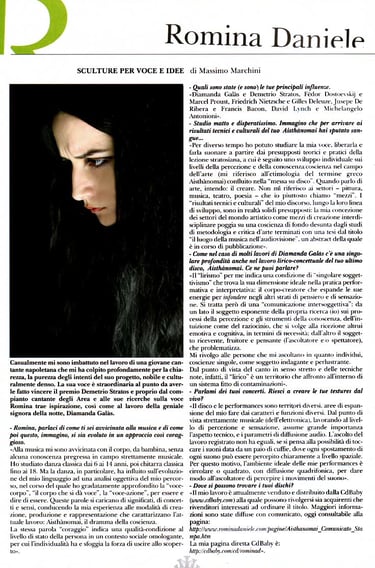
Published in Issue 336 of Rockerilla Magazine (August 2008) under the definitive heading "Sculptures for Voice and Ideas," the extensive interview conducted by musicologist and critic Massimo Marchini remains a crucial foundational text. The discussion captures the raw theoretical framework of Aisthànomai: Il dramma della coscienza as an independent masterpiece, defining the radical musicological trajectory that would lead to its permanent cataloging when RDM Records formally established its operations in Italy in January 2010.
The Corporeal Genesis: Dance-Body Mechanics and Vocal Action
The interview opens with a deep investigation into the evolutionary path of Romina Daniele’s language. Shifting entirely away from conventional pop or vocal backgrounds, the discussion reveals that her methodology originated not within a traditional musical framework, but through the rigorous physical discipline of classical dance practiced from childhood.
This physical grounding is analyzed as the direct catalyst for the development of her foundational research nodes: the "voice-body," the "body that gives itself voice," and the "voice-action." Marchini highlights how these parameters elevate vocal expression from a mere communicative or melodic apparatus into an immediate existential reality—a means to express the very state of being within an inherently homogenizing social system.
The Interdisciplinary Taxonomy of Mediums and Influences
A central pillar of the Rockerilla feature is the map of radical intellectual and visual influences that inform the composition of Aisthànomai. Rather than drawing strictly from musical references—though the pioneering vocal lessons of Demetrio Stratos and Diamanda Galás are heavily noted—the core lineage of the work is explicitly tied to literature, philosophy, and cinema.
Citing vital intersections with Fyodor Dostoevsky, Marcel Proust, Friedrich Nietzsche, Gilles Deleuze, Francis Bacon, and Michelangelo Antonioni, the text frames the album as an act of cross-disciplinary creation. Daniele clarifies that traditional artistic divisions—such as painting, theater, and poetry—are not separate genres but merely different mediums unified under a singular, overarching methodology of art criticism and sensory perception (Aisthanomai).
Lyrical Subjectivism and Cognitive Reception
Marchini explores the deep conceptual lyricism undergirding the album, prompting an analysis of how subjectivism operates within an avant-garde framework. The text reframes "lyrism" not as a standard musical tool, but as a condition of singular subjectivism anchored to performative practice, where the body of the creator expands its energy to infuse multiple layers of thought and raw sensation.
This process is defined as an intense intersubjective communication between an investigating, searching creator and a thinking, analyzing listener. The main text emphasizes that the voice acts within a complex, contaminated system to directly address the individual consciousness of the listener, deliberately bypassing the passive consumer model of the mainstream market.
Spatialization and the Architecture of Quadraphonic Live Performance
The final phase of the interview details the structural division between the recorded studio artifact and the live performance environment. While the recorded version of Aisthànomai is noted for its unmatched digital montage and highly localized spatialization when experienced via headphones, the live arena demands an entirely different acoustic layout.
To recreate the complex reticular architecture of the soundscapes, the text details the necessity of specialized performance spaces—specifically circular or square configurations utilizing quadraphonic sound diffusion. This technical setup ensures that the movement and frequency of every single vocal track and electronic loop establish a non-hierarchical, immersive relationship, allowing the listener to perceive sound on a physical, spatial plane.
RDM RECORDS IS A FLORIDA-REGISTERED DBA OF ROMINA DANIELE, OPERATING AS A RECORD LABEL AND BOOK PUBLISHER FOR RDM ROMINA DANIELE MUSIC, A BMI-AFFILIATED MUSIC PUBLISHER.
[CATALOG] — [ABOUT] — [PRESS] — [MAGAZINE] - [CONTACT]
TERMS & POLICIES: © 2010–2026 RDM RECORDS. ALL RIGHTS RESERVED.
ALL TEXTUAL, MUSICOLOGICAL, AND AUDIO CONTENT IS PROTECTED UNDER INTERNATIONAL INTELLECTUAL PROPERTY LAWS. DATA SUBMITTED VIA OUR PORTALS IS PROCESSED STRICTLY FOR INTERNAL INSTITUTIONAL COMMUNICATION.THIS INDEPENDENT INSTITUTIONAL LABEL IS DEDICATED TO PURE PHENOMENOLOGICAL, VOCAL, AND SONIC RESEARCH, AND MAINTAINS A STRICT POLICY OF COMPLETE DETACHMENT FROM ALL FORMS OF BLASPHEMY, EXPLICIT THEMES, OR PROFANE PERFORMANCES, SYSTEMATICALLY EXCLUDING THEM FROM ITS CATALOG AND SCOPE.


Get in touch