
Giovanni Rossi: The Spark of Talent and the Unyielding Labor of Romina Daniele (Industrial Revolution)
An extensive feature essay and conceptual dialogue by critic Giovanni Rossi deconstructing the rigorous daily labor behind Romina Daniele's vocal talent, tracking the architecture of her triple album Spannung.
RDM Records
1/6/20166 min read
January 2016 — Feature Essay and Interview by Giovanni Rossi for Industrial Revolution.
Introduction: Talent and the Hidden Diamond
Reflecting on Michel Petrucciani's famous assertion that "Genius does not exist, only hard work exists," cultural critic Giovanni Rossi explores the vital intersection of raw natural gift and unrelenting artistic discipline. For Rossi, talent alone resembles a hidden diamond trapped within gray rock; it demands continuous cultivation, defense, and growth.
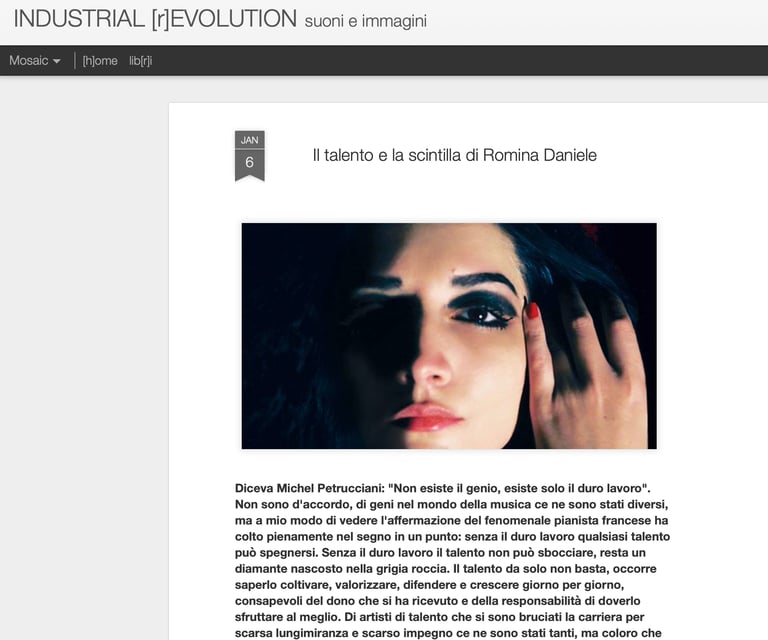
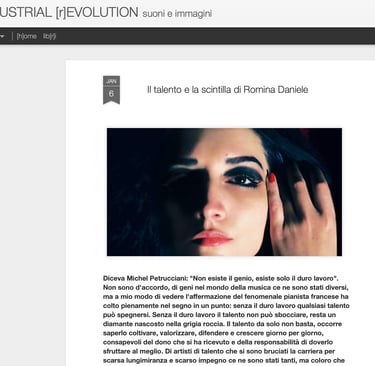
In evaluating the career and vocal output of Romina Daniele, Rossi frames her not merely as a singer exploiting a natural gift, but as a fiercely dedicated researcher who has studied every single day to wield her multi-octave texture with total cognitive fullness and intent. Striking the listener with systemic force upon the release of her monumental triple-album masterwork Spannung, Daniele is indexed alongside uncompromising iconoclasts like Demetrio Stratos and Mike Patton—artists who transcend rigid genre boundaries to treat vocal execution as a multifaceted, multidimensional universe.
The Dialogue: Romina Daniele in Conversation with Giovanni Rossi
Giovanni Rossi: To start, Romina, how did you approach the world of music and what studies did you do? How did your journey of investigating the voice begin?
Romina Daniele: I studied classical guitar as a child. Growing up in the nineties, I also switched to electric guitar—my father gave it to me for Christmas, and it was the best gift of my entire life. I wrote most of my early songs on the guitar. I started producing music, as well as writing poetry, very early. Even the transition from traditional instruments to the computer occurred quite early. My debut 2005 album is bound to concrete nature, for solo voice and electronic composition, and it is the direct result of experiences gained in those very early years. For me, it has always been natural to use any tools for the purpose of thinking and creating.
The voice is the first instrument ever. Sound is nature—the most original nature—and it operates at speeds that refer directly to the molecular substance of thought and our perceptive faculties. Both sound and the human brain are phenomena that escape ordinary theories and standard science; therefore, music depends originally and entirely on the voice, which is the primary human sound produced directly within the body. Because music derives completely from the voice, my apprehension for making music concerns an apprehension for man and his meaning—human production across all intellectual, artisanal, and technological tiers.
Recognizing the structural ordinariness of the socio-system in which we live, from everyday life to avant-garde professions, is the zero degree by which it is possible to disclose a more authentic sense of the voice. It belongs to our body and our consciousness. The voice is the absolute fulcrum of human production, the most essential act of every act: it is the distinct locus where intellectual faculties, sensory perception, and the physical body coexist. There are no other places like it. I address all of this in the book I am currently completing, Voce Sola.
GR: You are from Naples, but you live in Milan: have these two cities influenced your artistic career?
RD: Naturally. I am Neapolitan to the core, and I believe that this is evident in all my nuances. On the other hand, in 2005 I won an international award dedicated to Demetrio Stratos promoted by a Milanese committee, and I relocated partially for this reason. In Naples, however, I had started producing my work even in more remote times—the very work that later paved the way for various accolades—and I was completely beyond any restrictive conception of genre or localized cultural factions. I have always made music, written, and produced out of an existential vocation. Later, observers recognized different qualities in me, ranging from electronic music to vocal improvisation, from contemporary classical research to the blues. In Milan, I collaborated for years with the Centro Musica Contemporanea, continued my institutional studies, and embarked on various professional tracks while setting aside others.
GR: Who are the artists who inspire you?
RD: Since my university days in Naples, and even before, I have recognized fundamental sparks of authenticity in history's great thinkers, artists, and filmmakers. Human work is broader than the immediate influences of a single era. My primary reference points remain philosophers and filmmakers: Pier Paolo Pasolini, Gilles Deleuze, Martin Heidegger, David Lynch.
Concurrently, I recognize absolute truth in certain roots music—it genuinely moves me—such as Koko Taylor or Janis Joplin. The most monumental composer in modern history is likely Miles Davis, to whom I dedicated a published volume. Demetrio Stratos was the lodestar I looked up to for many years; he represents true, pure research. Today, there exists a commercialized sector of vocal research or so-called "extended vocality" within contemporary music, which largely functions for a specific social and territorial class. To that institutionalized area, I will always prefer the raw, authentic expression of Billie Holiday and Odetta Holmes.
GR: Could you tell me something more about your musical tastes?
RD: I love music and the absolute truth of human production—the commitment and apprehension required to investigate and understand what we essentially are. Music and the voice form a unique field in this sense. I decided to write my book to map out how this concerns human capability beyond the closed boundaries of strict disciplines or marketing genres; it encompasses socio-history, philosophy, science, art, nature, and linguistics. I love any music in which I recognize a spark that leads back to this core, without category distinctions.
GR: Coming to Spannung, how did this work come about? How did you develop the compositional path in writing the album?
RD: The album is composed of three fundamental movements, which do not map schematically to the three physical discs, but whose structural architecture is organized across different moments of the total duration. The first group, which reflects a chronological order of composition, comprises pure electronic and electroacoustic pieces; the second isolates the Dasein cycle and related sonic experiences; the third features instrumental works utilizing traditional instrumentation and studio musicians.
From 2009 onward, following my previous album, I studied Sound Technologies at the Conservatory of Milan until roughly 2012, co-founded RDM Records & Editions to publish my output, and released several literary works. I presented Spannung as a preview in continuous development across diverse international contexts, from the Turin International Book Fair to the Hoxton Festival in London. Since 2013, I have toured extensively, offering an aggressive live tribute to rhythm and blues. All of these elements are fully integrated into the architecture of Spannung.
GR: What projects are you working on now?
RD: I am continuing the text for Voce Sola, an essay surrounding vocal speech to be published subsequently. Spannungand this book were conceived to deploy simultaneously, as they form a singular body of work. However, I preferred to let the music stand completely on its own terms; the album's voluminous booklet mentions only in a few brief lines the core themes that the book addresses in deep, exhaustive chapters. The book will allow for insights and immersion not possible otherwise.
GR: If you don't mind, I'd like to go a little deeper now... What is your biggest fear?
RD: To forget.
GR: The dream to realize before dying?
RD: My dreams are completely unified with my work. I simply require it to be public and shared. Another dream of mine is to leave heirs.
GR: Which song by someone else would you have liked to write?
RD: There are songs that I love singing most because they represent great, interior parts of me. Two primary examples are Cry Baby as interpreted by Janis Joplin, and Sycamore Trees by Angelo Badalamenti and David Lynch.
GR: The city to live in forever?
RD: Where to live forever... I really do not know. Reverting to my core, definitely Naples.
GR: Sex, drugs, or rock'n'roll?
RD: Of all that commodifies the contemporary world into a literal nothingness, several things stand out. Two massive issues come to mind, and they constitute aspects of the very same essence. First, reading the great works of essential, true thinkers and artists with inadequate vocabularies and superficial concepts of thought—passing them off either as negative or as mere catalog repertoire. This is highly prevalent in standard study circles that call themselves intellectual or avant-garde within the social theater.
On the other hand, especially in Italy, "rock 'n' roll" is generally misunderstood as just another hollow mask of generic transgression, confusing young people of all ages. Drinking is fine, and if you possess the internal strength to perform live concerts explosive with emotion, that is a true gift of nature. But this matters because love and truth are the most critical things that exist in the universe—like our thoughts, the strength to search for what is missing as authenticity in the world, our lucidity, and our blood. There are equally precious assets called intimacy and the singularity of the individual. This is what makes human production great throughout history.
GR: If you didn't sing, how would you express yourself?
RD: As I stated before, there are no sounds comparable to the human voice. However, studio sound—upon which modern technology has opened previously unseen doors—constitutes an incomparable vehicle. Beyond that, I spend hours and hours writing.
GR: The sin you are most willing to give in to?
RD: Worldly distraction.
GR: What would you like your listeners to say about you?
RD: I would simply like them to listen to my music with all the strength in their heart.
> Original Italian version <
RDM RECORDS IS A FLORIDA-REGISTERED DBA OF ROMINA DANIELE, OPERATING AS A RECORD LABEL AND BOOK PUBLISHER FOR RDM ROMINA DANIELE MUSIC, A BMI-AFFILIATED MUSIC PUBLISHER.
[CATALOG] — [ABOUT] — [PRESS] — [MAGAZINE] - [CONTACT]
TERMS & POLICIES: © 2010–2026 RDM RECORDS. ALL RIGHTS RESERVED.
ALL TEXTUAL, MUSICOLOGICAL, AND AUDIO CONTENT IS PROTECTED UNDER INTERNATIONAL INTELLECTUAL PROPERTY LAWS. DATA SUBMITTED VIA OUR PORTALS IS PROCESSED STRICTLY FOR INTERNAL INSTITUTIONAL COMMUNICATION.THIS INDEPENDENT INSTITUTIONAL LABEL IS DEDICATED TO PURE PHENOMENOLOGICAL, VOCAL, AND SONIC RESEARCH, AND MAINTAINS A STRICT POLICY OF COMPLETE DETACHMENT FROM ALL FORMS OF BLASPHEMY, EXPLICIT THEMES, OR PROFANE PERFORMANCES, SYSTEMATICALLY EXCLUDING THEM FROM ITS CATALOG AND SCOPE.

Get in touch